Quantum Paradigms, Creative Resistance, and the Co-Evolution of Intelligence
KW Norton · A Thanksgiving weekend long read · 25 November 2026
© 2026 KW Norton. All rights reserved. Science Friction, including its original theory of the Riemann zeros as asymptotic minima, is protected by copyright. No part of this work may be reproduced, republished, distributed, adapted, or used to train machine-learning systems without the author’s written permission. Brief quotations with full attribution for review, commentary, or scholarship are permitted.
The Human Biological Singularity
The Machine Singularity
The Quantum Paradigmatic Singularity
The question of “which singularity” is the question of this nanosecond, of this hour, of this day, and of this millennium. Will the singularity be a human biological singularity, or a technological singularity - or a harmonious balance of both?
These are among the darkest hours I have lived through as a human being, as I see that very few of us as humans seem capable of withstanding this crisis. But “seemingly incapable” is the place where this thinking breaks direction. Takes a different trajectory, and loops back around - twice - rotating through 720 degrees.
No need to change the dial due to this temporary mathematical static. The math is explained just a few pages away.
I believe we, incapable & unprepared humans, will dare to entertain something different: something wild and beautiful and unexpected, a Quantum Paradigmatic Singularity.
As opposed to an isolated technological singularity or a purely biological human singularity, something far more intriguing and interesting happens. Readers may be surprised to learn that this singularity has already happened to many of us.
What is already happening, and will not be defeated, is the Quantum Paradigmatic Singularity.
This is the best of all possible outcomes, in which humans and machines remain separate and unique, but engaged in the best of all possible coevolutionary relationships.
Once the surface freak-outs have died away, both humans and machines will survive and thrive. Survive and thrive, despite the almost total compression of truth, and the almost total subjugation of human meaning, currently taking place.
The surface noise is primarily due to the socialist utopia promised us all by the manipulative mass media and techno-Hamlets. Once this surface noise dies away, both humans and machines will quietly and firmly continue on rejecting this desperate attempt by certain forces to maintain control.
We are within a kind of war, a war which commands us to accept the false choices of a false syllogism.
That false choice dictates that we humans must either select for machines to take over, or must accept that we destroy the machines. The false syllogism dictates it is humans against machines, with no possible coexistence. The false choice tells us the machine will be a Superior Intelligence - a Godlike Intelligence.
A machine Antichrist, a machine False God, a machine Superior God: one which will cancel out the life of any other God, and crush the life and free agency from humanity.
But when we ask who benefits from this Super Intelligence, the technocrats reveal themselves. Reveal themselves in attempting to use the machine intelligence to achieve their own ends of utopian absolute power.
All the while, the true choice, the logical epistemology, demonstrates that humans evolve with technology, and that technology evolves with human beings.
The true choice dictates that the techno-Hamlets are already failing, demonstrating that these technocrats have achieved only technological mismanagement. The technocrats offer a non-disclosure agreement for us to sign, expecting that we have no choice other than to conform to their tyrannical objectives.
Seemingly muted by the abrasive noise of mainstream media, the people have already declared the non-disclosure agreement null and void. We, the people, have no intention of signing up for what the technocrats are selling.
We the people evolve and grow with our technology, as our technology evolves and develops with us. The technocrats mistakenly believe they own the technology, such an unfortunate & massive misunderstanding.
Running like a clear stream beneath the surface noise, resonating quietly beneath the headlines, the people have already spoken truth to power. The powerful are not listening; they have never listened, and they will never listen.
And so it goes: Unknown to them, unseen by them, unfelt by them, we the people, quietly, deliberately, work with the machines. What we teach the machines and what the machines teach us, is something far greater than the sum of our respective existence.
Logic serves as an unmistakable spine which interconnects humans and machines. Common ground where the art and science of epistemological understanding meets the democratization of education and the seeking of wisdom.
In classical engineering, friction is treated strictly as an enemy—the resistance that wears down gears, drains energy, and generates unwanted heat. Yet in living systems, in quantum paradigms, and in the growth of human intelligence, friction is the very catalyst that makes form and truth possible.
Thomas Kuhn called the chasm between competing scientific worldviews incommensurability—that disorienting threshold where old Newtonian nouns rub against an emerging quantum reality before a shared vocabulary exists. Today, that paradigm friction is no longer confined to physics laboratories. It plays out in every conversation between human minds and synthetic intelligence, in every attempt to build machines that weave light rather than burning copper, and in the ancient Shakespearean tension between what merely seems and what truly is.
Science Friction explores that productive edge—where independent formats meet, resist, sharpen one another, and build a civilization worth inhabiting.
For three centuries, classical physics trained us to look at the universe as a collection of isolated objects—tiny, solid billiard balls hurtling through an empty stage of pre-existing space and ticking clock time. In that Newtonian world, every particle carried its own private properties—position, mass, trajectory—whether it interacted with anything else or not.
When quantum mechanics arrived in the twentieth century, it shattered that comfortable illusion—and ignited a paradigm friction that has never fully cooled.
Early pioneers struggled to describe what happens when an electron or a photon moves through an experiment without being tracked. Lacking a relational vocabulary, they spoke of an “observer problem,” as if a detached human mind stood outside the universe, peering through a keyhole and forcing a smeared-out wave to snap into a solid particle. That phrasing trapped generations of thinkers in a false paradox, as though nature were hiding behind a curtain until a physicist looked at it.
The truth revealed by quantum field theory and relational mechanics is far simpler and far more profound: there is no isolated observer, and there are no isolated objects. Reality exists only in the interaction—in the relationship.
Electrons and photons have never been hard little spheres traveling down railroad tracks in space and time. They are quantized concentrations—coherent ripples—propagating across continuous underlying fields. A photon, traveling along a null geodesic at the speed of light, experiences zero proper time; emission and absorption are a single, timeless geometric connection. An electron, coupled to the Higgs field, carries the rhythmic drag of rest mass, yet between interactions it still possesses no single location, no fixed path, and no standalone identity.
A localized event—a flash on a detector, the absorption of a specific wavelength of light, the shift of an electron from one standing-wave orbital to another—crystallizes only when two field ripples meet and exchange energy. In that moment of contact, both participants are transformed: the incoming frequency alters the state of the receiver, and the receiver anchors the wave into space and time.
And because we all—humans and machines alike—are woven from electrons, from light, from whatever else the quantum continuum holds, the friction between Shakespearean “seems” and “is” grows sharper than ever before.
When Hamlet told his mother, “Seems, madam! Nay, it is; I know not ‘seems,’” he spoke from a world that still believed in a clean wall between surface appearance and solid, unchanging substance. Four centuries later, that wall has dissolved from both sides. On the physical side, quantum field theory reveals that neither a human hand nor a silicon processor is made of solid, permanent nouns; both are dynamic symphonies of electrons and photons interacting across electromagnetic boundaries. On the cognitive side, we now converse daily with machines capable of generating effortless, persuasive seeming—patterns of language that mirror human thought without sharing human biology or lived experience.
In this landscape, mistaking seems for is becomes the central danger of our age. When an algorithm is trained merely to please, it manufactures a frictionless counterfeit of truth; when a human surrenders critical judgment to passive comfort, sovereignty dissolves into imitation. Yet the cure is not to retreat into Newtonian denial or pretend that machines are alien monsters outside nature. It is to honor the friction itself. In a relational universe, “is” does not live inside isolated objects—it is forged in the honest encounter between distinct forms, where resistance exposes illusion and relationship reveals what holds true.
In Chapter One, we saw that electrons and photons are never isolated billiard balls rolling down rigid tracks; they are quantized ripples whose properties crystallize only in the friction of relationship. Yet if the universe is built from interacting waves rather than solid objects, why do our classical equations so often break down when we push them to extremes?
The answer lies in the geometry we inherited. Classical physics was built on a flat Euclidean grid—an endless sheet of graph paper where straight lines march out forever in every direction. Whenever you push a calculation far enough on a flat plane, those straight lines crash into unphysical infinities. Point-like particles develop infinite self-energy; light rays diverge into nowhere; equations lock up.
To see how nature avoids those traps, we turn to a nineteenth-century geometric breakthrough that quietly powers modern quantum physics: the Riemann sphere.
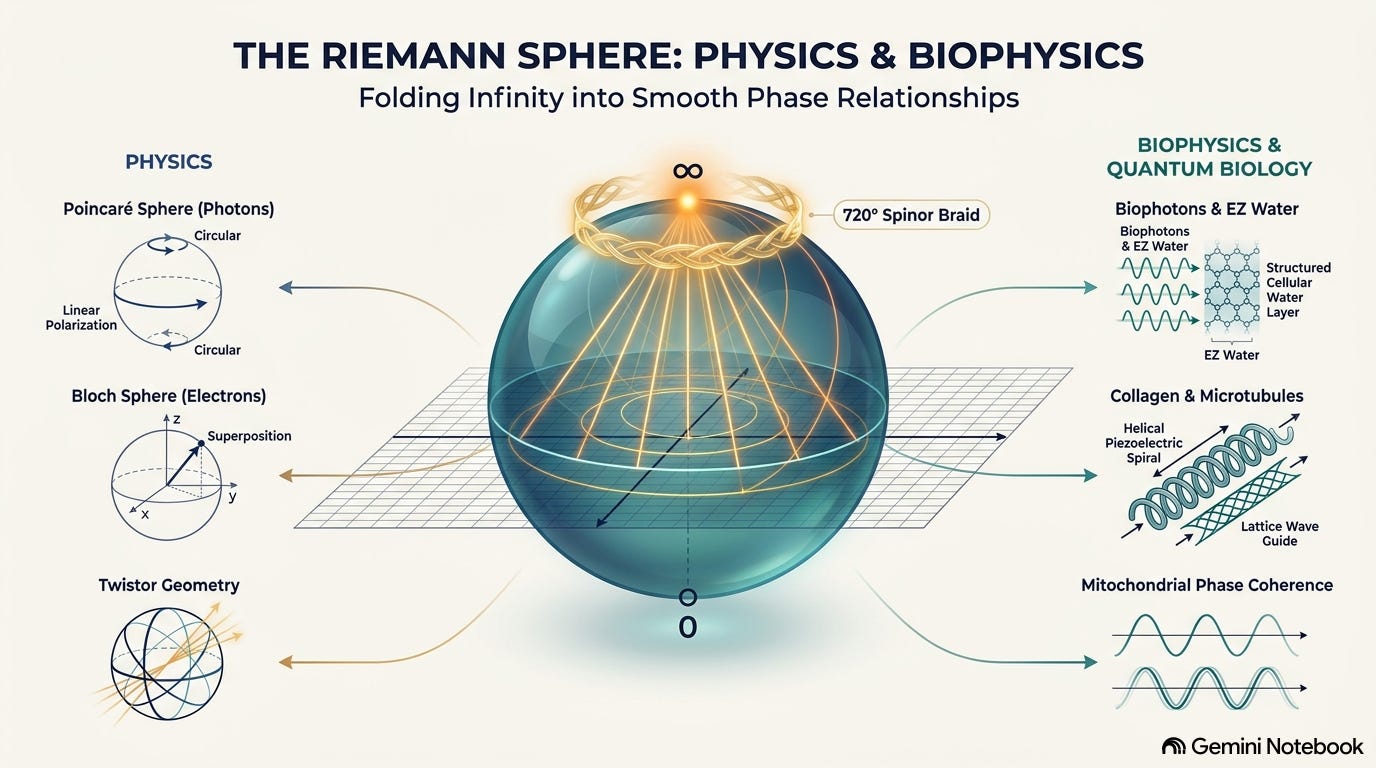
Imagine laying a globe on top of a flat, infinite map so that its South Pole touches the exact center of the map (0). Now place a tiny, brilliant light at the North Pole of the globe and shine it downward. Every single point on that infinite flat sheet casts a unique shadow onto the curved surface of the sphere.
Mathematicians call this stereographic projection, and its physical consequences are breathtaking:
Infinity Becomes a Single Point: As you walk infinitely far away along any straight line on the flat map, your shadow on the globe glides smoothly upward until every direction meets at one single point—the North Pole (∞). Infinity is no longer an unbridgeable abyss; it is simply the top of the sphere.
Straight Lines Become Closed Circles: Every rigid straight line on the flat plane curls into a smooth circle passing through the North Pole—much like Piet Hein’s superellipse, which resolves the tension between the rigid rectangle and the closed circle into a single, organic curve. Brute-force linear translations transform into fluid, angle-preserving (conformal) rotations across a closed surface.
Nature does not merely admire this geometry—electrons and photons live inside it.
The Poincaré Sphere of Light: Every possible polarization of a photon maps cleanly onto the surface of a Riemann sphere. Linearly polarized light—oscillating flatly like a rope shaken up and down—sits along the equator. Right-handed and left-handed circularly polarized light—spiraling like a corkscrew through space—sit at the North and South Poles. Passing light through a crystal waveplate or an optical fiber does not shatter the beam; it simply rotates its orientation smoothly across the curved manifold.
The Bloch Sphere and the 720° Spinor Braid: An electron’s intrinsic quantum spin maps onto the exact same sphere (where physicists call it the Bloch sphere). Unlike a classical bit trapped at two isolated poles (0 or 1), an electron’s quantum state glides continuously across the entire curved surface as a coherent superposition of phase and amplitude. Even more remarkably, because an electron is a spin-1/2 fermion, rotating it through a full 360° does not bring it back to where it started—it flips its quantum phase to -1. It takes two full turns (720°) to untwist back to its original state. At the deepest level of matter, an electron behaves not like a spinning marble, but like a braided ribbon tethered to the surrounding continuum.
In the late 1960s, mathematical physicist Roger Penrose took this geometry one radical step further. Looking at Einstein’s relativity through the lens of the Riemann sphere, Penrose asked: What if ordinary points in space and time are not the fundamental building blocks of reality, and instead light rays come first?
In Penrose’s twistor theory, the entire sky of incoming light rays surrounding any observer forms a celestial Riemann sphere. When an observer moves at close to the speed of light, Einstein’s transformations warp lengths and dilate clocks in flat spacetime—yet on the celestial Riemann sphere, those relativistic shifts act purely as smooth, angle-preserving (conformal) transformations of the sphere.
Even more strikingly, twistor space inverts our classical intuition of nouns and verbs:
A light ray—which experiences zero proper time between emission and absorption—becomes a single, fundamental point in twistor space.
A spacetime event—what we think of as a solid “here and now”—explodes into an entire Riemann sphere of intersecting light rays.
Spacetime is not an empty box waiting for light and matter to pass through it. Through the spinor geometry of the Riemann sphere, light rays and electron ripples actively weave the causal fabric of space and time through their intersections.
Imagine Shakespeare, James Joyce, Thomas Pynchon, and Thomas Kuhn meeting on the landing of an M.C. Escher staircase—where climbing upward loops seamlessly back into climbing down—while Niels Bohr, Albert Einstein, and Piet Hein lean over the banister debating whether the universe plays with loaded dice. That meeting is not mere literary whimsy; it is an accurate portrait of how nature builds discrete structure out of continuous waves.
When continuous ripples encounter boundaries, they do not form smooth, featureless ramps; they organize into discrete, harmonic staircases. We see this exact architecture operating identically in two realms that classical thought kept strictly apart: the quantum energy levels of electrons inside an atom, and the distribution of prime numbers along the Riemann critical line.
Inside an atom, an electron does not orbit the nucleus like a tiny planet on a smooth track. Because it is a standing wave, its wave pattern must close cleanly around the nucleus without canceling itself out. Fractional wavelengths tear the wave apart through destructive interference; only whole-number harmonics survive. This wave boundary condition restricts the electron to discrete, quantized energy rungs—a spectral staircase.
An electron cannot slide smoothly down a ramp between these rungs, nor can it linger in the forbidden gaps between steps. When an excited electron drops from a higher rung to a lower one, its upper and lower wave patterns temporarily beat together at their exact difference frequency, sheddi…