There are a bunch of miracles that supposedly vindicate Catholicism: Padre Pio’s stigmata, Lourdes healings, Fatima, Eucharistic miracles, plus my friend tells me that some woman mysteriously oozes olive oil upon occasion—so submit to Rome, bro! Sure, maybe the other Churches have some miracles, but all the ones with specific theological import seem to be Catholic. How do non-Catholics explain that? Why do the Catholics have the most apparent miracles?
Here is the standard answer: Catholicism is very large, very interested in miracles, and very interested in investigating miracles. It isn’t that surprising that the giant institutional body that works super hard to investigate miracles has the best apparent miracles. Miguel Juan Pellicer’s leg al(leg)edly miraculously regrew after he prayed to Mary. The Catholic Church carried out a detailed investigation right after. If he’d been, say, Anglican, probably his name would have been lost to history.
Fortunately, I think we have a pretty straightforward way of testing to see if this is the complete explanation: we can look at fraudulent miracles and see if they’re disproportionately Catholic. If they are, this would seem to provide strong evidence that the Catholics have extra apparent miracles for reasons unrelated to the miracles’ veracity. If almost all the fake miracles are Catholic, then this would indicate that apparent miracles disproportionately appear in Catholic settings apart from Catholicism being set apart by God.
Now, one objection that you might have is that perhaps these are both explained by the Catholics being judicious investigators. If they investigate carefully, it’s no surprise that many debunked miracles are Catholic. But, of course, if they investigate carefully, it’s also not surprising that the miracles that seem to most withstand critical scrutiny are Catholic.
Note that what I’m saying here is not on its own enough to defeat the Catholic miracle argument. If it turns out that there are some miracles that are both true and vindicatory of Catholicism, then this would simply confirm Catholicism. All my claim is supposed to illustrate is that you shouldn’t take the fact that the well-evidenced miracles are mostly Catholic to be strong evidence for Catholicism.
Okay, enough preamble out of the way, let’s explore two classes of miracle: stigmata and Eucharistic miracles.
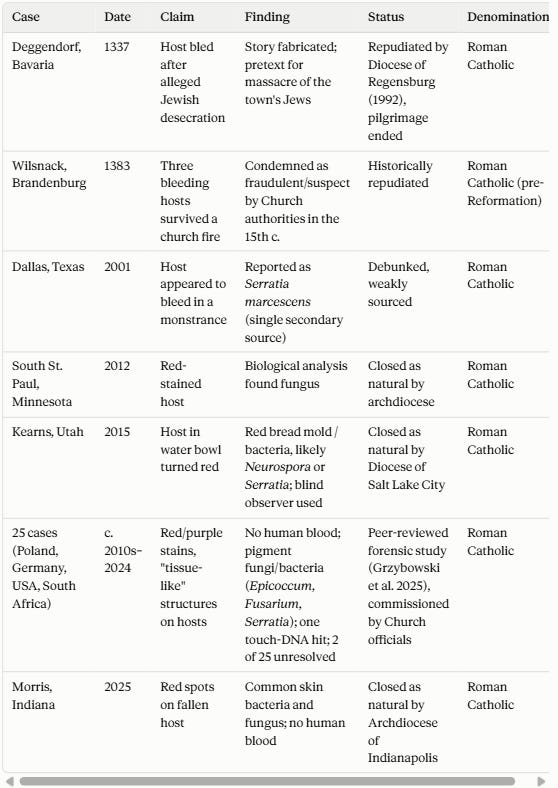
Starting with Eucharistic miracles, I asked Claude to make a chart of debunked Eucharistic miracles. Then I asked it to list by denomination.
As best I could tell, all of Wikipedia’s examples of eucharistic miracles were Catholic. There’s at least one supposed Anglican eucharistic miracle—and it’s obviously fake—so maybe this list was biased towards Catholic miracles, but the Anglican eucharistic miracle also just involved it glowing—if we included Catholic eucharistic “miracles” where a light shines on the host, we might have many more.
Thus, it seems pretty clear that selection effects can explain why the eucharistic miracles are mostly clustered in Catholic settings. We shouldn’t be that impressed by the argument that eucharistic miracles are mostly Catholic so they vindicate Catholicism.
What about Stigmata? These are when people bear supposedly supernatural wounds that mirror those of Christ.
I had Claude go through the book The Devotion and Promotion of Stigmatics in Europe. It has a comprehensive glossary of stigmatics, with about 250 total stigmatics. Claude informs me that only one of these people was non-Catholic. Now, there are a few other cases of stigmatics that aren’t in the book. But the overwhelming majority—probably over 99%—are Catholic. And a bunch of the stigmatics are fakers; so of the fakers, they are mostly Catholic.
Now, it may be that these kinds of miracles are distinctively Catholic for cultural reasons. Non-catholics have a lot more alleged healings, for example. But at the very least, I think this illustrates that the fact that the Catholics have most of various kinds of miracles isn’t very strong evidence for Catholicism. Selection effects explain it.
As notes, this will at least cap the evidential force of Catholic miracles. Is the fact that the largest and most judicious investigator of miracles has the best apparent miracles very surprising if Catholicism isn’t true? No. It would be one thing if there were totally obvious miracles that confirmed Catholicism in straightforward ways. But in many cases, e.g. with eucharistic miracles, the vindication is supposed to come primarily from the fact that they occur mostly in Catholic settings. Nobody should be much impressed by that argument, even if they think some eucharistic miracles are miraculous.
And note, in total, Catholics report miracles at pretty similar rates to other groups. They just investigate them more. As Craig Keener notes in his * Miracles *book:
More surprisingly, 34 percent of Americans claim to have witnessed or experienced divine healing; these figures include 30 percent for Hindus; 34 percent for members of Orthodox churches; 27 percent for Catholics; 54 percent for members of historic African-American churches; 50 percent for evangelicals (with Pentecostals and independent charismatics perhaps raising the overall evangelical figures); and so forth.
Again, I don’t think this is anything like dispositive. It could be that most apparent miracles are fake and that Catholics are more sober about such judgments than others. I think this is probably right; I know Pentecostals go kind of nuts with thinking everything is a miracle. But it’s at least some reason to be more skeptical about the Catholic miracle cluster.
So maybe specific decisive miracles confirm Catholicism. I’m skeptical, but fine, could be. But I’m pretty sure the overall pattern of miracles does not. The fact that the Catholics have most of the well-evidenced miracles just isn’t that surprising.