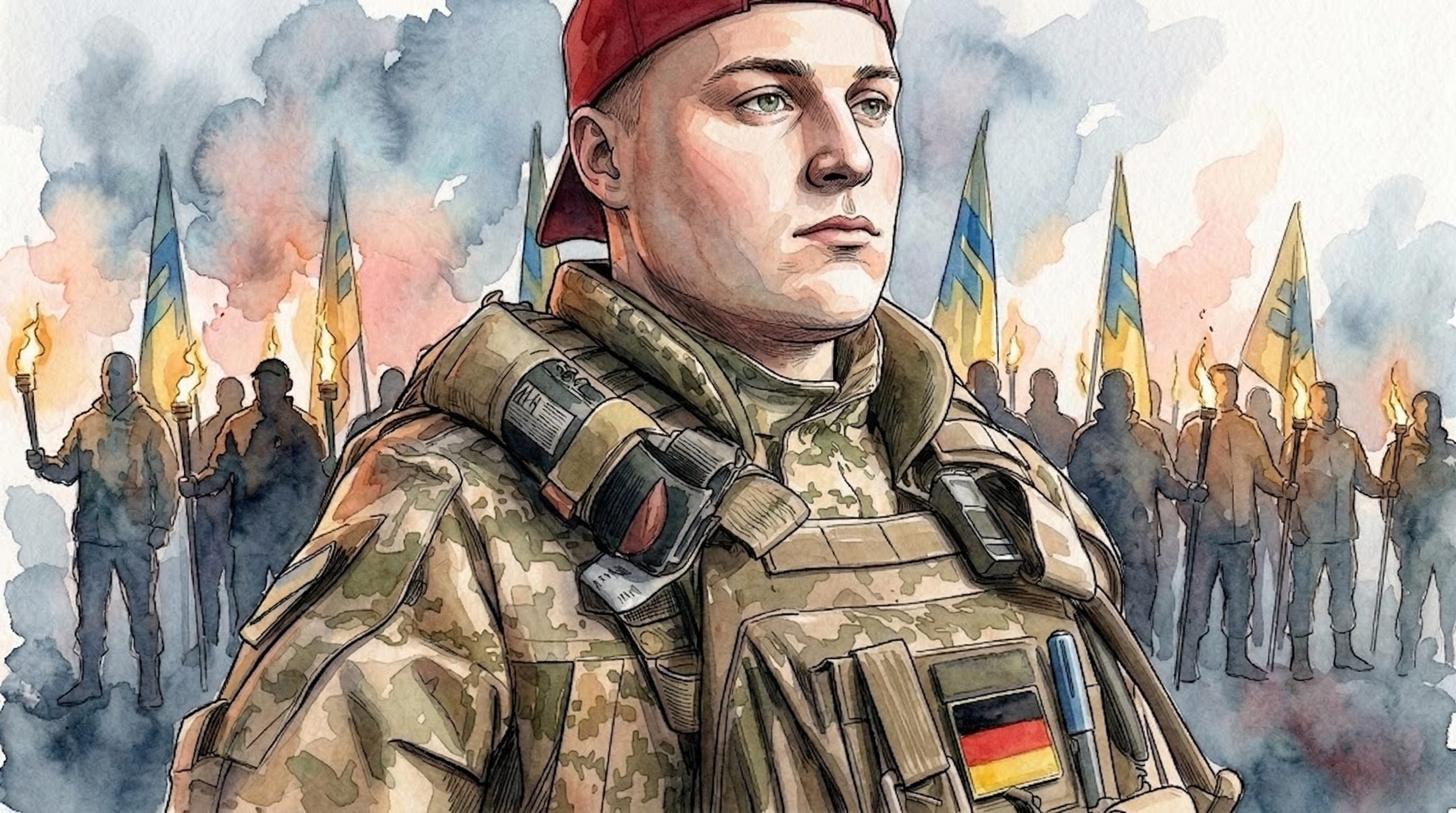
ODESA—Last December, Chay Bowes, a notorious Irish pro-Russian propagandist living in Moscow, shared on X an image of Ukraine’s elite Azov Brigade wielding torches. He called Ukraine “a bigger threat to Europe than Russia will ever be.”
We publish this newsletter every day at 9:05am NYC time / 4:05pm Kyiv.If you’re not already subscribing, why not do so now?
Into the fray stepped Tim Schramm, a German far-right politician who, unlike his party, supports Ukraine so much that he spent nearly a year fighting Russian invaders on Ukrainian soil. Back home in Germany, Schramm reposted Bowes’ image with a counter: Germany, he wrote, could learn a lot from Azov.
And here is where his trouble began.
In the heart of Europe, a man defending Ukraine gets punished for refusing to accept the Kremlin’s lies.
For the German state, Schramm’s post defending Ukraine was criminal. An unknown person had reported Schramm to the police and upon returning from a humanitarian trip to Ukraine, he received a summons—and soon after, a conviction.
What was the problem? Schramm had, by quoting Bowes’s original post in his rebuttal, shared the Azov Brigade’s symbol, visible in a shoulder patch of a Ukrainian soldier. The Azov emblem resembles the German “Wolfsangel” (“Wolf’s hook”), a symbol that is banned in Germany if used in the context of the Third Reich. In fact, the Wolfsangel has a longer, deeper history in many cultures and even today in Germany is permitted in traditional ways, as a boundary marker and as the emblem of a famed hound-breeding club.
But none of that mattered. Someone wanted to cause trouble for Schramm, an outspoken supporter of Ukraine. Already, high-ranking officials in the Alternative für Deutschland party had tried to expel him. But Schramm stuck to his guns, staying in his party in hopes of changing its Ukraine stance:
“Russia is doing exactly what many on the right accuse the globalists of doing, only worse,” Schramm told us. “All under the guise of anti-fascism.”
For Europe, it is more comfortable going after an individual that was actually sitting in the trenches than confronting the regime that put him there.
It was not enough for Schramm to be attacked by pro-Russians in Germany. The allegedly pro-Ukraine German state also piled on.
Schramm was not even able to defend himself in court: The German legal system, in a preview of coming attractions for the United Kingdom which is considering dispensing with some jury trials, allows sentences to be delivered in a “fast-track” way, whereby a judge simply issues a sentence based on the prosecutor's demand. This is exactly what happened here: The prosecutor demanded that Schramm be sentenced, and the judge handed out a fine of €1,200.
Too much of Europe still prefers the
comfort of symbolic hygieneto the burden of concrete and brave action in defense of freedom.
This might seem like a small price to pay, but the larger implication is that since Schramm is now legally convicted of a crime, he stands to lose his job, his position as an elected member of the city council of his hometown of Wuppertal, and he is now registered in the “Bundeszentralregister” (“Federal Centralized Register”) as a convicted felon. This is a clear case of political persecution. Why? A look into the case files reveals something interesting.
Germany has managed to become the perfect symbol of its own strategic confusion: a state so eager to police memory and speech that it risks criminalizing solidarity with the people now fighting the very kind of evil Europe once vowed never to appease again.
German officials might feel like fighting fascism. In reality, they are rewarding Russian fascist propaganda.
When the police received the report, they investigated Schramm’s X post and correctly identified that he had (a) simply commented on a current political issue, (b) shared an image of a current military unit of an ally and aid recipient of Germany, and (c) made no reference to Nazism. The police reported these findings to the prosecutor, suggesting no need for further action.
Yet the prosecutor argued that because of Schramm’s position as a right-wing politician and because “people holding burning torches is reminiscent of the Third Reich,” he must have meant his post in a way that glorifies Nazism and had to be convicted accordingly. And thanks to German efficiency, the conviction was swiftly carried out. It’s doubtful the same would have happened if Schramm was a member of, say, the Greens.
To be clear, Germany’s ban on unconstitutional symbols exists for good historical reasons. Section 86a of the Criminal Code criminalizes the use of symbols of unconstitutional or terrorist organizations. But German law is not supposed to operate like a childishly literal pattern-recognition machine. The Bundestag’s own legal service noted last year that context matters, that the law must be interpreted restrictively, and that there is no punishable use where the symbol appears in unmistakable opposition to the ideology in question or for purposes such as civic education, art, scholarship, or “reporting on current events or history.” In other words: German law itself recognizes that meaning is not reducible to geometry.
That matters here, because Azov in 2026 is not some frozen relic from 2014, nor is it identical to the caricature endlessly circulated by Russian propagandists. The unit was born in crisis—founded in May 2014 as a volunteer militia when Ukraine’s military was barely functional and Russia was threatening to strangle the newly free society. Anyone willing to fight was welcomed, and this drew some unsavory elements. But that is not the whole story, and it is certainly not the current one.
Ukraine has paid in blood for Europe’s strategic education.
Even Western institutions that spent years keeping Azov at arm’s length have revised their assessment. In June 2024, the U.S. State Department under Biden said the 12th Azov Brigade had “passed Leahy vetting,”** **which means they passed human rights screening and were eligible for U.S. military assistance.
Reuters reported that Washington concluded there was no evidence of human-rights violations by the brigade and that “Russian disinformation has actively worked to discredit” it by conflating the current formation with an older militia.
German analysts Christian Mölling and András Rácz went further, writing for ZDF that today’s Azov “does not have much in common” with its far-right predecessor. They called it “one of the most experienced and efficient combat units of Ukraine.” AP likewise described Azov as one of Ukraine’s most effective and popular fighting units, while noting that its current members reject accusations of extremism.
Lord Ashcroft, the British Conservative peer and philanthropist, traveled to the front to meet Azov’s commanders twice—in 2024 and again in 2025. His conclusion was unambiguous: Azov is among the most formidable fighting forces in the world. He noted pointedly that one of its most celebrated fighters is Jewish—a fact that, he wrote, flatly ridicules Moscow’s claim that Azov’s ranks are filled with Nazis.
Moscow, seeking to discredit Ukraine, calls Azov terrorists and neo-Nazis; Russian courts handed long prison terms to captured Azov fighters in March 2025. Meanwhile, in the heart of Europe, a man defending Ukraine gets punished for refusing to accept the Kremlin’s lies.
So what exactly is Germany doing when it fines a Ukraine volunteer for posting an image from an Azov ceremony in the context of a live war?
For a smug bureaucrat, comfortably sitting in his Western European courthouse, sheltered from the reality of war, it may feel like fighting fascism. In reality, it is rewarding propaganda.
The deeper problem is not just legal but civilizational. Too much of Europe still prefers the comfort of symbolic hygiene to the burden of concrete and brave political action in defense of freedom. Europe knows how to be anxious, procedural, and self-protective. Europe knows how to hold seminars on democratic resilience. Europe knows how to turn every hard question into an administrative one.
For Europe, it is more comfortable going after an individual that was actually sitting in the trenches than confronting the regime that put him there.
Ukrainians have spent more than a decade fighting a war that Europe preferred, for years, to misunderstand. They fought when many Europeans still believed Minsk formulas and gas deals could tame Moscow. They fought when Western capitals worried more about “escalation” than occupation. They fought when Russian lies about “denazification” seeped into respectable discourse through the back door of caution and nuance.
To tell a Ukraine veteran that Germany can distinguish perfectly well between context and propaganda, except when the context is Ukraine and the propaganda is Russian, is an insult not only to him, but to the country that has paid in blood for Europe’s strategic education.
The question is not whether Azov’s history is complicated. It is. The question is whether Europe is serious enough to face the evil in front of it instead of ritualistically shadow-boxing with ghosts while Russia wages an actual war on its doorstep.
The German bureaucrats did the work that Russian propagandists had long tried to do: make Schramm pay for his steadfast defense of Ukraine.
Prosecutions like this are not just absurd. They are cowardly.
Help us keep Under Fire News independent and daily.If you’d like to support our work with a one-time contribution, you can do so here
DEVELOPING: Major Russian missile and drone attack on Ukraine beginningUkrainian airspace monitors are currently reporting that a major aerial attack on Ukraine is starting. Over 1,000 Shahed-type drones have been launched from various points in the Russian Federation, which would mark a new record of drones launched on one day.
Odesa, 17:30 -**Hundreds are already in Ukrainian airspace,**while more continue to pour in, and Ukrainian defenders on the ground are actively intercepting them.
In addition, six TU-95 bombers have fired missiles from their launch areas, and**we are awaiting their entrance into Ukrainian airspace.**Finally, there is a heightened risk of strikes both from Kalibr cruise missiles from the Russian Black Sea fleet, as well as from ballistic missiles from launch points across the Russian Federation. Either way, the coming evening, night, and possibly next day are shaping up to be another night of terror in Ukraine.
Kyiv Criminalizes Antisemitism While Western Europe Hosts ItPresident ZelenskysignedLaw No. 2037-IX on 14 April, turning antisemitic acts in Ukraine from something merely condemned into something explicitly prosecutable, with penalties ranging from fines and restrictions on liberty to prison terms of up to eight years in the most serious cases.
The law reportedly tightens punishment when violence, threats, official abuse, organized groups, or grave consequences are involved, and completes a process that began with Ukraine’s 2021 antisemitism law and a parliamentary vote in 2022. The contrast is striking:while much of Europe drowns antisemitism in euphemisms, protest aesthetics, and institutional cowardice, Kyiv has chosen the less fashionable but more serious path of attaching moral boundaries to criminal consequences.
Iran’s War Machine Just Got an Upgrade From ChinaLeaked Iranian militarydocumentssuggest the IRGC quietly bought control of aChinese-built satellitein late 2024 and then used it in March to surveil U.S. bases across the Middle Eastbefore and after missile and drone strikes, including sites in Saudi Arabia, Jordan, Bahrain and Iraq.
The system reportedly gave Tehran access to roughly half-metre imagery, a dramatic leap over Iran’s own far weaker satellite capabilities, while Chinese-linked ground infrastructure allowed operations to continue through overseas stations that are far harder to disrupt.
The Blockade takes ShapeThe U.S. has nowmovedfrom coercion to something far closer toeconomic strangulation: Within roughly 36 hours, American forces effectively shut down nearly all maritime trade to and from Iran, targeting the lifeline of an economy that depends overwhelmingly on sea-based exports. At least six ships have already been turned back, with more than 10,000 troops and a sizable naval force enforcing the blockade across Iranian ports.
And yet, in parallel, Washington is still talking about renewed peace negotiations in Pakistan, with Trump signaling optimism while demanding a long-term halt to Iran’s nuclear program and removal of enriched material.
Moscow Targets the People Cleaning Up UkraineRussia-linked hackerscompromisedmore than 170 email accounts belonging toUkrainian prosecutors and investigators, part of a broader campaign that hit at least 284 inboxes across Ukraine and several countries in the region.
The targets included officials working on corruption cases, collaborator investigations, and seized Russian-linked assets. Moscow is not only trying to break Ukraine at the front, but also**to penetrate the institutions meant to hold the country together.**While Europe still talks about cyber resilience in sterile bureaucratic language, Russia is treating email as what it really is in modern war: an intelligence goldmine, a pressure point, and another battlefield.
Turkey Talks Like an Empire, Governs Like a GrievanceTurkish PresidentRecep Tayyip Erdoganhassharply escalatedhis rhetoric against Israel, accusing it of atrocities in Palestine and Lebanon and even hinting that Turkey could one day take military action, invoking Ankara’s past interventions in places like Libya and Karabakh.
The exchange has quickly turned into a full diplomaticbrawl: an Israeli minister fired back by calling Erdogana delusional tyrantwith imperial fantasies, and the feud is now being further fueled by Turkey’s indictment of Netanyahu and other Israeli officials over the 2025 Gaza flotilla interception. Erdogan, facing a collapsing economy and a tired political model at home, once again reaches for civilizational theatrics abroad, wrapping old Ottoman swagger in the language of moral outrage.
China May Turn Solar Into the Next ChokepointChina isweighingrestrictions on exports ofadvanced solar manufacturing equipmentto the United States after initial consultations with equipment suppliers, a move that could hit American factory plans…