A Polish woman booked passage on a small sailing boat’s trip from Europe to South America. In 𝕏a short video she posted to Twitter, the woman pleads with the captain of the to stop to pick up an overloaded boat full of African men motoring in the open Mediterranean. She takes them to be asylum seekers in trouble. Emotional to the point of tears, the Polish woman demands that the captain stop and take them aboard to help them. The captain refuses. If he did as she requested, the men would likely have commandeered their boat, killed the captain and other male passengers, and raped the women. Many women making these journeys have been raped along the way by the barbaric men they accompany. By his refusal, the captain almost certainly saved everyone on board’s life.
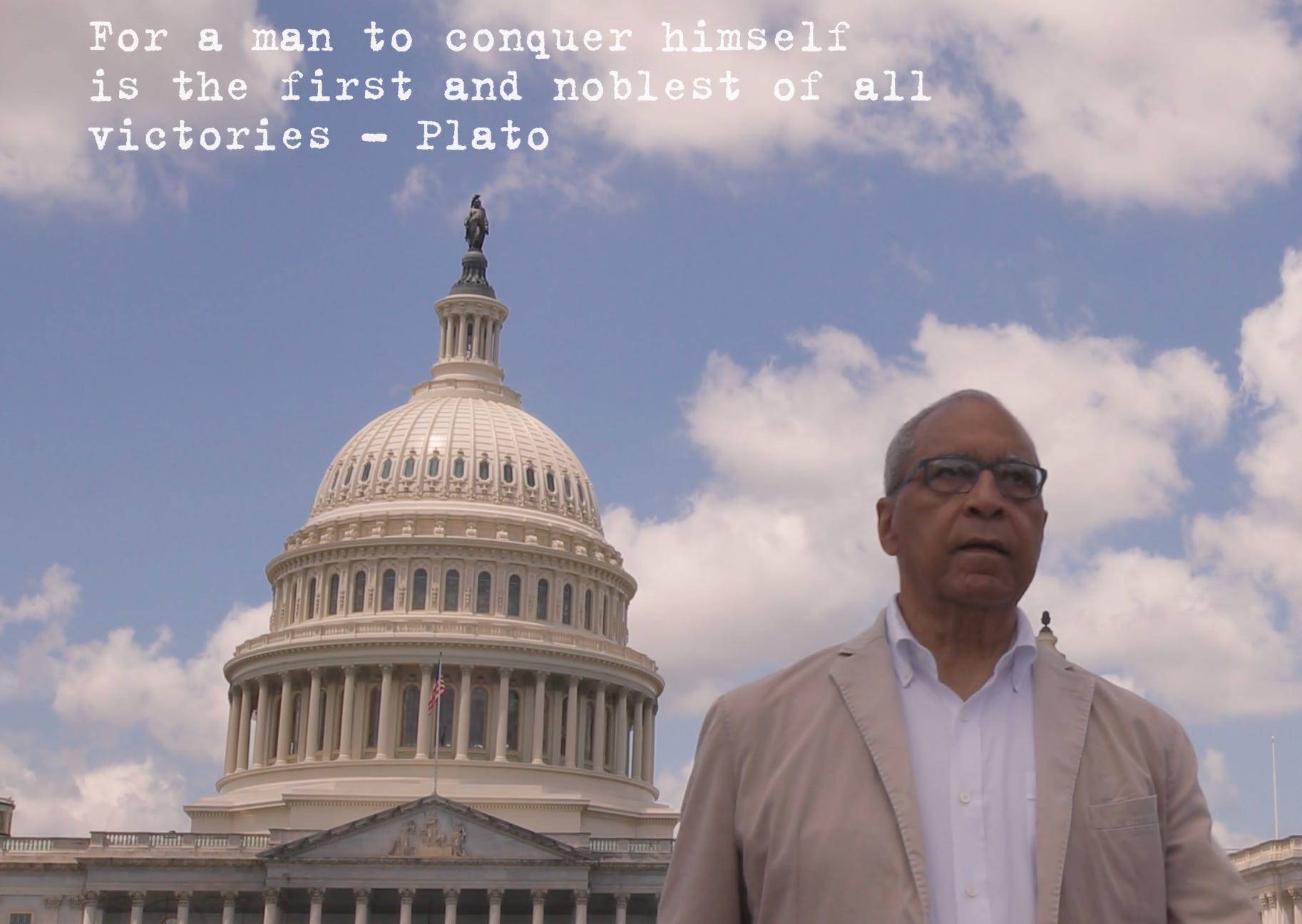
Karyna On The Boat is a living metaphor for the West today, gripped to the death by what Gad Saad calls “suicidal empathy,” which is a version of what Shelby Steele calls “white guilt.” The black conservative scholar did so in the title of a 2006 book by that name, and he does so in “White Guilt,” a new documentary made by his son, Eli Steele. It’s a fabulous movie, one that historians of the future will look back on as a key document to understand our decadent age.
Shelby Steele, now in the twilight of his long life, has been one of the bravest patriots of his time. When he was a literature professor at San Jose State some decades ago, Steele, who is black, earned cancellation before we even had a word for it for his bracing writing about race in America. A former black radical, Steele refused to buy the oppressor-oppressed narrative that the academy and the media required one to affirm to be thought decent, and was courageous enough to speak out about it, in beautifully written and intelligently argued essays and books. For these thought crimes, for his refusal to live by lies, Steele lost both white and black friends. “It was a lonely path, but I was now free: free to say what I wanted.”
The documentary is a feature-length essay about the power of the concept of “white guilt,” which Steele argues is an acid corroding Western civilization. “White guilt is the terror of being seen as a racist,” Steele says, in an interview clip appearing in the doc. It is the source of the power of those — both non-whites and their progressive white allies — who want to destroy the West.
Eli Steele’s film begins with his father citing Hamas post-October 7 as “the latest iteration of white guilt.” The barbaric Palestinian terrorist organization tapped in to the power of white guilt not only to absolve itself of the ghastly rape, torture, and mass murder of Israeli civilians, but to rebrand itself as heroic resisters. Says Steele, “It was almost as if Hamas knew the world was ready for its message.”
As a young man, Steele shared this mindset. In the film, he talks about how blacks like him emerged from the civil rights victories of the 1960s not with a sense of triumph, but soaked in rage over what whites had done to his people over the centuries. Steele recalls growing up in Chicago, which might not have been George Wallace’s Alabama, but was de facto segregated. His parents — a mixed-race couple — had raised him to believe that America was good but flawed by racism, and was redeemable. He marched with them for civil rights. But their son, as a college student, embraced Black Power, and saw personally just how potent it was.
As a student at an Iowa college, Steele led an occupation of the college president’s office, invading it with a list of outrageous demands. Steele marched in with a cigarette in his hand, its ashes falling on the president’s carpet. That cigarette was a symbol of his insolence. In the showdown, the white institutionalist leader capitulated.
“Our outrage at racism had far greater moral authority than his outrage over my cigarette. It was this moment that I understood white guilt for the first time. President McCabe agreed to every one of our demands, not because he cared about black people, but because he wanted to reclaim his innocence, his moral authority.”
His militancy led Steele and his new wife, a Jewish woman, to travel to Algeria, at the time an international base of radicalism, to meet with Black Panthers who had moved there to escape American justice for their violent crimes. There they saw that most of the Panthers were dead-eyed killers, and the Third World Arab paradise, free from the taint of whites, was actually a sullen, angry, backwards place. Steele learned from that trip that to destroy America, as had been his self-appointed mission before, would be to destroy human freedom. The Steeles came home changed.
The film quotes Panther leader Eldridge Cleaver after his return to America to stand trial, saying that living abroad had taught him what a great country America is. Cleaver said publicly that in Algeria, he had seen Arabs owning black slaves, sometimes entire families. Cleaver would later vote for Ronald Reagan. Of Cleaver, Steele observes, “We shared a fate: not what to do with our race, but what to do with our freedom.”
This anxiety, according to Steele, is what drives resentment of whites among blacks today: the terror of how to handle the responsibility that comes with freedom. He notes a curious thing: the better conditions grew for black Americans in the post-civil rights era, the angrier and more despairing they became. For whites guilt-ridden over the racism of their ancestors, capitulating to the worldview and demands of militant blacks was a desperation move to recover their own sense of innocence — ““an unearned innocence, a false innocence … grounded in tribal defensiveness rather than in God-given principles.”
“White America, acting out of white guilt, said what’s important about you is your identity, and that’s it. That’s exactly the same thing slave masters said hundreds of years ago.”
Steele shows how O.J. Simpson’s cunning lawyer, Johnnie Cochran, skillfully overcame the mountain of evidence pointing to his client’s guilt in the murders of Nicole Brown Simpson and Ron Goldman, by appealing to the Fear Of Racism among the jurors. LAPD detective Mark Fuhrman, who had worked the murder case, was shown to have said the n-word at least twice. That tainted everything in the minds of jurors.
Steele provocatively compares O.J.’s exoneration to the exoneration in Mississippi decades earlier of the white murderers of Emmitt Till; in both cases, the verdicts were necessary to uphold a corrupt social settlement. “Both [O.J. and the Klansmen] invoked their race to gain immunity from the law.”
Said the OJ Simpson case hinged on white guilt — Johnnie Cochran showing that Mark Fuhrman had said the n-word. He banked on the jury being more concerned about its own moral innocence than guilt. All this was evidence of a fatal bargain contemporary America entered into: “We made a deal with the devil. We plunged into a tribalism of identity politics.”
Watching the film, I thought about how white guilt serves as our very own Pill of Murti-Bing. That’s a concept introduced by a Polish writer in a dystopian 1920s novel, to describe a magical medication invented by Mongols intent on invading and conquering Poland. They dose the population with the Pill of Murti-Bing, which makes them docile and compliant in their own subjugation. Czesław Miłosz later developed that idea in his 1950s book The Captive Mind, to explain how Communism corrupted intellectuals. White guilt is our own Pill of Murti-Bing because it paralyzes our minds and neutralizes our will to resist our own conquering by barbarians.
The documentary takes us through the Great Awokening, showing how there were no crimes that blacks could commit, and no claim that black intellectuals and their white fellow travelers could make, that would challenge the power of White Guilt to justify destruction and injustice. Steele describes race pimps like Jesse Jackson and Al Sharpton (and later, the Black Lives Matter leaders) as “the backward men who saw not black development, but white guilt, as the single greatest opportunity for power.”
This power comes at tremendous cost. There are the whites and Asians, people with real merit, who have lost jobs and opportunities, simply because of the color of their skin. (Many whites, Steele notes, “had been conditioned to fear white guilt, rather than losing their freedoms.”) There are the universities, such as UCLA Medical School, that are wrecking themselves by substituting racial ideology for real scholarship and real training. There were the citizens of all races of cities like San Francisco, which turned into a sh*thole after its radical leadership embraced BLM’s “defund the police” policy.
“The people had given up,” Steele says. “They had organized their lives around race, victimization, and criminality, instead of the law.”
Echoing this, the younger black journalist and intellectual Jason Riley says:
“We are living in a white guilt country. Blacks were held to a different standard. You couldn’t have honest conversations about antisocial behavior in the black community. That behavior was being subsidized by the government, and explained away by intellectuals.”
Adds Steele: “The one thing white guilt can never do is look the problem in the eye. It always gaslights the problem.”
This is where we are today, all across the West. “Because historical guilt must always trump present reality,” says Steele. “This is the ‘compassion’ of the backward man: innocence instead of solutions, the slow suicide of the West in the name of moral superiority.”
Towards the end of the film, we see an old television interview clip of Steele warning that the day is coming when whites will no longer be intimidated by weaponized white guilt — implying in context not that they will stand firm for justice, but will embrace the identity politics that have given non-whites so much real power. The film then cites a clip of the racist white provocateur Nick Fuentes saying, “Whites have forgotten how to be tribal. They haven’t.”
“White identity politics” was predictable reaction to its non-white predecessor, says Steele. “Yet it is tribalism all the same.”
Yes, yes, it is. This is one of the arguments I make in * Weimar America*: that the Left’s extremely effective use of racial identity politics has called up the same demon from whites, chiefly among the generation (Zoomers) who have been abused and disempowered by weaponized White Guilt, and are fighting back by using the same weapon as their opponents: assuming the innocence of their own race, and turning “justice” not into an individual matter, but as a group phenomenon.
The film doesn’t get into this, but I’ve seen evidence that at least some of these young white men of the Right who embrace white identity politics do so for the same reason blacks have long done: because they are paralyzed by the responsibility that comes with freedom. This past weekend, I was talking with a friend about an intelligent young man we know who has surrendered to this ideology, despite having been raised with many advantages in life. It appears to us both that this capable young man is intimidated by responsibility, and has fallen into the seductive narrative that all his problems are the fault of Others. It relieves him of the psychological burden of being free and responsible.
“The false innocence masks raw tribal hatred,” Steele says. And, profoundly, what we are living with now is:
“…what happens when a civilization grounded in Judeo-Christian values loses faith in itself, but is still hungry for innocence. We still believe in our fallenness. But now innocence is granted by skin color alone, not by our character.”
It is surely no coincidence that Steele, a retired literature professor, loves Russian novels. He has seen all this play out in the pages of Dostoevsky, who, more acutely than any other Russian writer of the 19th century, foresaw the coming destruction of civilization at the hands of the Communists. Steele is a gentle man, but his message in this movie is apocalyptic: we stand on the threshold of the destruction of Western civilization. The valorization of the barbarians of Hamas, and the mass turning against Israel, represents a stunning victory of the oppressed-oppressor narrative. For defending itself against exterminators, Israel is now coded as Oppressor — even on the young Right.
“White Guilt” ends on a melancholy note. It’s as if the aging Steele knows he’s not going to live to see how America, and the West itself, resolves this crisis — or if it will be resolved at all — and is giving his final warning. The only way to save ourselves from the ongoing civilizational suicide is to live not by lies, whatever the cost. Steele’s own life and work have been a stellar example of just this principle — and so too are the lives of the contemporary Americans interviewed in this film, men and women who refused the racial lie, and paid a professional price.
We will soon see how much wokeness was set back during the last two Trump years. I’m not hopeful, and besides, we now have the woke right to contend with. I cannot recommend strongly enough watching “White Guilt” with your kids, and then talking about justice, and America. Tribalism and racialism is pure poison. If you want to turn America (and Europe) into 1970s Algeria, then let’s keep going down this path. Shelby Steele, a black American who as a boy marched for civil rights, but who learned from his travels that a flawed but fixable America is vastly preferable to the false utopias of the ideologues, is both patriot and prophet. Pretty soon, though, if things don’t turn around, it’s going to be too late for prophets. We really are living through Yeats’s immortal lines from “The Second Coming”:
The best lack all conviction, while the worst
Are full of passionate intensity.
Shelby Steele is the best, and has immense, iron-hard conviction. We need millions of men and women like him if we are going to save ourselves. “White Guilt” is, among other things, a recruitment film for Western civilization’s resistance army. Go here, to the “White Guilt” website, to learn how you can stream it (Amazon Prime, AppleTV, YouTube, etc).
I did not vote for the Democratic takeover of Congress, but here’s one thing I’m looking forward to: Democratic Congressional investigations of Trump corruption. There might be some lawfare involved (boo!), but as Noah Shachtman makes clear in this NYT op-ed, the Trump family, its close associates, and players who did shady business with them have provided a bounty of investigative targets. And as exit polling from the recent election showed, corruption was the top issue among voters, linked to the cost of living crisis. People — even ordinary Republicans — are ready to clean house. Schachtman:
Right at the top of the incoming Congress’s priorities is corruption, starting with business transactions involving President Trump’s children or those of his advisers.
Democrats don’t need to persuade Americans to care about corruption; according to a recent Gallup poll, a stunning
[89 percent]already think it’s widespread. I spoke with a dozen congressional staffers, open government advocates and lawyers for companies expecting to be targeted, and almost all of them said lawmakers’ goal will instead be to link all these shady deals to the other big theme of the midterm election: affordability. They’ll try to show that the princelings’ profits come at e…