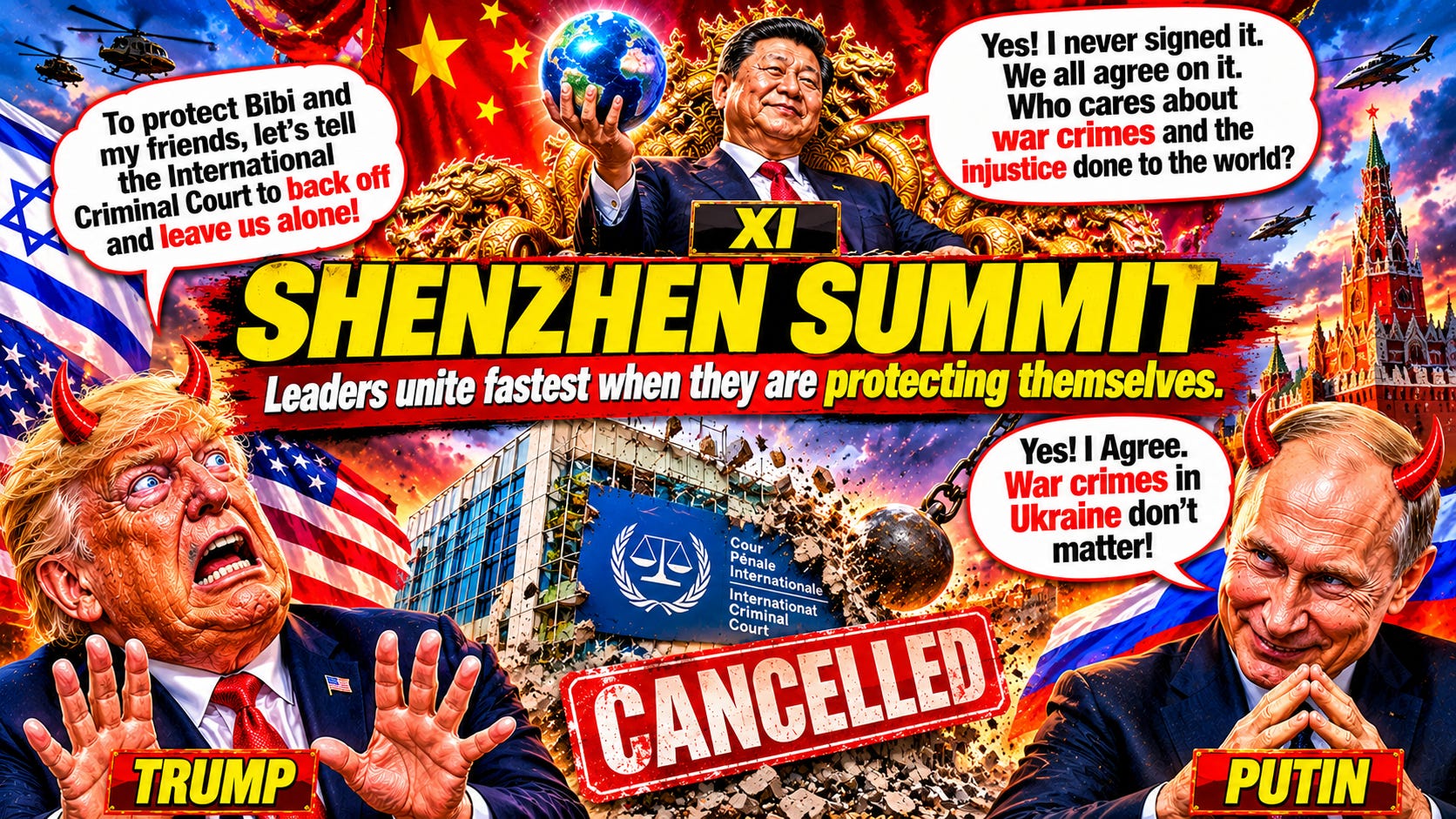
Three superpower leaders. One Chinese city. A “Yalta 2.0” rumor that gripped the experts—and four global crises. No answers to the questions that mattered most.
Then came the ICC clause, along with three intelligence revelations exposing what the cameras missed, where the real leverage lay, and who walked away with the ultimate prize. Here is what really happened in that room, and who walked out richer.
The meeting lasted about an hour and a quarter.
In that time, the leaders of the United States, Russia and China had a war around Iran to think about, a war in Ukraine, an oil chokepoint that could be squeezed shut, and a global economy that is paying for all of it. Then they walked out and announced that they would reform the United Nations.
Yes, really.
We went through this summit piece by piece, and what we found is stranger and more revealing than the carve-up everyone was predicting. Stay with us, because each odd detail connects to the next, and by the end you will see how the whole thing hangs together.
We will also show you how intelligence agencies around the world train their analysts to read a summit, and what a spy-trained eye sees in Shenzhen that the cameras never caught.
Start in 1945.
World War II has just ended. The heads of state of Britain, the United States and the Soviet Union travel to a small town called Yalta, on the Black Sea coast of Crimea. They are not there to admire the water. They are there to decide what the postwar world will look like.
The meeting became known as the Yalta Conference, and it was one of the most consequential summits in modern history. Over those few days, three leaders effectively redrew the map of the world. Europe, above all.
What came after was not a calm peace. It was 45 years of Cold War, a long and tense standoff between two rival ways of running the world. Nobody called it a war in the usual sense, but it was an ideological confrontation that split a continent and shaped almost everything that happened in global politics for the better part of half a century.
One conference, three leaders, and 45 years of fallout.
Keep that in mind, because recently we watched something that looked a lot like it.
The heads of state of the United States, Russia and China met in Shenzhen, China.
Look at the guest list for a second. In 1945, it was Britain, America and the Soviet Union. Now it is America, Russia and China. Britain is no longer at the table, and China has taken its chair. That swap alone says a lot about how the balance of power has shifted in the decades since.
Before the meeting even began, one phrase was ricocheting around the analyst community: “Yalta 2.0.”
The idea was simple, and a little frightening. Three of the most powerful countries on earth were sitting down together again. Maybe they were about to divide the world into separate parts, the way their predecessors had done at the first Yalta.
It was not a crazy theory, either. Each country’s recent behavior gave it real fuel, and the biggest driver of all was Washington.
The United States. The kind of diplomacy and strategy America has been pursuing raised a possibility that it wants to hold its dominance, and keep its focus, on North and South America. In other words, its own hemisphere.
Russia. Moscow has been fighting in Ukraine for three to four years now. After all that, some thinkers started to wonder whether Russia would be given the power to dominate the whole European sphere.
China. Beijing has been flexing across an enormous stretch of the map. It starts in the Middle East (what many people call West Asia), runs through South Asia and Southeast Asia, and reaches into Oceania, with the South China Sea in the middle of it. It keeps leaning on Taiwan, and it harasses a long list of other countries nearby. So the analysis said: why not formalize it, and hand China that whole sphere?
A quick note for anyone new to the term. A sphere of influence is a region where one big power gets to make the calls, while the other big powers agree to stay out of the way.
So the deal, as imagined, looked something like this. America takes the Americas. Russia takes Europe. China takes Asia and the waters around it.
Scholars and thinkers argued about it right up to the day before the meeting. The whole debate boiled down to a single, enormous question: was the world about to be split into three parts, again?
Then the leaders walked out of the room.
Nothing like that.
The summit followed an entirely predictable script. Perfect handshakes, perfect lighting, perfect framing. It was a high-quality photoshoot with a final result of zero.
Picture a luxury coffee-table book. Heavy paper, stunning photographs, a cover that makes you want to pick it up. Guests flip through it, murmur appreciatively and put it back. Nobody ever learns anything from it.
That is what Shenzhen produced. A coffee-table book for global politics. All the glamour of a historic meeting, with none of the substance.
To feel how empty that result really is, you need to know what the leaders were supposed to be dealing with. This is the part most coverage skips, and it is where the real story sits.
The biggest conversation in the world at that moment was meant to be about Iran. Would the war there resume, or wouldn’t it?
To see why that mattered, you need the backstory. The United States had fought a pointless war alongside Israel. It was pointless in the sense that nothing worth the cost came out of it, and both countries ended up paying for it.
The bill came due in two different places.
In America, the Republicans were hit hard in the midterm elections, the nationwide votes held halfway through a president’s term. The defeat was bad enough that, by one blunt assessment, the party may struggle to show its face in public for the next 20 to 50 years. The embarrassment runs so deep that it is hard to see where the party would even find the standing to look voters in the eye again.
In Israel, Prime Minister Netanyahu is currently trying to build a government out of spare parts. He is leaning on state institutions to help him stitch together a patchwork coalition, reaching for small-change political players who would never ordinarily be near real power, just so that he can get into a position to govern.
Why is he scrambling? Because even after what was billed as a powerful and aggressive military campaign, public support for him in Israel is a lot lower than before.
Remember both of those facts, the pointless war and the leaders paying for it. They are going to keep coming back.
Next on the list was Ukraine, and for many people this was the most important item of all.
The question was whether the United States could pressure Russia into ending its war. That conflict stopped being a regional problem long ago. Its damage is being felt across the entire world, which means almost everyone is paying for it in one way or another.
This is the one the public rarely hears about, and it is where the real power sits.
Suppose America attacks Iran again at some point. Would Russia and China keep supporting Tehran, the way they do now? Washington badly wanted the answer to be no.
Why does that support matter so much? Because of what it actually delivers. Russia and China gave Iran satellite-based intelligence, which is the equivalent of a pair of eyes in space showing you exactly where your enemy’s bases and equipment are, and what they are doing.
Now look at what Iran did with it.
During the war involving Iran, America and Israel, Iran used Shahed drones. These are cheap, one-way attack drones that fly straight into their targets. Defense researchers widely put the cost of building one at around $20,000 to $50,000. That is the price of a decent used car.
With machines like that, guided by intelligence from two rival superpowers, Iran completely destroyed the American bases across the Middle East, country by country. Not one or two. Every country where America had built a base in the region.
Think about that for a moment. Military installations built over years at enormous expense, wiped out by weapons that cost about as much as a family sedan. It is a harsh lesson in modern warfare: cheap weapons combined with good intelligence can beat expensive ones.
That is why Washington was so desperate to cut off the supply of intelligence. If Moscow and Beijing keep sending it, any future American strike on Iran invites the same outcome.
Finally, there was the Strait of Hormuz.
It is a narrow sea passage through which a large share of the world’s oil has to travel. Whoever can threaten that passage can threaten the energy supply of the whole planet, and with it the global economy. That is what it means to weaponize the strait.
So the open question was how to stop it from happening again.
That was the agenda. Four enormous problems, each of them urgent, each of them global, each of them capable of shaking the world economy.
Now watch what came out.
The leaders sat for roughly an hour to an hour and a quarter. Then they stepped out and issued a joint declaration, a kind of edict handed down to the rest of us.
It made three headline promises. Each one tells you something different, so we will take them one at a time.
That was the first point. The very first.
Think about the scene. Iran, Ukraine, Hormuz and the risk of a bigger war were all sitting in that room. The leaders spent barely more than an hour with them. And the opening announcement was United Nations reform.
We have to ask what any sensible person would ask. What on earth was going on in there?
Either something was being smoked in that room that the public is not supposed to know about, or someone served a very special lunch. Because we cannot think of another explanation for walking out of a meeting on Iran, Ukraine and Hormuz and declaring that you will fix the United Nations.
This is the dumpling dipping sauce. Think about it. Beijing is the host, the food is excellent, and somewhere on that table is a small, innocent-looking bowl of sauce. It seems like China stirred some mysterious powder into it, tasted a generous spoonful itself so nobody would feel singled out, and the entire table drifted off into a pleasant, reform-minded haze. We want the recipe. We also want it analyzed by a laboratory.
(This is satire, because the gap between the agenda and the announcement is truly ridiculous. Someone ought to investigate what exactly was consumed during those 75 minutes.)
And underneath the sarcasm is a straight question. You gathered to deal with four global emergencies. What are you actually telling us? Reform the United Nations. Fine. Wonderful. If that is where the conversation ended, then that is where it ended.
On the surface, this one sounds sensible. Look closer, and it is a confession wearing a suit.
Start with the obvious problem: there is nothing new in it. Every country in the world already wants more oil on the market. So why present it as a headline achievement?
Because of how the shortage got here.
A pointless war helped throw the global oil supply into disarray. After that came the midterm defeat. After that, Bibi Netanyahu of Israel, America’s partner in war crimes, failed to win a majority in the Israeli parliament. And only then, once the political damage was done, did Washington suddenly remember that the world needs more oil.
There is a second catch. America cannot raise the world’s oil supply by itself. It needs the support of Russia and China.
So consider the sequence. America damaged the global oil supply with a needless war. It paid for that war at the ballot box, and so did its partner Israel. It then traveled to foreign soil and promised to help repair the damage. And it can only do so with the help of the two rivals it was fighting against.
What does that add up to? A concession of defeat. America effectively admitted, in a country that is not its own, that it could not manage the world’s oil supply. It had wrecked a public good, the oil and gas that the entire planet depends on and that no single nation owns. Now it is working to bring it back.
Nobody in the declaration used the word defeat. Nobody needed to.
This is the promise that tells you what the summit was really for.
The declaration said that the International Criminal Court (ICC), the global court that prosecutes the gravest crimes, would not pressure any leader. It added that no leader is prepared to accept the language of such courts.
Start with what everyone already knows. Even inside their own countries, powerful people have a famously flexible relationship with the courts. Who actually has to obey every ruling and every order? Ordinary citizens. We are the ones who live with the consequences. Leaders do what they like, and the entire world knows it.
So why did the ICC come up in Shenzhen at all? Follow the arrest warrants.
Vladimir Putin already has an ICC warrant against him. So does Benjamin Netanyahu.
Netanyahu is Donald Trump’s closest partner, and that is the key to the whole clause. Protecting Netanyahu and protecting Trump are, in practice, the same thing.
Now look at what each leader wanted out of it.
America came to shield its devoted ally, and by extension itself. Russia came for Putin, to keep him from becoming the scapegoat for the world’s anger. And China? China had no warrant to worry about. Xi Jinping does not even recognize the ICC. China never joined the court in the first place. But Beijing spotted a free opening. When America arrived to protect its friend and Russia arrived to protect its own leader, Xi saw his chance to say, We never signed it either.
Three leaders with one shared interest, wrapped up in one tidy paragraph.
That is the real headline of the summit. The one thing these leaders truly protected in Shenzhen was not the world. It was themselves.
And so the much-hyped “Yalta 2.0” shrank into what can only be called a hollow, embarrassing pact: the Shenzhen Declaration.
Which brings us right back to the dumpling sauce. Because the real mystery is how the leaders ended up setting aside so many urgent issues to sign something this thin. Whatever Beijing put on that table, it worked far too well. This deserves serious analysis.
Step back from the individual promises for a second and look at the whole picture. One thread runs through all of it.
It begins with one pointless war.
That war damaged the oil supply, which is why the oil promise exists. It cost the Republicans the midterms, which is why America showed up in Shenzhen weakened. It left Netanyahu with no public support, which is why he is scrambling to survive. It kept his ICC warrant in the headlines, which is why the ICC promise exists. And it gave Iran the chance to demonstrate what cheap drones and foreign satellite data can do to American bases, which is why Russia and China hold so much leverage.
One war, and every consequence. Every item on the agenda, every line of the declaration.
Here is the realization we want you to leave with.
The declaration was not a plan for the world. It was a damage-control memo for the people who caused the damage.
And notice what happened to the actual agenda. Will the Iran war resume? Silence.
**Can Russia be pressured to end the Ukraine war? Silence. **
**Will Russia and China stop backing Iran? Silence. **
**How do you stop the Strait of Hormuz being weaponized? Silence. **
Four urgent questions, and zero answers. What came out instead were three promises, and not one of them was aimed at the crises that had brought the leaders to the table.
If you have read so far and it gave you clarity you didn’t find anywh…