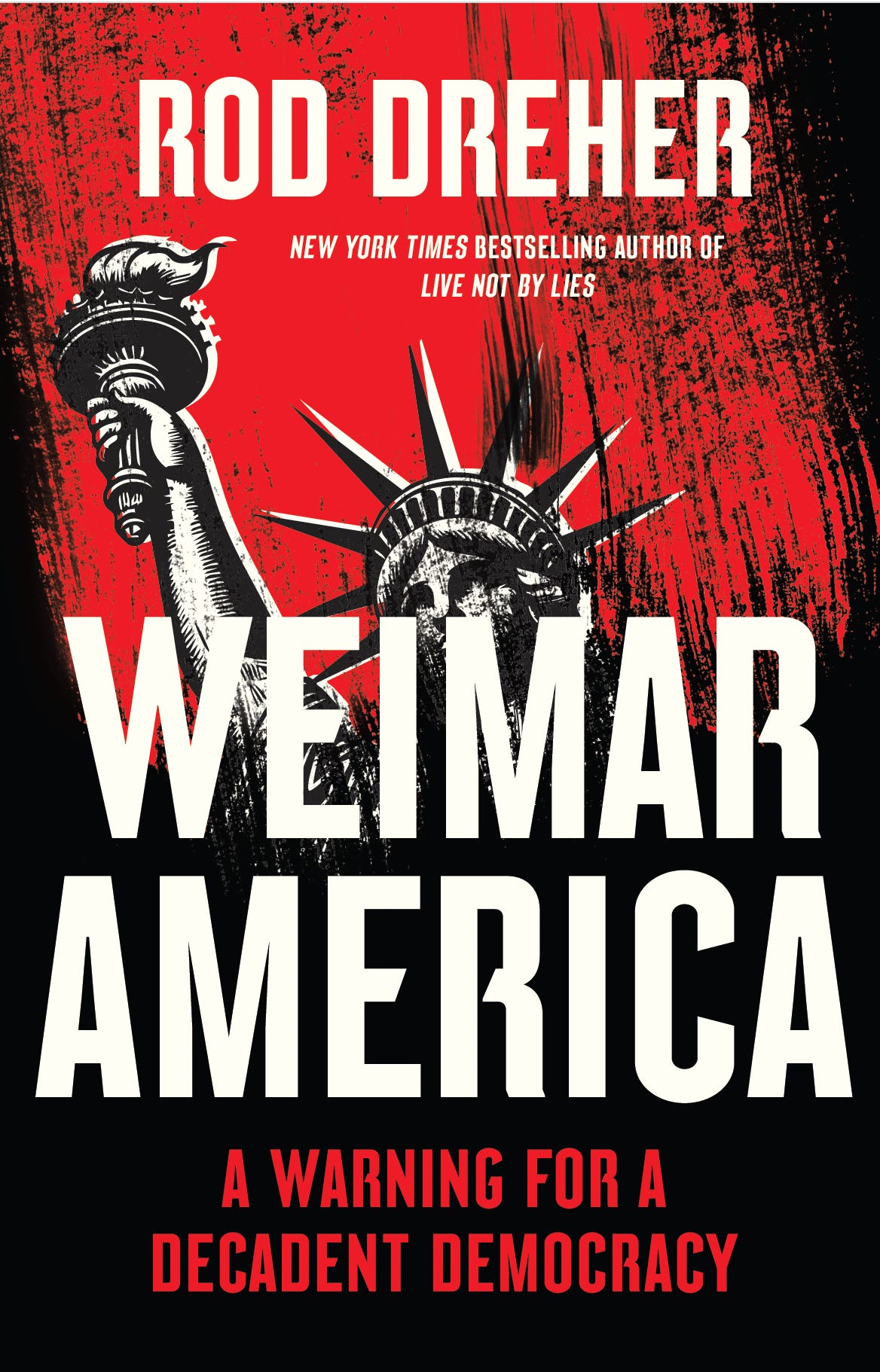
First things first: today is the “cover reveal” of * Weimar America*, which will be published by Basic Liberty, a Hachette imprint overseen by the great Tom Spence, my editor. Out early next May, but I encourage you to
Yesterday’s final panel at NatCon Jerusalem shows why. Though most of the speeches (including my own) were more or less pro-Israel, though in my own remarks, I said that Israelis need to understand that public opinion in the US has radically shifted against Israel, and that all national politicians in America, in both parties, are going to have to deal with this. And so too, I said, will you Israelis. Well, I didn’t know what was going to come with this panel yesterday, but that panel illustrated vividly what I was talking about.
That panel was a bombshell. I’m not going to write a lot about it here, because I’m working on a piece for The Free Press about it. It has caused an explosion online among pro-Israel commentators — entirely understandable. They’re jumping all over NatCon organizer Yoram Hazony for platforming these four Americans — Matthew J. Peterson (Catholic), Amanda Milius (Jewish), Jonathan “Lomez” Keeperman (Jewish), and William Wolfe (Southern Baptist) — especially on October 7.
This is wrong. I am confident that Yoram doesn’t share all their views. But I am equally confident that Yoram — an American Jew who is also an Israeli, and who lives in Jerusalem — understands the new and coming political situation in the US better than many Israelis, and even better than most pro-Israel Americans. It is always better to live in reality, and figure out how to deal with it, than to rely on an outdated set of assumptions and strategies. Yoram allowed the Israeli audience to hear harsh truths that they needed to hear. It’s also true for pro-Israel older Americans like me.
These four gave speeches warning Israelis that the old settlement on which America’s strong relationship with Israel has been based is completely outdated for Americans on the Right age 40 and under. (Milius, a Jew who said she is also a Zionist, said in her speech that we shouldn’t even think about the Left — it’s entirely gone into Israel hatred and antisemitism.)
You can see the speeches on Twitter. I strongly encourage you to watch them. It’s important that you get the full speeches, not just snippets. These were extremely controversial, so it’s important to know what you’re talking about.
𝕏Here is the full speech by Matthew J. Peterson.
𝕏Here is the full speech by Amanda Milius.
𝕏Here is the full speech by Jonathan “Lomez” Keeperman.
𝕏Here is the full speech by William Wolfe, a self-described “Christian Nationalist”.
Here are some key excerpts from the speeches:
Amanda Milius:
If we continue to jump and, in a fit of hysteria, call as many people as possible anti-Semitic. The word loses all meaning when overused. We are now at risk of becoming BLM to the younger American right. They are correctly sick of being called racists, and mentally this connects to them in the same wiring, even if it shouldn’t. That’s what’s happening.
Jonathan Keeperman:
What I offer instead is a modest account of the attitudes toward Israel I see among Americans, particularly on the right, whose shifting intellectual and political currents I have observed up close for the last two decades.
The first thing to understand is that attitudes toward Israel have gone through a dramatic change over the last three years, and the old attitudes that prevailed for the last generation or more of American conservatives will almost certainly never return.
More:
The second important trend is the softening of the deeper cultural and theological commitments that historically anchored support for Israel among its two most reliable American constituencies: American Jews and Evangelical Christians.
There are evangelicals on this panel who can speak about their own cohort better than I can, but in my conversation with younger Christians engaged at the level of political opinion making, there is a pervasive frustration with the central role Israel plays in bygone eras of conservative politics.
This frustration is rooted in a sense that because Israel is treated as a theological lodestar, this relation is therefore exempted from ordinary political scrutiny. This disguises potential conflicts of interest and distracts from more pressing concerns. The politics of this older generation is receding, and as they do, deprioritizing Israel will therefore become the clearest way of signaling a break with that older conservative order.
And:
But while the Holocaust and the on again, off again persecution of Jews remains a potent aspect of historical self-knowledge. It no longer resonates in the way that it did when the Holocaust was still in living memory.
Attempts to keep the Holocaust at the center of Jewish life will not revive these commitments to Israel for younger generations, and
and I would argue might only make the problem worse. Younger American Jews and Americans in general are much more inclined to respond to strength and competence and confident optimism than memories of collective anguish.
Matthew J. Peterson:
The worry about the conflict in Iran on the part of many Americans on the right is not due to any support for the current regime in Iran. We would all like to see it go. The worry on the part of some Americans is that this turns into another fruitless war. This is why its outcome will likely shape Israeli-American relations for the next generation.
Take me as an example. I support the American military. I support President Trump and his administration in the hard work of governing. But I'm also among those troubled by the framing and escalatory logic and timing of the conflict with Iran. If I'd been in a position to advise, which I was not, I would likely have counseled restraint. I have many friends who disagree vehemently.
That disagreement, of course, is not civilizational betrayal. Opposing endless war is not hostility to Israel. Having a different opinion of how America should fight Iran is not hatred of Jews. Those who conflate these things now are committing an error with strategic consequences.
America is a nation. Israel is a nation. Interests sometimes align and sometimes do not. When they align, we act together with clarity and strength. When they do not, it is not a scandal. It's ordinary politics among free peoples.
This sort of thing. It’s worth hearing. Do I agree with all of it? Of course not — and I especially note that none of these speakers actually called out the true bad actors on their own side, only those outside their circles who condemn New Right figures for anti-Semitism. It is true that too many are too quick to call critics of the Israel-US alliance anti-Semites. But it is also true that there really are more than a few anti-Semites on the New Right. If that side wants the other side to be more precise and just in their accusations, they could help by distinguishing themselves from the actual anti-Semites in their ranks. Because following a “No Enemies To The Right” strategy is not helping.
Earlier in the conference, Heritage Foundation president Kevin Roberts gave this address, embedded below. It’s worth listening to the whole thing. Remember that Roberts became a goat among older Republicans, Jewish and Christian, for last year’s ill-advised defense of Tucker Carlson after Carlson. In this speech, he did not mention Carlson’s name, but said he has “learned” that there’s no point in engaging with (unnamed by him) “fringe” podcasters. He said they are like toddlers:
Roberts went on to condemn antisemitism as evil, in no uncertain terms. He also said that Israel is a “bulwark” of Western civilization. He said that before the conference began, he made a pilgrimage around Israel with the Catholic priest Father Ben Kiely, and an Israeli guide. They prayed at the holy sites, and also engaged in friendly arguments about theology, and disputes he had with the Israeli point of view. Roberts said that going forward, we must be able to have these discussions without falling into either side smearing the other.
Earlier this week, The New Yorker published a piece about Roberts’s efforts to manage the emerging fracture on the Right. He referenced his video defending Tucker Carlson immediately after the criticism of his platforming Nick Fuentes (he calls his extremely controversial response “videogate”). Excerpt:
He brought up “videogate” before I did. “Obviously, I stepped in it,” he said. I asked why, after all these months, Heritage still hadn’t taken the clip down. “I’m a historian,” he said. And, besides, “if I were to take it down, it would still exist.”
Roberts acknowledged a larger problem. “There’s a very troubling rise of antisemitism on the right,” he said, adding that he intends to “really make sure Heritage continues to be a vital institutional player in that work against antisemitism.” In think-tank fashion, the organization has initiated studies on the origins of right-wing antisemitism, the first of which is expected this month; it plans to hold events and possibly propose legislation around the findings. Roberts told me that he had called up the presidents of Catholic colleges—he wouldn’t tell me which ones—and “privately excoriated” them for hiring professors he sees as antisemitic. This spring, Heritage hired Luke Moon, a Christian pastor who co-chaired the antisemitism task force, as a visiting fellow. When I asked Roberts whether he had been persuaded that Carlson is exacerbating antisemitism in America, he smiled, as though he had been waiting for the question. “Yes,” he said.
So, here is Kevin Roberts admitting that the “No Enemies To The Right” strategy is wrong. This is progress! I don’t have any real inside information, but I think Roberts got to this place of admitting he was wrong to defend Tucker Carlson, and giving a talk in Jerusalem affirming that Israel, America, and the West must stand together against a common enemy, because Yoram Hazony did not react to his pro-Tucker mistake by distancing himself from him. I think Roberts’s speech in Jerusalem was a triumph for pro-Israel conservatives. Note especially Roberts saying how** visiting the actual existing state of Israel made a big difference to him. **
It really does. If “Israel” exists as an abstraction in the minds of right-wing Americans who hate it, then coming to the country and seeing for yourself what it’s like is a potential antidote.
Now, I think Roberts downplayed the power and presence of the “New Right” — meaning the antisemitic New Right. He said that Heritage is fully onside against antisemitism, and that “at Heritage, we don’t engage them” (“them” meaning the hard right represented by inflammatory podcasters). That may be true from a formal institutional perspective — recall that Heritage has a “one voice” policy, meaning that its public-facing position on any issue must be united — but we know well, from lots of reporting and commentary since the Tucker debacle, that a number of young Heritage staffers are highly critical of Israel and America’s relationship with it. It is certainly not the case that all of them are therefore antisemites. It is unjust and misleading to make that claim. That said, there really are among a significant cohort of young conservatives working in Washington conservative circles actual antisemites. I know this because I have interviewed people in those circles.
At one point in his talk, Roberts condemned the “Red-Green alliance” — leftists and Islamists — for wanting to “tear it all down.” Funny he used those words: that’s exactly the phrase that a well-connected Zoomercon used with me last November when I asked him what these young right-wing radicals want to do. And it’s what I read recently in that book American History Z, by Joey Oliver, who is one of these figures. They don’t want to reform the system; they want to destroy it and replace it with right-wing Caesarism (so says Oliver).
In general, I’m glad these people gave these speeches, here in Jerusalem. I may not like all the things they had to say, but it does pro-Israel conservatives, Jewish and Christian alike, to pretend that their message is dismissable, either because it is supposedly motivated by bigotry, or because it doesn’t represent meaningful opinion.
But.
These speakers never criticized directly, if at all, the actually anti-Semitic podcasters — Tucker Carlson, Nick Fuentes, and Candace Owens leading the pack — who are truly influential in right-wing American politics. Roberts simply can’t write them off as fringe figures. They have huge followings. And not only them: my college professor friends tell me that open anti-Semitism and racism is a serious and widespread issue among their young white males, who don’t watch Tucker and Nick and Candace, but have even more radical online gurus.
Rather, the four figures entirely focused on people who complain about those who unfairly (in their view) call New Right figures anti-Semites. But again, **anti-Semitism among the under-40s is a real thing, and a growing thing. **
Keeperman said in his speech:
The majority of Americans on the right, especially harbor a variety of complicated views on Israel, often incoherent and lacking in any detailed knowledge or sustained attention. They are at present suspicious of the value of our country's geostrategic partnership. They are exhausted by efforts to use the Holocaust or Jewish suffering generally as a moral obligation to support Israel, they are completely unmoved by accusations of anti-Semitism and any hardline approaches to disavow and shame Israel's critics, and even those who soberly advocate for a more restrained foreign policy. These conversations cannot be off limits.
OK, but what conversations should be off limits? To be specific, which conversation partners should be off limits? If these people want to have these conversations — and I agree that they are necessary and even unavoidable — then they are going to have to do the work of drawing lines and establishing boundaries. Kevin Roberts did so, weakly but undeniably, on the matter of Tucker Carlson.
What I want to know from Milius, Keeperman, Peterson, Wolfe, and others sympathizing with them is this: **Do we have Enemies To The Right? If so, who are they? **
Let me be clear by repeating: I’m glad Hazony and NatCon gave these four a platform. What they said are uncomfortable truths about the social psychology emerging in full force on the American Right. It’s not as big now as it’s going to be as the Boomers die off, and memory of the Holocaust fades (I treat this topic in Weimar America, by the way). More traditional pro-Israel conservatives like me have to be ready for this. I am eager and willing to have the kinds of conversations they want to have. But what I am…