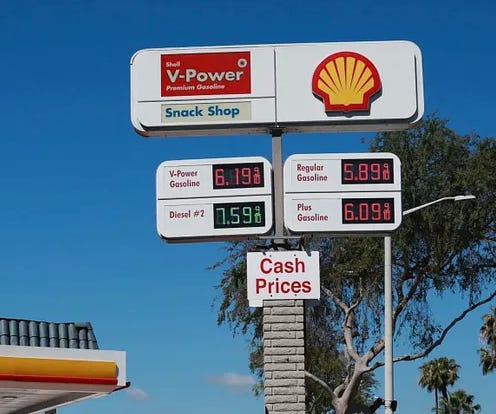
“The future is already here – it’s just not very evenly distributed.”- William Gibson
At some point, these two will converge- probably quite dramatically, and likely surprisingly.
If you’re looking fro a new spot-Bismarck, North Dakota, ranks No. 1 in rent affordability among 182 U.S. cities in 2026.
Underlying everything:
Add this to the supply chain issues and upcoming shortages
from News Items
‘Texas needs at least $174 billion to avoid water crisis, state says’
(Texas Tribune)‘Behind the Curtain: China wins by watching’
(Axios)‘How the Iran war set Beijing up for global clean energy dominance’
(Politico)
Weekend developments saw the US Navy seize an Iranian vessel and Iran reimpose controls on the waterway, sending oil prices surging 6-8% and equity futures down 0.5-0.9%, dimming prospects for near-term peace despite ongoing diplomatic efforts.
US equity futures are under pressure this morning following a turbulent weekend in the Middle East.
European markets opened lower. The Stoxx Europe 600 fell 0.8% in morning trading . France’s CAC 40 decreased 1%, Germany’s DAX dropped 1.1%, and the FTSE 100 lost 0.4% . Italy’s FTSE MIB fell 1.4% and Spain’s IBEX 35 fell 1.1% in opening trade .
Asian markets showed resilience despite the tensions. The MSCI Asia Pacific Index rose as much as 0.8%, while the MSCI Emerging Markets Index erased all of its losses during the now almost two-month war in Iran . Nikkei futures opened up 195 points at 59,000 on SGX .
Oil prices surged sharply on renewed Strait of Hormuz tensions. Brent crude rose 6% toward $96 a barrel after the US Navy carried out its first seizure of an Iranian vessel in the Strait of Hormuz . Brent surged as much as 7.9% to $97.50 a barrel before paring gains . Front-month WTI crude oil futures climbed 7.2% to $89.86 per barrel .
Energy shock threatens economic recovery: With Brent crude approaching $96-97 per barrel and the Strait of Hormuz still effectively closed, central banks face renewed inflation pressures just as they were considering rate cuts, while the EU scrambles to address potential jet fuel shortfalls.
Political pressure mounting on multiple fronts: Republican nerves are fraying ahead of midterms as high fuel costs bite voters, Kevin Warsh faces a contentious Fed confirmation hearing Tuesday. GOP senators are pressuring Trump on Iran exit strategy. Some Senate Republicans are starting to go public with their concerns about the ongoing conflict, which has kept energy costs high . GOP lawmakers who already feared November would be an increasingly tough battle are trying to nudge the president toward clearly defining his endgame .
AI investment divergence accelerating: European stocks risk falling further behind as restrictive EU AI regulations deter investment, while US and Asian markets benefit from aggressive AI spending—even as ByteDance’s 70% profit plunge highlights the massive capital intensity of the AI race.
M&A activity defies uncertainty: Major deals continue to close despite geopolitical volatility, including QXO’s $17 billion TopBuild acquisition and Eli Lilly’s reported $2+ billion Kelonia Therapeutics deal, suggesting corporate confidence in long-term fundamentals.
Market positioning at extremes: Aggregate equity positioning saw one of the biggest jumps on record last week, with both discretionary and systematic investors moving to overweight, while the Nasdaq 100’s 13-day winning streak—longest since 2013—raises questions about near-term sustainability amid renewed geopolitical risks.
JPMorgan disagree with bearish views that revolve around the stagflation narrative, don’t expect a prolonged conflict in the Middle East and see stock-market weakness as a buying opportunity
Tasnim News Agency—tightly tied to Iran’s IRGC—reports Iran has no plans to send a delegation to Islamabad for talks with the Trump administration while the U.S. naval blockade remains.
If history rhymes..
Long/Short books are light after weeks of whipsaw, while market seeing an increase in overall equity positioning. Overall retail volumes have diminished as well as headlines and growing economic concerns are having an impact.
‘Merz convenes Germany’s security council over looming jet fuel crunch’
(politico)‘War Revives Stagflation Dangers for Global Economy: Eco Week’
(bbrg)‘UAE Reportedly Seeks Financial Backstop from US to Hedge Against Iran War Fallout’
(bbrg)‘Goldman Calms Private Credit, Blue Owl Less So’: Paul J. Davies
(bbrg)‘The Vanishing: How BDCs Disappear Bad Loans’
(Rod’s Substack)‘Private credit gets the once-over:Do you want the bad news or the bad news?(ft). Links to this report: ‘PRIVATE CREDIT: AN HONEST ASSESSMENT’ (Sona)From Peter Boockvar
‘A lot of focus on tanker and shipping rates but air cargo rates have really spiked. According to the weekly figures from WorldACD Market Data, prices rose by another 3% in the week between April 6-12 and are now up 37% y/o/y and higher by 40% from the end of February. WorldACD said this, “The two-week ceasefire agreement this month between Washington and Teheran raised hopes of a lasting settlement of the conflict, although the truce remains fragile and the outlook for peace is uncertain. Most observers have warned that inflation and elevated fuel costs are likely to persist for some time, even if the current ceasefire holds, and there are increasing concerns that jet fuel shortages and rising costs of jet fuel will lead to flight cancellations and further air cargo rate rises in the coming weeks unless there is a swift resolution to the current crisis. Meanwhile, bellyhold capacity through the Middle East will take time to fully recover, and container lines do not expect a return to pre-conflict flows any time soon, meaning air cargo pricing is likely to remain elevated for some time.”’