Update: The American Association For State and Local History has some excellent resources that institutions can use to begin this important conversation with the public.
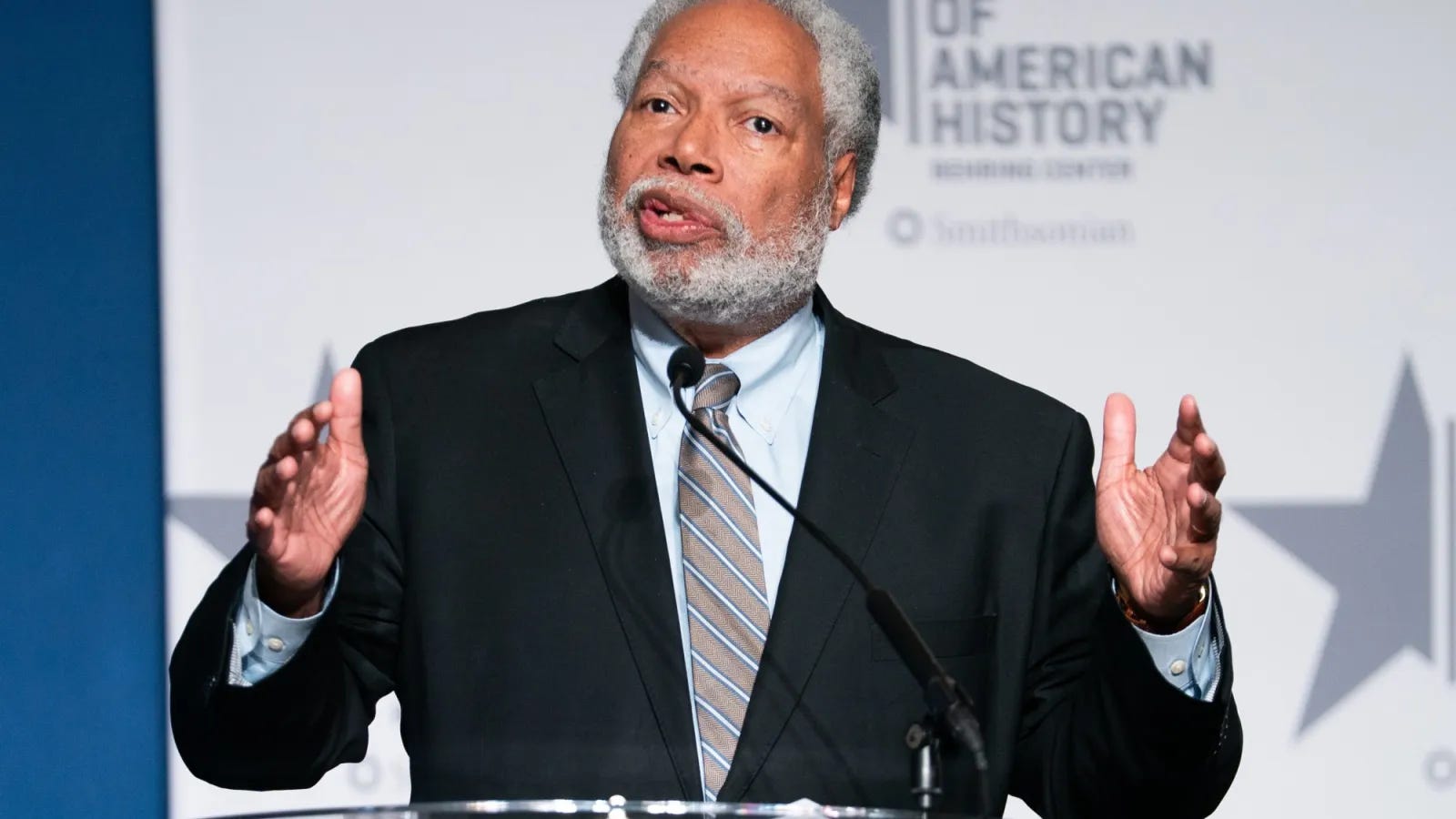
On Friday, Lonnie Bunch spoke to an enthusiastic audience at the Smithsonian Museum of African American History & Culture as part of its ten-year anniversary.
The outgoing secretary of the Smithsonian Institution pushed back hard against recent attacks by the Trump administration, which claim that the institution’s staff or exhibitions were unpatriotic.
The notion that somehow this museum or any part of the Smithsonian is done by people who don’t love America, don’t care about America, is unbelievably wrong. And what you see in this building is great love. Great respect.
The secretary’s response is, no doubt, correct and an important one to make. I have made it a point to defend the staffs and work of the Smithsonian and National Park Service in response to the Trump administration’s vile accusations and I will continue to do so moving forward, but it risks shifting the discussion away from what really matters when thinking about the work of public historians.
I don’t question the patriotism or love of country of anyone on staff at these institutions, but we haven’t asked why this matters to begin with. What does patriotism or any emotional connection to the United States have to do with doing good history and carrying out the mission of these respective agencies?
What do these terms even mean and who gets to define them?
I am reminded of the long history of accusations made against my scholarship on the Confederacy from certain quarters. I’ve been accused of ‘hating’ the South and the Confederacy as if the two concepts were interchangeable. The strongest accusations trace my supposed hatred to my politics, religion or place of birth.
While I am glad that the Confederacy lost its bid to create an independent slaveholding republic, I have no strong views about it, including its political and military leaders. They are subjects for serious study—a glimpse into our collective humanity.
I prefer to see my published work stand or fall based on the overall interpretation that I offer, including the questions driving the research and writing, the evidence offered, and the conclusions made based on that evidence. None of this has anything to do with whether I love or hate the Confederacy.
It’s irrelevant.
The goal should be to push ourselves to understand our respective subjects more deeply over time and this takes a certain amount of humility. It demands an acknowledgement that no one has a monopoly on historical truth. Our understanding of the past is always evolving because we are continually uncovering new evidence or interpreting old evidence in new ways. We ask new questions, which bring into focus new perspectives on the past.
What worries me about Bunch’s comment (again, even though I recognize it as a necessity) is that it reduces the work of public historians to some undefinable and politically charged question of patriotism or whatever you want to substitute for it. It reinforces the perception among the public that the work these people do has no legitimacy beyond their perceived political or ideological affiliation.
Engaging in public history involves much more than historical research. It’s the “public” in public history that gives it a dynamic that more conventional researchers and writers tend not to face.
But at its core public history is still a discipline that demands rigor and a commitment to a process of thinking critically/analytically and even creatively about the past. We can and certainly do disagree with individual interpretations, but these critiques should be assessed based on the reasoning behind the disagreement rather than some vague accusation that tells us nothing about the work involved or the final product.
We are certainly in a politically charged moment right now and this public debate about museums and historic sites will likely remain divisive.
All the more reason to find ways to communicate to the public just what it is that historians and public historians do and why their work matters.