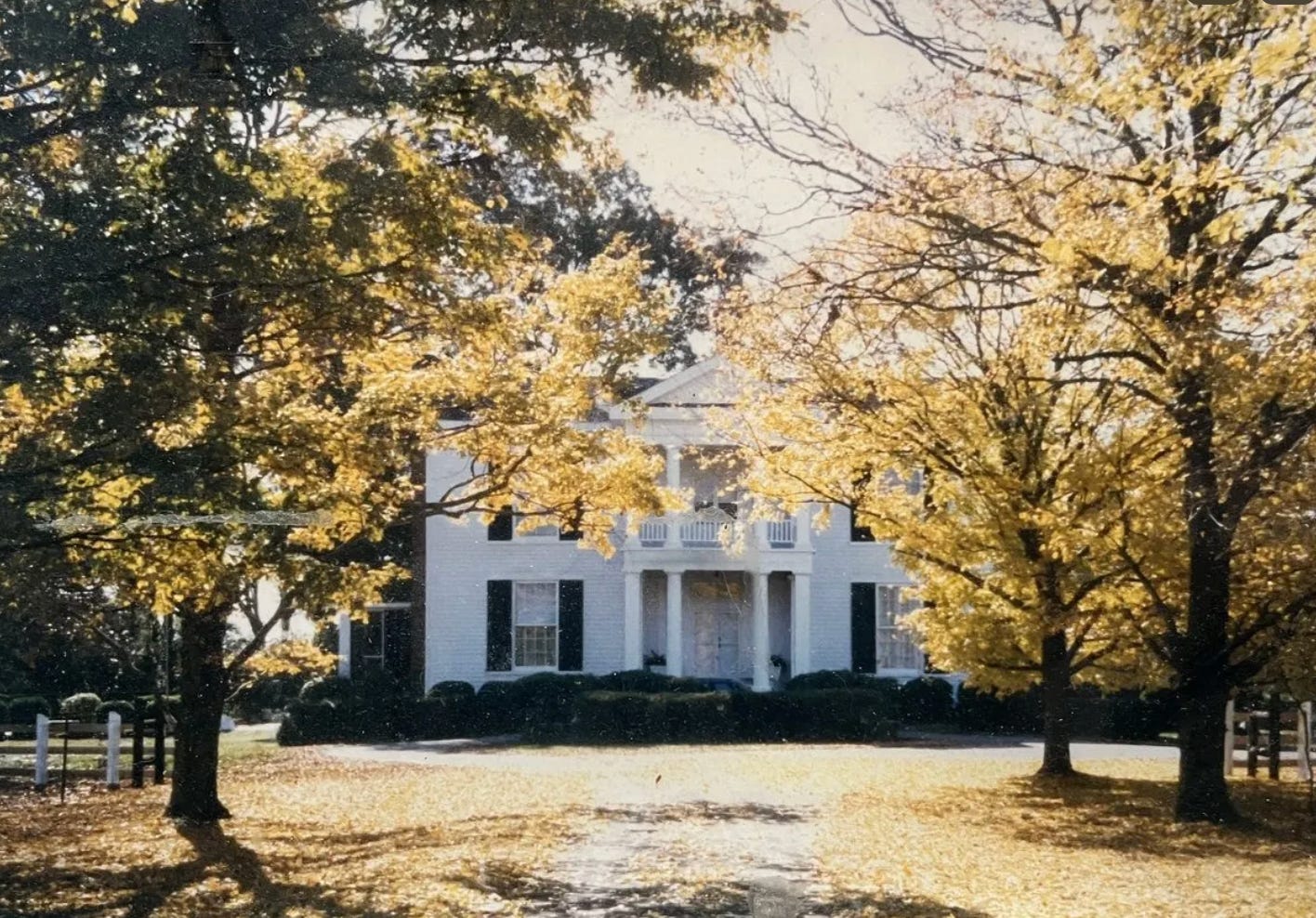
You want me to show you uplifting, beautiful things to counter the gloom? You got it!
Father Matthew Venuti tipped me off that the Southern Catholic writer Maclin Horton, now in his seventies and living in Mobile, has begun rolling out his memoir in a free Substack titled “Some Great Thing”. Wait, *what? *I don’t see much published writing from Mac Horton anymore — though here’s a link to his essays for The Lamp — but I can’t think of anything I’ve ever read from him that was anything short of beautiful and wise. How can he just give his stuff away? Well, I dunno, but he is, and let me tell you, it’s terrific stuff. Here is a link to the first page and table of contents. He’s still writing as he goes along, and there’s not a lot there yet, but there’s enough there to delight. He opens with this:
This book can fairly be described as a memoir. Yet from the moment I began writing it I have resisted calling it that. The memoir as widely practiced and admired today is often a non-fiction novel, a story with a well-shaped plot, often very dramatic, and with characters vividly realized, often intimately revealed. The writer may not be the most important of these, the witness to a story which is largely that of others. Whether I am capable of writing such a book is doubtful; that I do not wish to do so is certain.
Why then did I write it? For a few years long ago I participated in the cultural revolution that we refer to conventionally though not very precisely as “the Sixties.” I believe that phenomenon is best understood not so much as a social and political development as the flowering of a new religion: not its birth, which had happened many years earlier, nor its maturity, which is not yet full, but its attainment of youthful conquering strength, its sudden and rapid rise into a mass movement capable of transforming a society, and intent upon doing so.
I very much believed in and participated in that religious movement. What I have tried to do in this book is to use my own experiences as a means of looking at the movement: to give an account of what drew me to it, what I hoped for from it, how I lost that faith and found another. And I hope these explorations have more general application, suggesting some reasons for the movement’s success and the implications of that success. A new religion, if and when it becomes predominant, produces a new culture, even a new civilization.
Some forty years ago I wrote an essay describing my path through that revolution to the Catholic Church. A friend referred to it as a testimony, and I thought that a good term for it. What follows here is a book-length telling of that story, with more than forty years of thought and experience behind it. Testimony still seems the best word. It is the account of an argument with three sides: myself, the spirit of the times, and God.
Mac says the first beautiful thing he ever saw was a mallard duck, with its lustrous green head, brought in by the men from duck hunting. He remembers the little bit of blood on the jewel-like feathers being part of the beauty. Later, he read an illustrated encyclopedia his folks had, and dwelled on the colored pictures:
One was of a cedar waxwing perched among evergreen branches. I looked at it again and again, obscurely moved by its subtle coloring and the flash of bright glossy red on its wingtips, the sense that it was sweetly sheltered within dark fragrant spruce.
At the age of eight or ten I had no name for that sensation. Not until I was an adolescent did I put a name to it and come to the consciousness of beauty in which one not only sees and takes pleasure in a beautiful thing but recognizes the phenomenon and knows that there is a word for it.
In another entry, he goes on:
Beauty was inseparable from mystery; in a sense beauty
wasmystery, or at least intrinsically mysterious. And even as a child I was drawn to mystery. Not to puzzles, not to the sort of question that attracts people who become scientists—how do birds fly? why is the grass green?—but to a sense of something behind, beyond, and within the world we see and inhabit. It is in fact the precise opposite of the scientific fact-finder’s impulse. It is not the desire to comprehend and explain, but to enter into that which cannot be comprehended and explained, not because we lack the intelligence or the tools but because it is intrinsically so. Something rich and strange, something which can be experienced and described but not analyzed, never fully knowable, something that is beautiful not as an accident or by-product of physical processes, but in fact, in reality, in its essential nature. Something that is alive in a way not explicable as matter and energy, something that does not appear to be magical only because we have not yet figured out how it works but because it truly is magical: supernatural; ineffable; numinous; inexhaustible.That call is at least part of the mysterious phenomenon for which the German language—or should I say German Romanticism?—provides the word
sehnsucht. I experienced it when I was no more than five or six years old. I was holding an Easter basket filled with that green celluloid stuff which I think is called Easter grass. In this nest were dyed eggs and candy. I was digging for the candy, but as I looked into the basket I was taken up by an entirely different desire, a very powerful and sweet yearning to become very small and to burrow into that grass. I felt that somewhere within it there was another world, a secret, intricate, wonderful, magical world, some kind of home that would be like the sweet dreams I must already have been experiencing, but real. But I was powerless to enter. I could only look into it, longingly, and feel first the sadness of its unattainability, then a sense of loss as the feeling faded, because the longing itself had been very sweet.Looking deep into a Christmas tree had the same effect, and it did not disappear until I was well into adolescence. The lights and the ornaments were an enchantment that pointed a shining way into a deeper enchantment that was invisible somewhere in the green depths, but somehow sure to be there. But there was no way to enter, no way to follow.
Reading this passage, I had that wonderful feeling pass over me that one sometimes gets when reading autobiography: *“You too?” *This kind of thing happened to me a lot as a kid. I would stare at the Christmas tree for ages, trying to see through it and beyond it, knowing through intuition that something was there, but I couldn’t get to it. I’ve never really thought about it until reading Mac’s words here, but yes, that’s what a good part of my childhood was like.
I must have been three or four years old, snuggling in bed next to my bony, birdlike Aunt Lois on a winter’s night. That an 80-year-old woman shared a bed one night with a little boy who adored her is a testimony to her generosity. We toasted beneath the electric blanket and read the glossy mail-order catalog from a Wisconsin cheese company. The company packaged its cheddars in cellophane wrapping that looked like glass Christmas ornaments, or even jewels: rubies, emeralds, and sapphires. In the top margin of some pages was a drawing of a Wisconsin farmhouse in the snow. I couldn’t get enough of this catalog — the colors of the cheese balls, and the idea that the people who lived in this cozy farmhouse, with tendrils of smoke rising from the chimney above a roof frosted with snow — well, it was enchanting. That’s precisely what it was: enchanting.
My father used to complain that the old ladies, Lois and her sister Hilda, were “ruining” me. What he meant was that they were drawing me into their indoors world of books and art and intelligent conversation. He feared that they would train me to be dissatisfied with plain country life in Starhill, and to desire other places, and other things. And he was right. But they didn’t ruin me; they* made *me.
Anyway, this is the delightful effect of reading Mac’s memoir-in-progress: sending me off on walks down corridors of memory unvisited for ages. I bet it will do so for many of you too. I can’t express to you how rich this writing is, and his thinking. You’ve got to read it for yourself. Why is a publisher not calling Mac and telling him to STOP GIVING IT AWAY, and putting him under contract to put it all in a book?! It reads as if Walker Percy had been a repentant hippie. Publishers, I know how to get in touch with him — I’ll hook you up!
Again, here’s the entry point. Do remember to subscribe for updates. It’s free.
As I mentioned yesterday, I was, and am, prepared to believe that Lindsay Clancy is not guilty of child murder by reason of insanity. But these female jurors we’ve been hearing from, and the online cult of women — all white, apparently middle class — I’ve seen, who have rallied to her side, and some of whom had gone on social media while holding their babies, and saying, in effect, “I know how you feel, girl” — it’s an evil that shakes me to my core.
Attention must be paid. Serious attention, and not in a stupid culture-war way. Something profound is coming loose in the fundaments of our life together. We are now seeing a hidden and primitive darkness made visible.
(Subscribers, read on past the paywall for more on this, and discussion of the most important and insightful essay I’ve yet seen about this topic. If you aren’t a subscriber, please consider it. It’s cheap, and I write at least five days a week. There’s an eclectic range of topics every day, book recommendations, and a great comments section.)