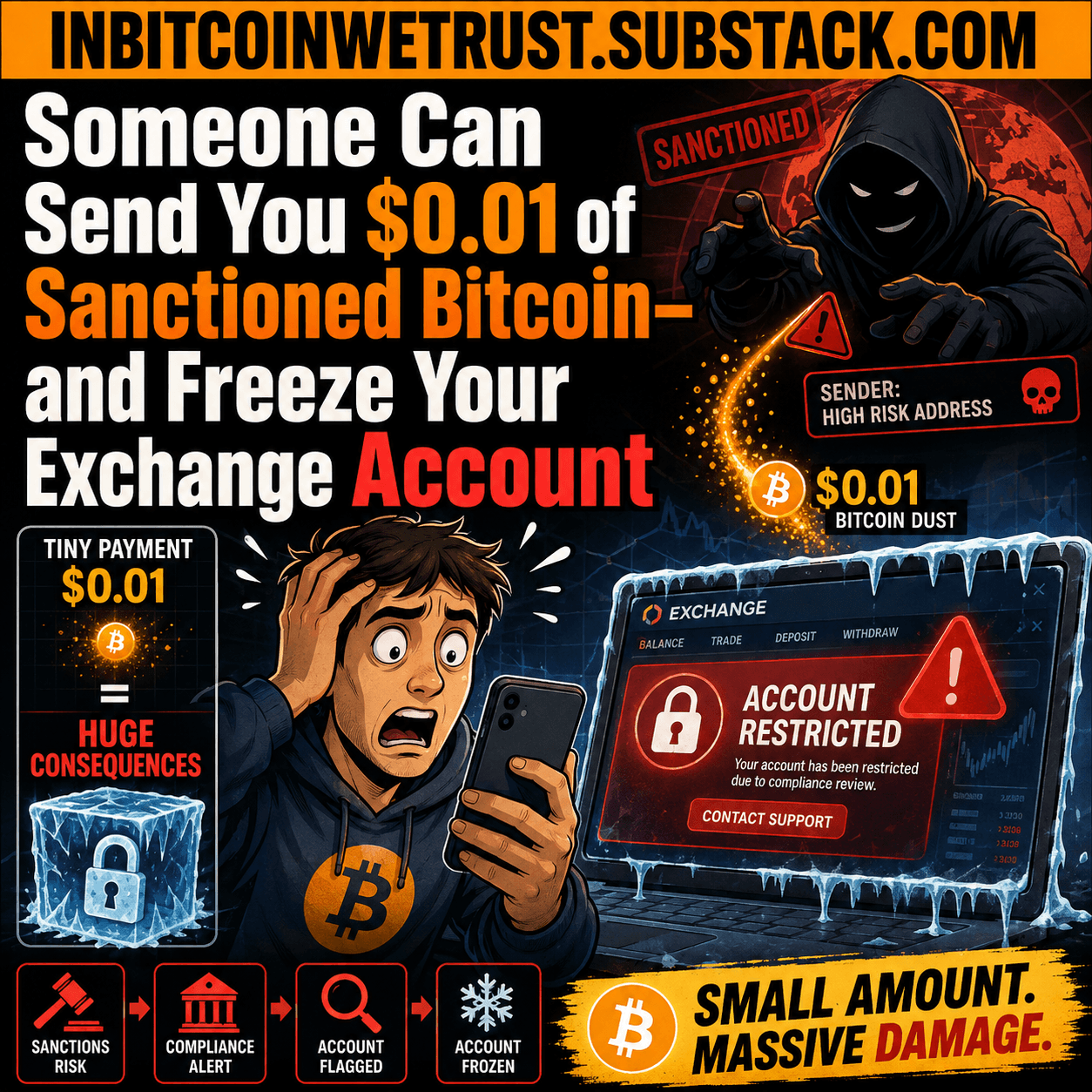
There is a very strange attack emerging at the intersection of permissionless money and regulated finance.
It can cost almost nothing.
The attacker does not need your password. They do not need your private key. They do not need to compromise your computer. They do not need to steal your Bitcoin.
They simply send you money.
A tiny amount. Pennies. Maybe less.
And suddenly your exchange account can become a compliance problem.
That sounds backwards.
Normally, attackers try to take money away from you.
This attack works by giving you money you never asked for.
In August 2026, Kraken said some customers were temporarily restricted after thousands of tiny unsolicited transfers arrived from wallets associated with sanctioned exchange HTX.
Kraken characterized the transfers as a possible dust attack intended to spread sanctioned funds across unrelated accounts and trigger automated compliance systems. Between August 17 and August 24, roughly 12,000 small transfers reportedly hit Kraken-linked addresses, most worth only a few cents or dollars. HTX denied intentionally initiating the transfers and said it was investigating.
Think about what just happened.
Someone potentially discovered a new form of financial denial-of-service attack.
Instead of flooding a server with packets… you flood financial accounts with compliance risk.
And the victim pays the price.
Welcome to the age of the Compliance DoS attack.
Before going further, we need to be precise.
The Kraken incident has widely been described as a “dust attack,” but that phrase historically means something slightly different in Bitcoin.
Traditional Bitcoin dusting involves sending tiny UTXOs to many addresses, often in an attempt to connect wallets together when users later consolidate or spend those outputs.
It is primarily a privacy attack.
What happened around Kraken is different.
The weapon was not necessarily the amount itself.
It was the provenance of the funds.
Kraken said the transfers came from wallets associated with HTX, which has become subject to sanctions.
The United Kingdom designated Huobi Global — HTX’s former name — on May 26, 2026. UK sanctions guidance explicitly confirms that the designation applies to the HTX exchange.
The European Union subsequently added HTX to a list of non-EU entities targeted under its Russia sanctions framework, with the measure taking effect on August 23, 2026.
So the real attack looks more like this:
Find addresses belonging to users of a regulated exchange.
↓
Send tiny amounts associated with a sanctioned entity.
↓
The exchange’s compliance system detects the connection.
↓
Automated controls investigate or restrict the account.
↓
The innocent customer suddenly has a problem.
The brilliance — and absurdity — of the attack is that the victim does not have to participate.
Crypto addresses are permissionless receivers.
Anyone who knows an address can send assets to it.
There is no “Accept payment?” button. There is no spam folder for blockchain transactions.
The transfer simply appears.
Nvidia isn’t just selling the AI boom anymore — it’s locking up memory, manufacturing, and future capacity before everyone else can.
Kraken told Bitcoin Magazine that it did not know who was behind the transactions. But its hypothesis was revealing.
The exchange said whoever was responsible may have expected sanctioned funds landing in customer accounts to trigger full account locks and create operational disruption across a large number of users.
That sentence deserves more attention. Because it reveals a fundamental conflict between two systems.
Bitcoin and public blockchain systems say:
Anyone can send value to anyone.Financial compliance systems say:
Institutions must evaluate where value came from.
Put those two properties together and you get an unexpected attack surface.
You can potentially contaminate someone’s compliance profile without their consent.
That is not a failure of Bitcoin’s consensus rules. Bitcoin did exactly what permissionless money is supposed to do.
The problem appears one layer higher.
Suppose I dislike you.
I discover your bank-account number. I send you one dollar from an account connected to a sanctioned organization.
Your bank detects the transaction.
Instead of isolating the dollar, its automated system freezes your entire account while compliance reviews what happened.
You cannot pay your mortgage. You cannot use your debit card. You cannot transfer savings. You did absolutely nothing.
Someone sent you $1.
Most people would immediately recognize the absurdity.
But public blockchains make unsolicited payments dramatically easier because receiving addresses are frequently visible.
Kraken’s deposit addresses are blockchain addresses. Once discovered, they remain valid destinations at the protocol level. An exchange can stop crediting an old address internally. It cannot stop someone from broadcasting a valid transaction to it.
One Reddit commenter suggested exchanges simply deactivate addresses after deposits.
Another immediately identified the problem: you cannot deactivate a Bitcoin address on Bitcoin.
You can only change what your internal software does when more funds arrive.
That distinction matters enormously.
The blockchain doesn’t know the address has been “closed.”
This is what makes compliance attacks fascinating.
Traditional financial attacks generally have a clear economic objective.
Steal money.
Extort money.
Manipulate prices.
Commit fraud.
Compliance DoS can have a different objective: create friction.
Suppose it costs an attacker $0.05 to send a problematic transaction.
Suppose that transaction causes:
automated sanctions screening;
withdrawal restrictions;
manual investigation;
customer-support tickets;
compliance analyst time;
legal review;
false-positive resolution;
angry customers.
Five cents of attacker cost might theoretically generate tens or hundreds of dollars of operational costs.
Scale that across thousands of users.
Now the economics look ugly.
Reports say nearly 12,000 small transfers were involved in the recent HTX-linked episode.
The amounts themselves were economically trivial. The compliance implications were not. This is classic asymmetric warfare.
Cheap attack. Expensive defense.
The theory is already becoming reality.
One KrakenSupport Reddit user described receiving dust associated with sanctioned HTX. According to the user, their Kraken account was suspended for several hours.
During that suspension, they deposited cryptocurrency from Binance — something they said they had done more than 100 times before.
That deposit was subsequently held for days.
Kraken support publicly acknowledged the case and said the held dust might require processing.
One Reddit anecdote cannot prove how widespread the problem is. But it perfectly demonstrates the second-order effect.
The user was not accused of deliberately dealing with HTX. They had simply received an unsolicited transfer. Yet another legitimate transaction then became trapped inside the compliance review.
That’s how denial-of-service attacks propagate. The attack does not need to steal your balance. It merely needs to interfere with your ability to use it.
Because Kraken is not operating in Bitcoinland.