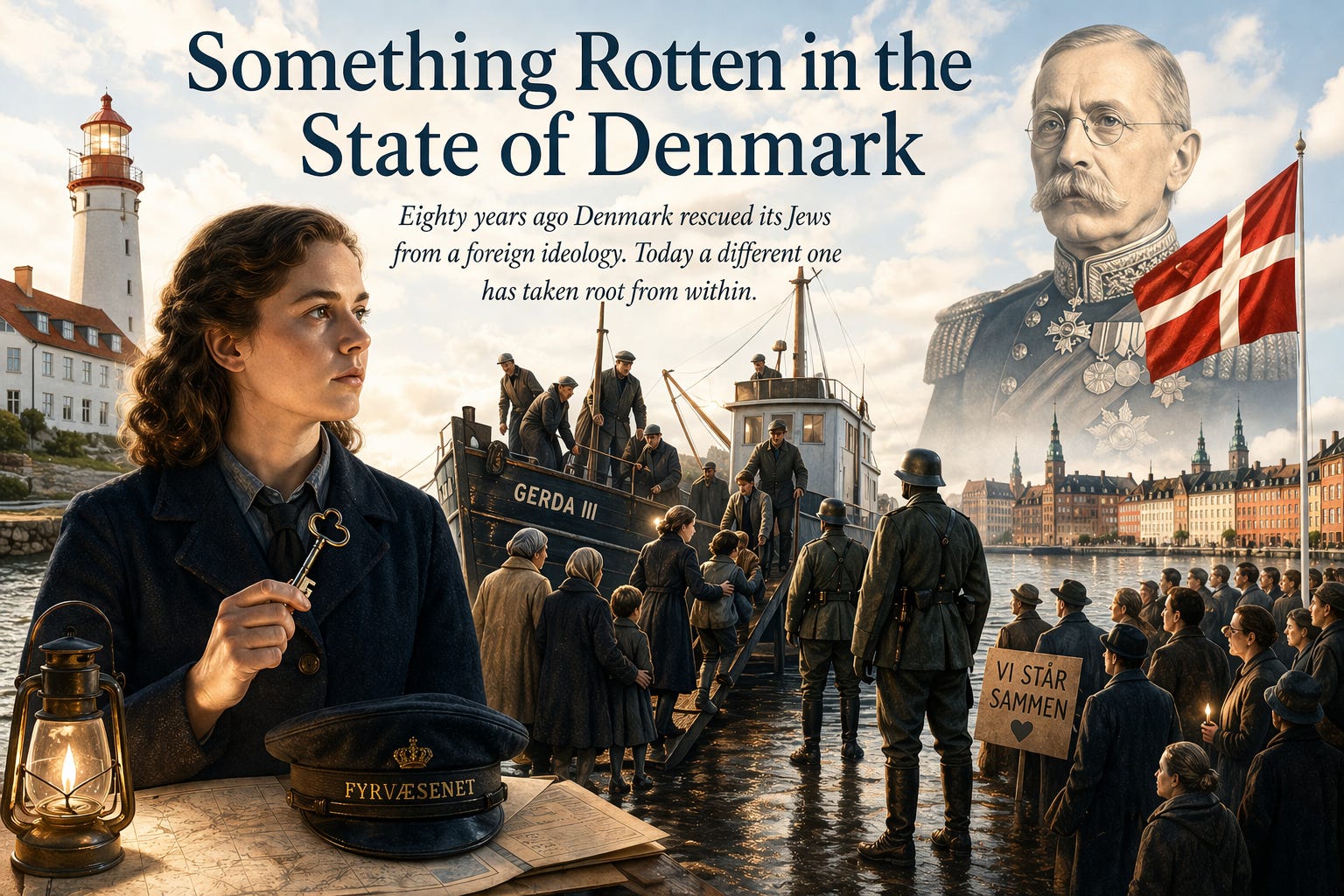
In early October 1943, a 22-year-old woman named Henny Sinding was attending to her duties at the Danish Lighthouse Service when four crew members of a supply vessel called Gerda III came to her quietly and asked for help. The Nazis had announced they were coming for Denmark’s Jews. The roundups were set to begin October 1st. The crew wanted to use the boat to get people out.
Henny went to her father, her direct supervisor, and asked him to get a spare key for the Gerda III and look the other way if it didn’t sail its usual route at its usual time. He did.
What followed was weeks of night work that could have gotten her killed. She gathered Jewish families in the middle of the night, in violation of the German curfew, and walked them through occupied Copenhagen to a dockside warehouse. She stocked the loft with food, drinks, and sedatives for the children to keep them quiet. Then, one by one, she ran them across an exposed stretch of open ground to the waiting boat, carrying the youngest children herself.
Every departure included German soldiers boarding the Gerda III to check papers. The crew had a routine. They offered beers, talked about the weather, kept things light and friendly, while the refugees lay below deck with German boots inches above their heads. Once the soldiers left, the boat set sail for Sweden.
The Gerda III made that run repeatedly. Ten to fifteen people per crossing. Over three weeks, an estimated 300 to 600 people reached safety on that one vessel.
Henny Sinding wasn’t a soldier. She wasn’t a politician or a resistance commander. She was a lighthouse apprentice who said yes when someone asked her a hard question in the middle of a war.
Henny wasn’t an anomaly. She was the product of a society that had been making its position clear since the first day of the occupation.
On September 28, 1943, a German diplomat named Georg Ferdinand Duckwitz leaked the Nazi deportation plans to Danish politician Hans Hedtoft. Hedtoft immediately contacted C.B. Henriques, head of the Jewish community, who in turn reached Rabbi Marcus Melchior, the acting chief rabbi of Copenhagen’s main synagogue. The warning moved through that chain in hours.
The following morning was the eve of Rosh Hashanah. The congregation was already assembled for early services when Rabbi Melchior stood before them and told them not to be there. The Germans were coming. The roundups were set to begin October 1st, the night of the Jewish New Year, when the Nazis knew Jewish families would be home celebrating. Go into hiding, Melchior told them. Tell everyone you know. The situation is very serious. We must take action immediately.
The warning spread fast, through the Jewish community and beyond it. Within hours, non-Jewish Danes were moving alongside their neighbors. Doctors admitted Jewish patients under false names. Civil servants went through telephone directories and called anyone with a Jewish-sounding name. The Danish bishops drafted a pastoral letter, signed collectively and distributed to every minister in the diocese. It was read aloud in every Lutheran church in Denmark on October 3rd. The message was unambiguous: they would fight so that their Jewish brothers and sisters maintained the same freedom that Danes valued higher than life itself.
The Torah scrolls from the Great Synagogue of Copenhagen were carried a few blocks away and hidden in the crypt of Trinitatis Church. They stayed there until the war ended.
Meanwhile, ordinary Danes moved Jewish families toward the coast. Fishermen ferried roughly 7,200 Jews and 680 of their non-Jewish family members across the Øresund strait to neutral Sweden. The operation ran for weeks. It wasn’t a government program or a military command. It was a country that had already decided what it stood for, and was acting on that decision.
About 500 Danish Jews didn’t make it out in time. They were deported to Theresienstadt. Danish officials spent the rest of the war pressuring the Germans on their behalf. All but 51 survived. When they came home, they found their apartments untouched, their belongings exactly where they’d left them. The Danish government had paid their rent during their absence. Some walked in to find fresh flowers in their vases. The Torah scrolls were waiting in the synagogue.
Over 95 percent of Denmark’s Jewish population survived the Holocaust.
That outcome didn’t happen by accident. It started at the top.
From the first day of the German occupation in April 1940, King Christian X made his position on Denmark’s Jews consistently and publicly clear. He rode through the streets of occupied Copenhagen daily, unescorted, a visible signal to his people that Danish identity was still intact and that it included every one of its citizens.
When Hitler sent a congratulatory telegram on the king’s 70th birthday in September 1942, Christian’s reply was two words: “My thanks.” Hitler took it as the insult it was. He recalled his ambassador and replaced him. A king who wouldn’t flatter an occupier was a king whose people understood exactly where he stood.
That posture filtered through every level of Danish society. When the Nazis suggested anti-Jewish legislation be introduced in Denmark, the government refused. When the question of the yellow star came up, the answer was the same. The order was never issued in Denmark, not because the Germans forgot about it, but because the Danes had already made the answer obvious. The occupiers calculated the resistance wasn’t worth it. So they never tried.
In most of occupied Europe, the yellow star came first. It isolated Jews from their neighbors and prepared the ground for what came next. In Denmark, it never got that far. A king, a government, and a lighthouse apprentice had already made the country’s position clear.
This work is entirely reader-supported. By choosing a paid subscription, you allow me to continue this long-form research and writing about the history that makes it matter. Thank you for helping this Lioness roar for the truth.