George Roux was probably best known as an illustrator. Working in the late 19th century, he illustrated many of Jules Verne’s early science fiction books. He was known for his exceptional ability to capture a moment, as if a film had just been paused. He heightened the drama by adding effects of light and movement.
Take, for example, his 1889 Illustration of a man attempting to purchase the North Pole. The wall-mounted Communication device seems almost animate with its two snake-like cords flying in the air. The table behind the man seems to be tipping over. The shadows in the room are attenuated by the bright explosive light at the center of the composition. Even without the story's text, any viewer could see this was a dramatic moment in the tale.
Along with his illustration work, Roux produced numerous standalone paintings. These narrative paintings allowed the story to unfold more subtly.
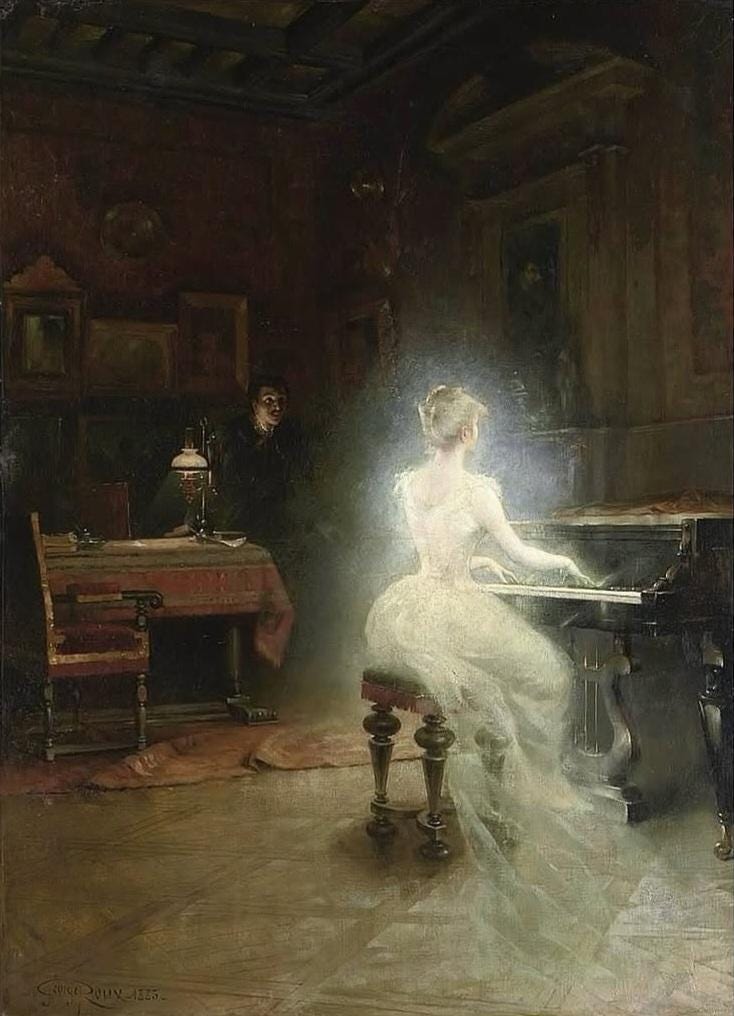
This painting, called Spirit, features at least one person. A man stands beside his desk; the bright light of his desk lamp barely illuminates his face. He’s in an opulent room with numerous depictions of people, including a portrait set in pride of place over the mantle. Architectural elements heighten the fireplace and add solemnity to the decor. Even though the room is shadowy, the opulent wall colors, table covering, and velvet chairs are obvious. The grand piano has many carefully crafted adornments, including Fringe highlighting the piano bench and scrollwork throughout. The dark wood might be fine imported ebony. The high-ceilinged room, with its fine coffered ceiling and parquetted floor, must be part of a luxurious home.
At this point you might wonder why I didn’t talk about the woman in white. Roux set up this painting so you would notice her first; she is in the foreground, much brighter than the rest of the scene, and see-through. She’s hard to miss.
With such a bright central figure, Roux needs to draw in the viewer to keep looking. The composition offers the viewer layers of interest. He creates a triangular composition that leads your eye from her head to the startled man and then to the portrait above the mantel. That triangle is the center third of the painting. If, for example, there was less parquet in the scene or less shadowy background, the scene would be less spooky. For example, because he is so far away, it’s hard to tell whether he is happily shocked or frightened. Similarly, while the woman glows and the painting is called the spirit, we can’t see her face. Is she a good spirit or a bad spirit? The ambiguity of the figures makes this interesting composition.
Roux created this large painting (42.5 by 31 inches) after reading the novel Spirit by Théophile Gautier. In that story, a woman dies without ever being noticed by her Crush. As in many romances, death is not a hurdle for true love. In her longing, she remains with her beloved.
While Roux began the composition with the story in mind, the visual ambiguity lets the viewer imagine what happens next. Is she playing a scary song? A playful one? Will the man run away? Will he move toward her?
This painting came at a time of rising interest in spiritualism, like séances and psychics. With both the rise in electricity and photography, much of life became clearer, brighter, and less ambiguous. Spiritualism let people connect with the unknown as a counterpoint to a changing world. Many people felt mystical and unexplained elements were an important counterpoint to the ever-growing rise of technology.
As for this ghost, in the book at least, did she have a happy ending? You tell me. In the book, the young man is being pushed into a marriage with a widow he doesn’t like. He dies and ends up with the spirit in eternal love in the afterlife.
This is part of a series about skulls, skeletons, and things spooky. Follow for more.