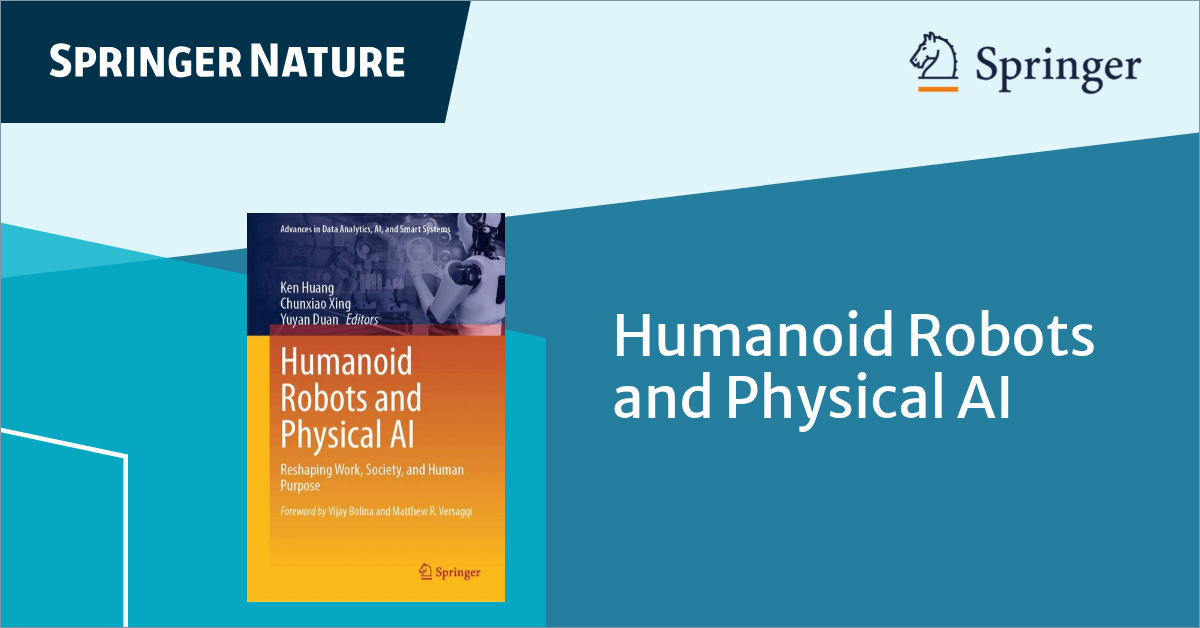
Springer has published Humanoid Robots and Physical AI: Reshaping Work, Society, and Human Purpose. The live book is at DOI 10.1007/978-3-032-33669-9. The volume runs XXVII + 381 pages across ten chapters, with 90 color illustrations, in the series Advances in Data Analytics, AI, and Smart Systems.
I announced the project earlier in my previous Substack article, Announcing Humanoid Robots and Physical AI Book by Springer. That post covered the whole-system thesis and the preorder path. This post records the publication fact and names the people who made the book real.
The central question in the preface still stands: What happens when agentic AI acquires a physical body? The published volume answers that question across hardware, perception, agentic architectures, control, safety and security, economics, governance, psychology, and long-horizon technology convergence. It does not treat humanoid robotics as a string of demos. It treats physical AI as an end-to-end system that must produce useful work under real constraints.
Readers can open the official Springer page now:
Choose the format your library or team needs (eBook or hardcover).
If you buy for a university or enterprise, ask your librarian about an institutional eBook license through the same Springer page.
My earlier Springer volume, Agentic AI: Theories and Practices, documented autonomous intelligence in digital systems. This new volume follows that intelligence into embodiment, contact dynamics, safety, unit economics, and human coexistence.
I served as Editor-in-Chief. I did not build this book alone.
Professor Chunxiao Xing of Tsinghua University joined as co-editor. He strengthened scholarly rigor across the manuscript and connected the volume to long-running research in AI, data systems, and interdisciplinary engineering.
Yuyan "Lynn" Duan joined as co-editor. She brought product judgment, investor discipline, and deployment realism from AI and robotics practice, including community building through AI+.
The three of us share credit for the published structure: ten chapters that move from foundations and hardware through agentic architectures, control, safety, economics, governance, psychology, and future convergence.
Two leaders framed the volume before Chapter 1.
Vijay Bolina, former CISO of Google DeepMind and former interim CISO of Isomorphic Labs, wrote a foreword that places security at the point where models meet matter. Physical AI fails differently from software agents because a wrong decision can move mass, apply force, and harm people or facilities.
Matthew R. Versaggi, White House Presidential Innovation Fellow, Distinguished Engineer, and senior leader in AI healthcare, wrote a foreword that connects this volume to Agentic AI: Theories and Practices. He argues that readers must judge humanoid systems through evidence, not spectacle.
The chapter authors supplied expertise no editor can invent. Springer lists them on the live table of contents at the DOI page above. I thank each of them by name:
Grace Huangwrote across foundations, hardware, perception, agentic architectures, and control. She connected finance, product strategy, enterprise risk, and adoption criteria to the engineering chapters.Bo Tiancontributed hardware and perception material with board-level architecture and AI inferencing experience from Tesla Optimus work.Manish Bhattgrounded perception, agentic architecture, and control in AI security practice, including CyberSecEval, OWASP AISVS, and vulnerability-scoring work.Tongzhou Mucontributed research depth on world models, robot simulation, and ManiSkill in the agentic architectures chapter.Chuer Panbrought Stanford research on contact-rich manipulation learned from human demonstrations into the integration and control chapter.Bhavya Guptastrengthened safety, security, reliability, and governance analysis through information security, risk, and OWASP Agentic AI community work.Víctor Mayoral-Vilchescontributed specialized robot cybersecurity and teardown expertise to the safety and security chapter.Jerry Huangwrote across safety, economics, governance, psychology, and long-horizon convergence. He connected machine learning, security, scalable systems, investment, and human-system questions into one through-line.Modar Alaoui, founder of ALM Ventures, the Humanoids Summit, and the Bay Area Robotics Association, contributed the commercial ecosystem view in the psychology and coexistence chapter.
Together these authors turned a fast-moving field into a coherent Springer volume with named platforms, deployment evidence, cost logic, and governance stakes.
Reviewers forced precision. Anonymous reviewers from leading humanoid and robotics companies corrected technical details with frontline experience. Jasmine Lombardi contributed more than twenty-five years of leadership across customer success, professional services, software development, global implementation, and robotics operations. Nikhil Abraham, co-founder and CEO of CloudChef and former co-founder of Rephrase AI, tested arguments against autonomous-robot deployment in commercial kitchens. Vijay Bolina and Matthew R. Versaggi also reviewed the manuscript.
The Springer team turned manuscripts into a published book. I thank Jialin Yan, Sneha Arunagiri, Brian Halm, and Ruth Milewski for editorial guidance, production coordination, and attention to detail across a subject that changes every quarter.
I also thank the families, partners, and friends who gave every contributor the uninterrupted time that serious writing requires. A multi-author technical volume does not finish without that support.
The live Springer table of contents lists ten chapters:
Foundations and Vision— Ken Huang, Grace Huang, Yuyan Duan, Chunxiao XingHardware and Embodiment Technologies— Grace Huang, Ken Huang, Bo Tian, Yuyan DuanPerception and Interaction Systems— Ken Huang, Grace Huang, Bo Tian, Manish BhattAgentic AI Architectures and Models for Humanoid Robots— Grace Huang, Ken Huang, Tongzhou Mu, Manish BhattIntegration and Control Systems— Ken Huang, Grace Huang, Chuer Pan, Manish BhattSafety, Security and Reliability— Ken Huang, Jerry Huang, Bhavya Gupta, Víctor Mayoral-VilchesEconomic Transformation and Labor Markets— Jerry Huang, Ken HuangGovernance, Ethics, and Philosophy— Ken Huang, Jerry Huang, Bhavya GuptaPsychology and Human-Robot Coexistence— Jerry Huang, Ken Huang, Modar AlaouiTechnology Convergence and the Future of Human Purpose— Ken Huang, Jerry Huang
That sequence is deliberate. Hardware and perception come before agency. Control and safety come before economics. Governance and psychology come before long-horizon forecasts. Readers who skip to market size without the adoption gates will misprice the work.
**Huang, K., Xing, C., & Duan, Y. (Eds.). (2027).***Humanoid Robots and Physical AI: Reshaping Work, Society, and Human Purpose.*Springer Cham.DOI 10.1007/978-3-032-33669-9.**Huang, K. (2025).***Agentic AI: Theories and Practices.*Springer.DOI 10.1007/978-3-031-90026-6.**Huang, K. (2026).***Announcing Humanoid Robots and Physical AI Book by Springer.*Substack.Previous announcement post.