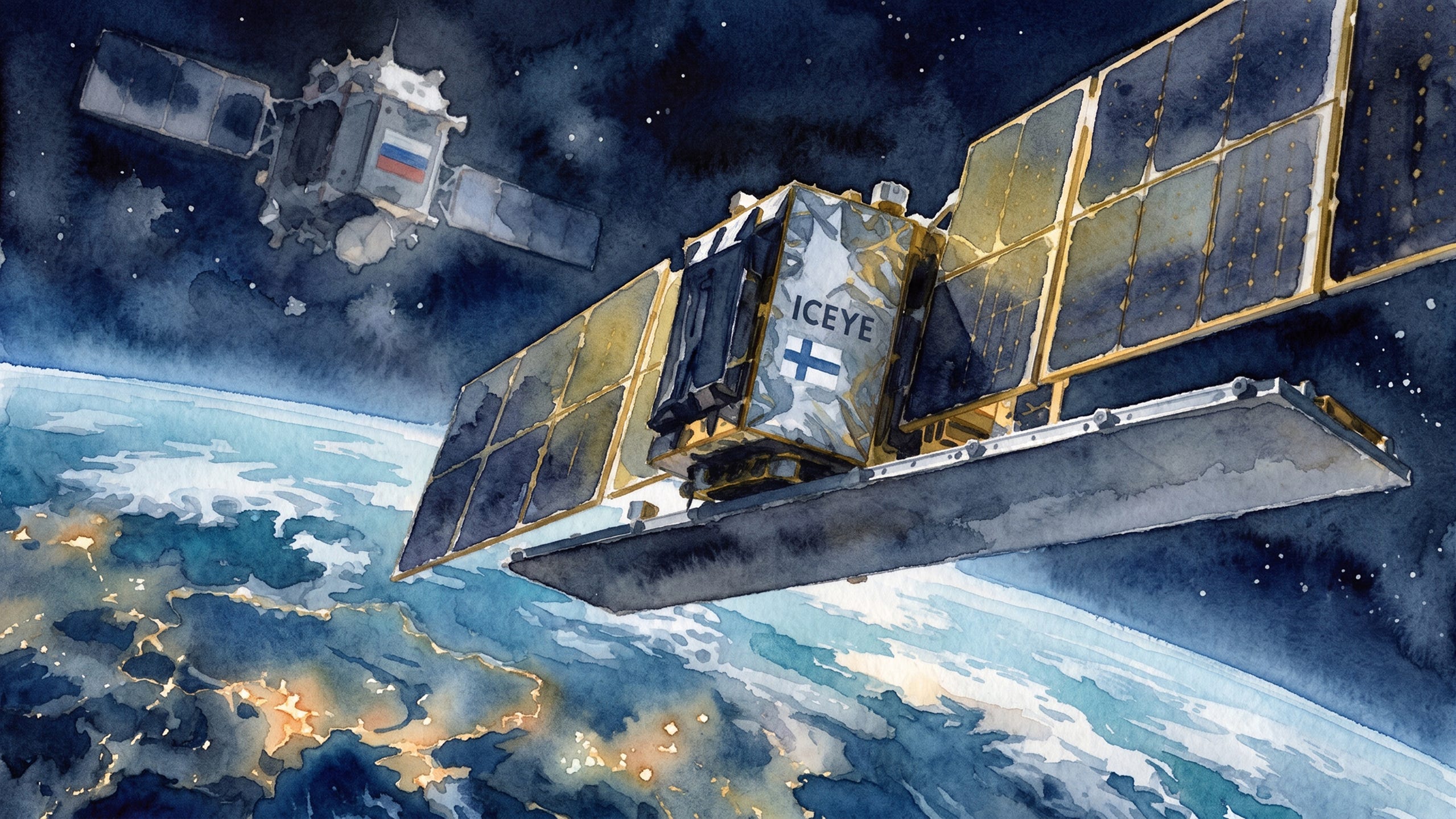
ODESA—Russia’s war on Ukraine reaches from infantry shelters beneath the earth to the spacecraft passing far above it. Drones hunt ammunition trucks along muddy roads. Air-defense crews chase incoming missiles on their screens, while in the information space, there is a fight for the opinion of the audiences watching everything unfold. And in orbit, the satellites that help Ukraine find Russian forces have begun attracting visitors.
We publish this newsletter every day at 9:05am NYC time / 4:05pm Kyiv.Your subscription fuels our work.
By October 16, the Russian military satellite Kosmos-2612 had approached within a few kilometers of ICEYE-X36, a commercial radar spacecraft operated by Finnish satellite manufacturer and radar image provider ICEYE. Over the following two days, it shifted between positions ahead of and behind its prey. Tracking company LeoLabs estimated that the separation narrowed to roughly 500 meters. At times, its trackers struggled to distinguish the two spacecraft.
The International Space Station’s crew had to close hatches and sheltered inside their Dragon and Soyuz vehicles as a
precautionagainst the debris.
The approach had taken weeks to arrange. Beginning September 30, Kosmos-2612 performed maneuvers that aligned its orbital plane with ICEYE-X36 and brought it to nearly the same altitude. Changing that alignment consumes substantial fuel, a limited resource aboard a satellite. Russia was paying to put this machine beside a particular spacecraft.
Below them, ICEYE’s customers had a war to fight. The company supplies Ukraine with radar imagery that can reveal activity through darkness and cloud cover. Its satellites transmit pulses toward Earth and construct images from the reflections, allowing analysts to examine locations that weather might conceal from optical instruments. ICEYE’s newer Generation 4 spacecraft can achieve resolution as fine as 16 centimeters, according to the company.