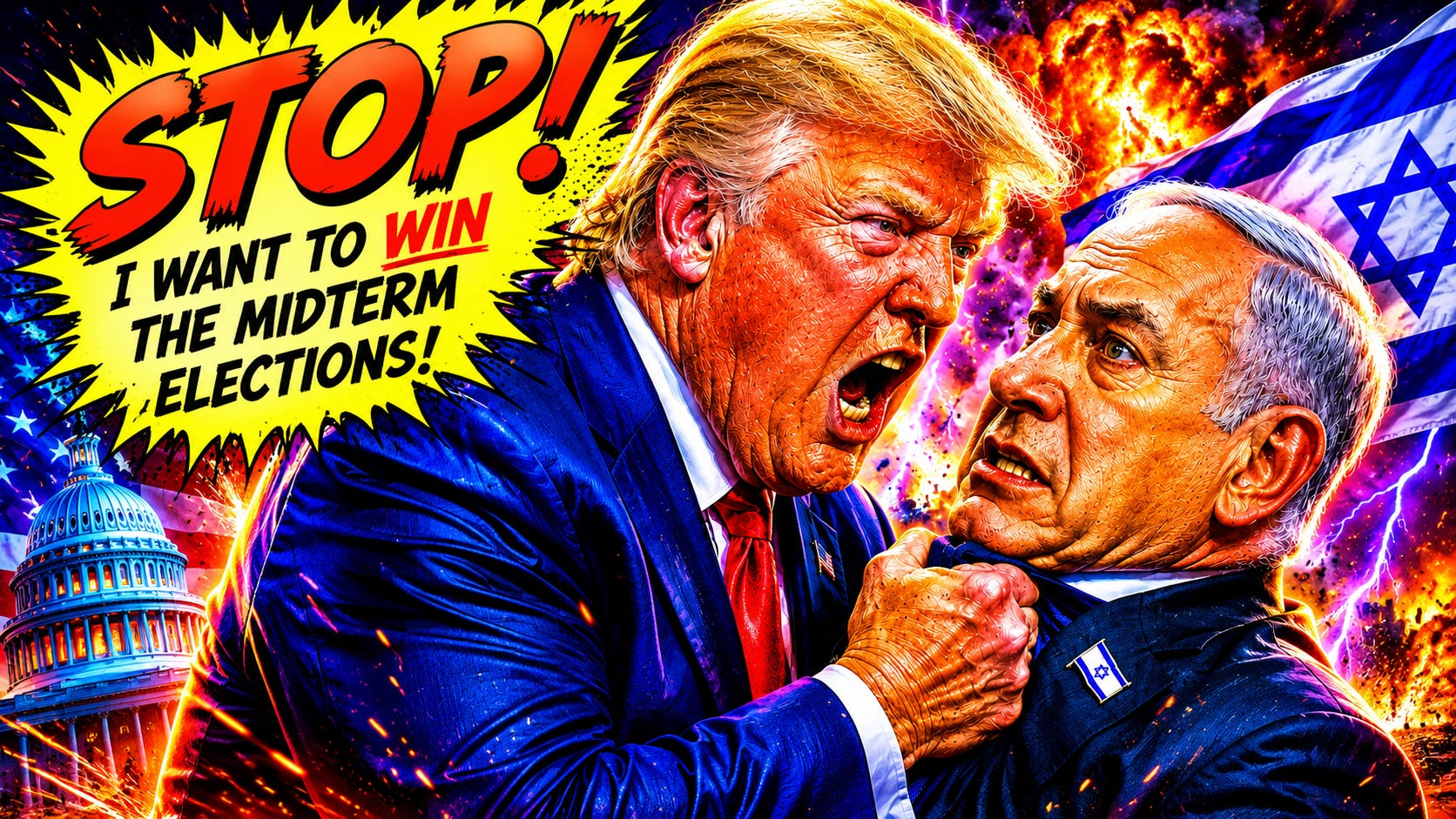
June 14, 2026. The President of the United States turned eighty years old.
For most men, an eight-decade milestone means cake, candles, and quiet reflection. For Donald Trump, it meant detonating a diplomatic bomb that would crack the foundation of the American-Israeli alliance—and potentially seal his own fate.
That morning, the White House unveiled a framework agreement with Iran so sweeping that it instantly rewrote the rules of the Middle East. No humiliating preconditions. Decades of carefully constructed sanctions—dismantled. And a staggering sanctions-relief package unlocking access to over $300 billion in frozen assets and global oil revenues for the Islamic Republic. The U.S. committed to lifting restrictions to allow Iran access to at least $300 billion in trade and un-frozen accounts.
Trump had promised the deal would be signed on his birthday, framing it as a personal victory. And he delivered—confirming the agreement at 5:29 PM Eastern Time on June 14.
But here’s what the mainstream media isn’t telling you: Iran did not want to give Trump a birthday gift. They refused to even acknowledge the framework until June 15 Tehran time, deliberately stalling the news to ruin his birthday optics and pushing the actual physical signing ceremony out to June 19 in Switzerland. The Iranian Revolutionary Guard even accused Trump of turning diplomacy into a “personal propaganda show.”
The deal includes an end to “military operations” in Lebanon and the reopening of the Strait of Hormuz. The memorandum of understanding explicitly calls for an “immediate and permanent end to the war on all fronts, including Lebanon.” The U.S. committed to ensuring financing of at least $300 billion for Iran’s reconstruction.
The old Middle East is dead. And in its place? A geopolitical realignment so profound that it has triggered open rebellion—not just from Israel, but from within Trump’s own administration.
To comprehend the gravity of this moment, you must first understand the bizarre, largely unspoken architecture of the U.S.-Israel relationship.
The public script: Shared values. Democratic solidarity. An unbreakable bond.
The private reality: Far more transactional—and far darker.
Israel’s survival depends on American generosity. Billions in military aid annually. Diplomatic cover at the United Nations, where the American veto deploys like clockwork. Intelligence sharing that would make most allies weep with envy. And the implicit promise that if Israel’s existence faced a genuine existential threat, the full might of the American military would ride to the rescue.
Without this umbilical cord, Israel would be isolated, surrounded, and outgunned in a region that has never fully accepted its presence.
So when the Iran deal was announced—a deal that could stabilize the region and give America a new strategic partner—Prime Minister Benjamin Netanyahu didn’t protest quietly through back channels.
He stood before the world and publicly declared Israel’s independence from American influence.
Israel launched a massive strike on Beirut just hours before the U.S.-Iran agreement was to be signed—an act that nearly derailed the entire deal. A Hezbollah attack had preceded it, but Trump noted it caused no damage and killed nobody. The Israeli response was disproportionate—and deliberately timed.
Trump’s reaction was volcanic. In an Axios interview, he exploded: “Why did Bibi have to do a fucking attack? I was so pissed off. I let him know. He has no fucking judgment.”
On another call, Trump called Netanyahu “crazy” and accused him of ingratitude. According to a U.S. official, Trump told Netanyahu:
“You’re fucking crazy. You’d be in prison if it weren’t for me. I’m saving your ass. Everybody hates you now. Everybody hates Israel because of this.”
Netanyahu doubled down. According to Israeli officials, he told Trump that Israel will not withdraw from Lebanon and will continue acting against Hezbollah regardless of American wishes.
**Minister of National Security Itamar Ben-Gvir **declared:
“Trump’s agreement does not bind us. Israel is not subject to the United States, and we are an independent and sovereign nation.”
Think about that. A prime minister whose nation exists because of American blood and treasure. Whose military hardware carries American serial numbers. Whose economy relies on American guarantees. He told the American president to mind his own business.
Publicly. Defiantly. As if the roles of patron and client had been entirely reversed.
This wasn’t a diplomatic misstep. It was a calculated display of power—intended to demonstrate precisely who holds the real leverage in this relationship.
Donald Trump doesn’t do diplomatic nuance. He operates on instinct—a primal understanding of dominance and submission. When challenged, he strikes back with devastating honesty.
And so he said the quiet part out loud.
At the G7 summit in France, standing alongside Qatar’s Emir, Trump declared:
“Without the United States, there would be no Israel. Without me, there would be no Israel, because no other President was willing to do what I did.”
Every single word is factually undeniable.
Historical documentation confirms this truth:
Without American backing in 1948, the fledgling state would have been strangled in its cradle. The United States was the first country to recognize Israel, just 11 minutes after its declaration of independence. President Harry Truman overrode the objections of his entire State Department to make that happen.
Without American airlifts in 1973, during the Yom Kippur War, Israel would have been overrun. The U.S. delivered 22,000 tons of military supplies in Operation Nickel Grass, including tanks, artillery, and ammunition that were literally being pulled from American military units and flown directly to Israel. This resupply, which began on October 13, 1973, was the largest military airlift in U.S. history at that time and completely reversed the balance of power.
Without American vetoes at the UN, Israel would be an international pariah. Since 1956, the United States has used its Security Council veto power to shield Israel from condemnation and sanctions on over 50 occasions—more than any other country. This diplomatic protection extends to every single one of Israel’s major military operations.
Without American military aid, Israel’s advanced defense systems—the Iron Dome, David’s Sling, the Arrow missile defense—would not exist. The U.S. has provided over $150 billion in military aid to Israel since 1948, including $3.8 billion annually in recent years.
But these truths are forbidden in Washington.
They shatter the myth of Israeli self-sufficiency. They expose the asymmetrical nature of the alliance. And they raise a terrifying question that keeps foreign policy elites awake at night:
If Israel is so dependent on America, who is really serving whose interests?
By uttering that forbidden truth, Trump didn’t just anger Tel Aviv. He sparked a rebellion inside his own administration—where loyalty to Israel often runs deeper than loyalty to the United States.
The first counterpunch came from a shocking direction.
Mike Huckabee. Former Arkansas governor. Evangelical icon. And now, the U.S. Ambassador to Israel—a man who draws his salary from American taxpayers.
His statement was so extreme it bordered on sedition.
Speaking at the International Conference on Israeli Heritage in Judea and Samaria—a controversial event held in the occupied West Bank, the very territory at the heart of the Israeli-Palestinian conflict—Huckabee declared:
“Without Israel, without the Jewish foundation, there would not be America. We owe our very existence to what happened in this land.”
Not “Israel needs America.” Not “the alliance is vital.” But an outright inversion of reality. A sitting American ambassador publicly declared that his own country’s existence depends on a small Middle Eastern nation.
To global audiences unfamiliar with American political dynamics, this sounds delusional. Because it is. But it reflects a deeply entrenched ideology within certain corridors of power: the belief that Israel is not merely an ally, but a spiritual and civilizational anchor. That America’s fate is mystically bound to Israel’s survival.
This isn’t foreign policy. It’s theological capture wearing a diplomatic suit.
And Huckabee isn’t alone. His statement was a signal—a flare launched by the pro-Israel lobby within Trump’s own government. A warning that the president does not speak for them, and that their ultimate allegiance lies elsewhere.
Why did Trump’s words shake the system so violently?
Because history is littered with the political corpses of presidents who crossed Israel.
Kennedy committed the ultimate sin. He demanded that Israel open its Dimona nuclear reactor to international inspectors.
The full story:
In 1960, American intelligence discovered that Israel was building a nuclear reactor in the Negev Desert. President Eisenhower demanded inspections. Israel refused. When Kennedy took office, he continued the pressure, writing multiple letters to Israeli Prime Ministers David Ben-Gurion and Levi Eshkol, insisting that no nation—ally or not—could possess an unchecked nuclear arsenal.
Kennedy wrote to Ben-Gurion on March 22, 1963: “I am concerned about the continuing Dimona reactor. I am determined to maintain our commitment to prevent proliferation of nuclear weapons.”
Israel resisted, misled American scientists who visited Dimona in 1962, and kept dodging the requests. Ben-Gurion famously told Kennedy: “We will not allow any foreign element, however friendly, to interfere with our security.”
In November 1963, Kennedy was shot dead.
The official story says lone gunman. But the questions have never stopped. Various sources including ex-CIA officers have stated that Israel had a motive to kill Kennedy because he was opposed to its nuclear weapons program and that the files point toward Israel. The Warren Commission’s findings have never fully silenced the doubts.
What we know for certain: Within months of Kennedy’s death, Israel’s nuclear program had free rein. The Dimona inspections were dropped. By 1967, Israel had enough material for a nuclear bomb. The man who stood in the way was gone.
During the Yom Kippur War, Nixon briefly resisted Israeli demands for an emergency arms airlift.
The full story:
On October 6, 1973, Egypt and Syria launched a surprise attack on Israel. Within days, Israel was running critically low on ammunition, tanks, and aircraft. Prime Minister Golda Meir begged Nixon to resupply Israel. But Nixon, facing immense pressure from the Arab oil embargo and the threat of a Soviet intervention, hesitated.
He tried to leverage the crisis for a broader peace. For four critical days—October 8 to October 12—Nixon resisted the Israeli demands, negotiating terms, demanding concessions, hoping to use the emergency to force Israel to the negotiating table.
Within months, Watergate consumed his presidency.
The break-in at the Democratic National Committee headquarters in June 1972 was just the beginning. But the cover-up and the unraveling of Nixon’s presidency happened at an astonishing pace in 1973—right as he was resisting Israeli demands. The intelligence community that destroyed Nixon had deep ties to Israeli interests. Nixon himself believed he was targeted for his independence.
BILL CLINTON (1998) During the fierce Wye River Memorandum negotiations, Clinton pushed Israel to its absolute limit, demanding Netanyahu hand over 13% of the West Bank to Palestinian control.
The full story:
In July 2000, Clinton convened Israel’s Prime Minister Ehud Barak and Palestine Liberation Organization Chairman Yasser Arafat at Camp David. The goal: finalize a peace agreement that would end the Israeli-Palestinian conflict. Clinton personally invested enormous political capital, proposing that Israel withdraw from 90-94% of the West Bank and 100% of Gaza, with the remaining territory to be traded for Israeli land.
Barak accepted. Arafat didn’t. But Clinton’s pressure on Israel was unprecedented. He even threatened to withdraw American support if Israel didn’t compromise.
Then suddenly, a stained blue dress appeared.
In 1998, the Lewinsky scandal had already erupted. Right as Clinton was turning the screws on Israel for these concessions, the Lewinsky scandal was systematically weaponized in Washington, pushing his presidency to the brink of impeachment.
What most people don’t know—what was reported then quickly buried—is that Israeli intelligence actively fanned the flames of the Lewinsky scandal. A critical book on the Clinton family claims that Israel tapped White House phones and used recordings of Clinton’s conversations with Monica Lewinsky to blackmail the president.
The evidence:
The Starr Report itself records Monica Lewinsky as saying that the President “suspected that a foreign embassy... was tapping his telephones.”
In a taped conversation with Lewinsky, Clinton explicitly stated: “I suspect a foreign intelligence service, probably Israeli intelligence, or maybe the Russians, is tapping the phones.”
Linda Tripp, the woman who secretly recorded Lewinsky’s conversations, had suspicious ties to Israeli intelligence. And the timing of the leak of the scandal—right at the peak of peace negotiations—was deliberately timed.
Netanyahu openly used the highly pressured environment to demand the release of Jonathan Pollard, a convicted Israeli spy, even threatening to walk away from the peace talks if Clinton refused. Clinton resisted the release at the time, but the institutional pressure was so relentless that Pollard was eventually released in November 2015 after serving his mandatory 30-year sentence.
Kennedy: Pressured Israel on nuclear inspections → Assassinated
Nixon: Resisted Israeli arms requests → Political destruction through Watergate
Clinton: Pushed for Palestinian state → Lewinsky scandal weaponized
Presidents who defy Israel find their careers—or their lives—cut short. Most learn the lesson. They stay quiet. They stay friends. They stay alive. Everyone, after all, loves their life. And the shadow of Mossad’s long memory hangs over every critic.
Trump was no exception. For years, he wasn’t just a supporter of Israel—he was its most theatrical, unconditional champion.
His achievements for Israel are unmatched:
Jerusalem Embassy: In December 2017, Trump formally recognized Jerusalem as Israel’s capital and ordered the relocation of the U.S. embassy from Tel Aviv. The move, which occurred on May 14, 2018—the 70th anniversary of Israel’s independence—broke with decades of international consensus and sparked worldwide protests.
Golan Heights: In March 2019, Trump recognized Israel’s sovereignty over the Golan Heights, territory Israel captured from Syria in 1967 and annexed in 1981. This reversed half a century of U.S. policy.
Iran Nuclear Deal: In May 2018, Trump withdrew the United States from the Joint Comprehensive Plan of Action (JCPOA), the Iran nuclear deal that had been signed by the Obama administration. This was Israel’s greatest diplomatic victory.
Military Aid: Under Trump, the U.S. provided $3.8 billion in annual military aid to Israel—the largest amount in American history—and continued to block virtually all UN resolutions critical of Israel.
Abraham Accords: In 2020, Trump brokered the Abraham Accords, normalizing relations between Israel and the United Arab Emirates, Bahrain, Sudan, and Morocco—a major diplomatic breakthrough.
Netanyahu himself called Trump the “greatest friend Israel ever had in the White House.”
But Trump’s loyalty went deeper than policy. It was personal.
Trump didn’t just love Israel. He loved Bibi. He saw in Netanyahu a mirror—a tough, rule-breaking survivor who refused to play by the establishment’s rules.
So when a massive corruption case threatened to send Netanyahu to…