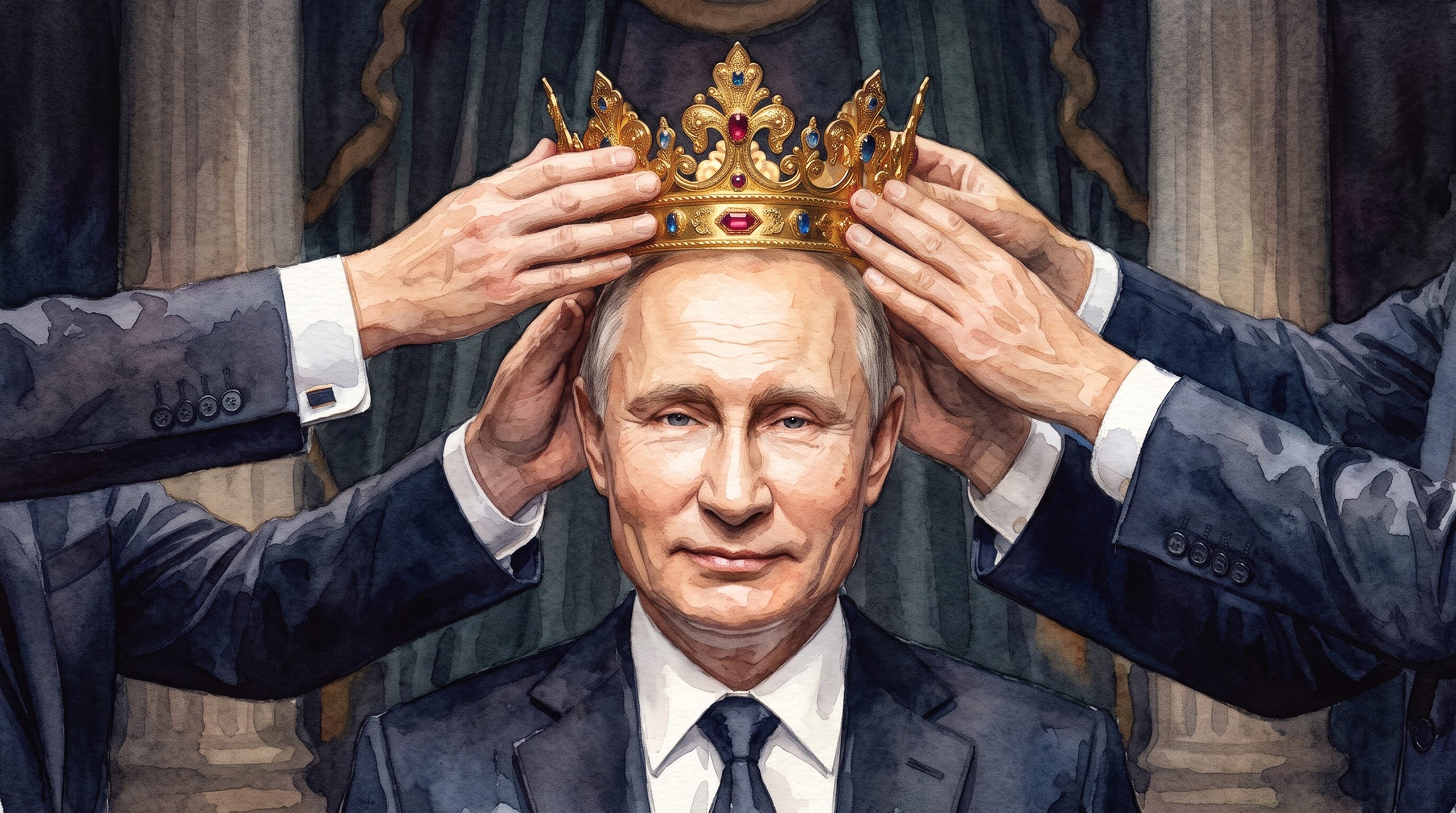
ODESA—At the latest peace talks in Abu Dhabi, Russia behaved as though it had assembled the defeated collective West to hear its terms. Moscow demanded land its army has not captured, a permanent bar on Ukraine joining NATO, and a rollback of the alliance’s military posture toward 1997. Putin also rejected foreign troops in Ukraine after a settlement. It was the usual absurd spectacle: The country that started the invasion, losing on the battlefield, behaving as if it had won already.
We publish this newsletter every day at 9:05am NYC time / 4:05pm Kyiv.Your subscription fuels our work.
Europe, the continent most directly affected by Russia’s actions, was not even permitted to challenge this absurd theater directly. Russia refused to meet the European delegation. American envoys subsequently announced that Europeans could join the next round. European weakness and American naiveté had allowed Putin to claim the authority to dictate who deserved a voice in discussions about Europe’s own security.
Consider the reality behind this swagger. The Institute for the Study of War assessed net Russian territorial losses in September and October. Its November 11 assessment credited Ukrainian counteroffensives with liberating more than 1,000 square kilometers this year. The Kremlin demands the treatment of a victorious power while Ukrainian soldiers keep demonstrating the limits of its force.
Anyone who has been studying Russia’s behavior in during negotiations understands by now that Russia’s demands in negotiations are always inversely proportional to how it fares on the battlefield. The weaker its position becomes, the more it demands, counting on Western hesitation to turn military setbacks into political gains.
The stronger coalition is allowing a weaker adversary to turn military frustration into negotiating advantage.
Russia’s attacks on Ukraine’s energy system serve the same purpose. The political calculation is to make civilian suffering unbearable until outsiders pressure Kyiv to surrender more. Whenever diplomacy rewards that pressure, Moscow learns that terror can accomplish what its infantry cannot.
This grotesque situation is a political choice. European weakness has tolerated the humiliation. American naiveté has dressed it up as diplomatic progress.
Imagine Germany in 1944 dictating peace terms to the Allies: recognize our conquests and weaken the armies resisting us. Now imagine Allied leaders treating Hitler’s demands as a constructive starting point.
Together, they have handed Putin a negotiating advantage his army has failed to earn. Their conduct encourages him to demand more precisely when his battlefield difficulties should force him to accept less.
Europe’s weakness comes from the gap between its resources and the commitments its governments will enforce. Reliance on Washington turns every American change of course into a European crisis. Its leaders were still organizing a common negotiating team on November 13. Moscow watches this fragmentation and calculates that the coalition will lose patience before it does.
Washington’s error is to confuse access to Putin with influence over him. Witkoff and Kushner reportedly relied on Kremlin interpreters without expert support during their meetings with Putin. America has the expertise to recognize an imperial ultimatum. Its envoys should arrive equipped to challenge one, with consequences already agreed if Moscow refuses reasonable terms.
The Kremlin exploits this combination of Western urgency and uncertain resolve. Raise an outrageous demand, let the other side negotiate downward from it, and the remaining demands begin to look moderate. Threaten to leave the table, and someone searches for a concession to keep the process alive. Our eagerness becomes their bargaining power. Putin does not need to believe that Russia can defeat the combined strength of the West. He needs to believe that its leaders will keep declining to use that strength.
Each concession offered simply to preserve the talks reinforces that belief. We are manufacturing the confidence we then complain about.
It is now time to establish a legally defensible mechanism to
transfer the frozen Russian assetsinto a fund for Ukrainian weapons during the war and reconstruction afterward.
Imagine Germany in 1944 dictating peace terms to the Allies: recognize our conquests and weaken the armies resisting us. Now imagine Allied leaders treating Hitler’s demands as a constructive starting point. We are entertaining that same diplomatic absurdity when Moscow demands territory it has failed to capture and authority over Europe’s defenses. The Allies had already adopted Germany’s unconditional surrender as their policy at Casablanca in 1943. Russia’s military position is different, and its nuclear arsenal requires different calculations. But historical differences do not entitle Putin to dictate the security of the countries resisting his aggression, they simply require a different, yet similarly decisive approach.
The current Western negotiation approach must be completely changed. Every Russian refusal should increase the cost of continuing the war. Washington and European capitals must agree with Kyiv on a position designed to preserve Ukrainian sovereignty and defeat Russian aggression, then give it the material backing to survive Moscow’s threats.
Russia’s continued pursuit of sanctions relief, alongside proposals to restore its gas sales to Europe, reveals a key weakness for those willing to spot it. Moscow wants access to the Western wealth it claims it can do without. It wants European customers paying into its economy while it demands the right to threaten their security.
That appetite for renewed business gives us leverage. We should use it ruthlessly. Access to our markets must carry our conditions. Sanctions relief should follow completed obligations, with penalties for breaches authorized in advance. Europe owes Russia neither a market for its gas nor a return to energy dependence. Remind Moscow that every day it wastes at the negotiating table gives Ukraine’s “long-range sanctions” more time to destroy the energy infrastructure financing its war.
Negotiations usually begin with maximalist demands that are narrowed toward an agreement. Moscow has moved in the opposite direction, reviving its original ultimatums and adding restrictions on Europe’s defenses.
The financial burden should move in the same direction. More than €210 billion in Russian central-bank assets are immobilized in the EU, stored away in Belgium. Existing schemes draw on the revenues they generate. It is now time to establish a legally defensible mechanism to transfer the frozen Russian assets into a fund for Ukrainian weapons during the war and reconstruction afterward.
Russian reserves should buy the interceptors that stop Russian missiles, then rebuild the homes those missiles destroyed. The aggressor’s wealth should help defeat its aggression. Our taxpayers should not carry the burden while Moscow’s money waits intact for a diplomatic bargain.
Negotiations usually begin with maximalist demands that are narrowed toward an agreement. Moscow has moved in the opposite direction, reviving its original ultimatums and adding restrictions on Europe’s defenses. It treats the continuation of talks as an opportunity to demand more. Western negotiators cannot keep responding with concessions and call that good faith. We should raise our own demands when Moscow raises its price.
Every new Russian ultimatum should therefore trigger a tougher Western position, backed by additional economic pressure and stronger support for Ukraine. Further obstruction should make the conditions for normalization more demanding. Attendance at another summit earns nothing. Moscow must learn that prolonging the process will leave it with less to gain and more to concede.
The lesson will travel beyond Moscow. Every adversary watching these negotiations is assessing whether violence brings concessions and whether Western threats carry consequences.
Ukraine is the immediate test of whether the West still intends to defend its people and its freedom. We cannot keep telling ourselves that restraint will be appreciated by adversaries who interpret every retreat as permission to advance. Their confidence grows when our power remains unused.
Every enemy of the West must face the same certainty, whether a rioter burning a street in Paris or a regime in Russia or China calculating the rewards of coercion. At home, defend citizens through firm law enforcement. Abroad, make hostile states face the military and economic consequences of aggression. Attacking us must cease to be a profitable wager.
Ukrainians have shown what determination can achieve against a larger enemy. The West has vastly greater resources to bring to their defense and its own. We must use them to ensure that the resistance Putin could not break becomes the failure he cannot negotiate away.
We are stronger, and the price of attacking us must be defeat.
Nikolaus Muchitsch is chief of staff and strategy at Under Fire News.
Under Fire News joins the Dzyga’s Paw charity to provide Ukraine’s Da Vinci Wolves 1st Assault Regiment with crucial life-saving equipment. This fundraiser’s goal is $10,000 out of our $250,000 overall target.
The funds collected—tax-deductible for U.S. donors—only go to the non-lethal support: drones to assist with essential recon, supply delivery, and evacuation to save lives and enable the Da Vinci Wolves to protect free people.
**Xi Hosts Trump and Putin for Nuclear Talks—**Xi Jinping hosted Donald Trump and Vladimir Putin for theirfirst trilateral meeting in Shenzhen on November 19, with Trump presenting nuclear arms reductions and the wars in Ukraine and Iran as subjects for discussion. Putin invoked the three countries’ shared status as World War II victors to claim joint responsibility for international peace.Earlier, Trump called Putin “my friend” during separate talks that Kremlin aide Yuri Ushakov said focused primarily on Ukraine. Ukrainian representatives were absent. Washington had already played down expectations of an immediate arms-control agreement, describing the gathering as an opening conversation. The diplomatic significance extends beyond any eventual communiqué: Beijing convenes the meeting, Moscow gains recognition as an indispensable negotiating partner, and Trump places considerable weight on personal relationships. That format risks reinforcing Putin’s preferred premise that major powers can negotiate Europe’s security over the heads of the countries whose territory and sovereignty are at stake.
**Kerch Bridge Hit Again—**Russian-appointed governor Sergei Aksyonov reportedanother Kerch Bridge attackon November 18, prompting a fresh traffic suspension. The earlier Ukrainian strike destroyed a custom-built road arch spanning 227 meters and weighing more than 5,000 tons, creating a reconstruction challenge far greater than previous damage.
Anengineering assessment estimates replacement could take over two years: the original arch required roughly 14 months for assembly, finishing, and installation, excluding component manufacturing and preparations for specialized lifting equipment. Earlier repairs involved standard spans and supports that could be replaced within months. Sanctions and the risk of further Ukrainian strikes could extend reconstruction considerably, although the two-year figure is an analytical estimate rather than an announced Russian timetable. The railway is a separate issue: Russia reported reopening it on November 18, so the road arch’s destruction does not establish permanent closure of the entire crossing. Repeated attacks nevertheless threaten to turn restoration into a prolonged struggle to protect construction work as well as rebuild the bridge.
**Europe Gathers in Berlin as Trump Talks in China—**Ukraine’s European allies aregathering in Berlin on November 19to reaffirm support for Kyiv and coordinate their response to the Trump–Xi–Putin summit in Shenzhen. US envoys Steve Witkoff and Jared Kushner are expected to join discussions with Ukrainian and European officials, while Germany says the meeting will focus on robust, legally binding security guarantees taking effect after a ceasefire.
Those plans include a multinational force to help rebuild Ukraine’s armed forces. Britain is also expected to detail support involving long-range strike drones, alongside reconnaissance and logistics systems. The gathering follows the European Commission’s proposed €45 billion loan for Ukraine and fresh military commitments from its partners. European governments supply the bulk of Ukraine’s aid, yet Moscow continues to dispute their participation in future negotiations. Berlin’s task is therefore both military and diplomatic: sustaining Ukraine’s ability to fight while securing a European role in decisions that will shape the continent’s security.
**Willing to Help, Struggling to Lead—**Ukraine’sCoalition of the Willing faces doubts about its political strengthas more than 35 supporting countries gather in Berlin. Four European officials described the authority of its French, German, and British co-chairs as weakened: Friedrich Merz has suffered severe electoral setbacks, Emmanuel Macron faces deep unpopularity, and Andy Burnham is still establishing himself internationally after becoming prime minister in July.
The meeting is the coalition’s first at leaders’ level since August, following a loss of momentum as the Iran war absorbed attention. Meanwhile, thousands of troops are exercising in Poland to rehearse a possible mission securing peace in Ukraine. British officials reject suggestions that their commitment has diminished, and a senior Ukrainian official praised all three governments’ support. The tension is between substantial assistance already delivered and the political durability needed to guarantee Ukraine’s security for years. A multinational force would require governments able to sustain deployments through elections and crises, making domestic authority part of the credibility of any ceasefire guarantee.
**Ukraine Aid Becomes Leverage in Pentagon Oversight Fight—**Senior House Republicans arethreatening to strip Ukraine-related provisions from the annual defense policy billto pressure Democrats into abandoning stronger congressional oversight of Donald Trump and Defense Secretary Pete Hegseth, according to seven people familiar with the negotiations.
House Speaker Mike Johnson and Foreign Affairs Committee Chairman Brian Mast are reportedly targeting measures covering intelligence sharing, expanded military assistance, and sanctions against Russia. In exchange, they want Democrats to drop proposed limits on executive war powers and tighter scrutiny of Pentagon personnel decisions, alongside restrictions on Hegseth’s travel spe…