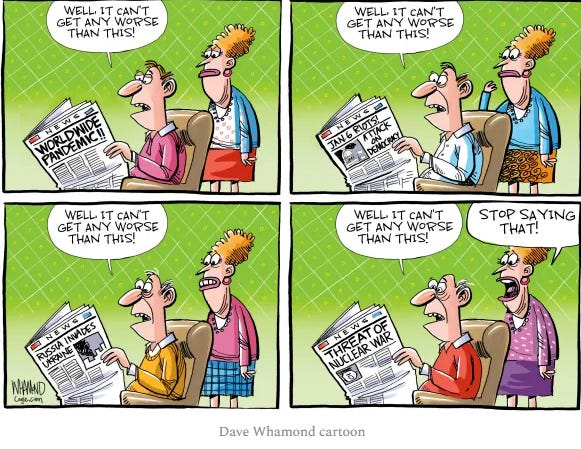
“The optimist proclaims that we live in the best of all possible worlds; and the pessimist fears this is true.” James Branch Cabell
Elections are supposed to settle things. Lately, they seem to do a better job of showing us how divided we are than of resolving anything. I’m thinking about the U.S. elections and their aftermath, coming next week, but also about elections more broadly. The results in Serbia and Brazil were surprising: the left beat right-wing candidates and reversed a recent trend. It strikes me that the fringes on both sides are gaining ground, not just the right. I’m not sure that’s an improvement.
The Israeli elections are particularly on my mind. Netanyahu’s Likud still has the most seats, but his coalition has lost its majority. The opposition gained seats, though not as many as expected, and still trails Likud. The real tectonic shift, however, is the surge in Arab turnout and the gains by Arab parties, which are expected to win 17 to 19 seats.
The question of how to fully integrate Arab Israelis into the country’s political life has been simmering for years. Now it must be confronted directly. This bloc could determine which side governs. But especially in the aftermath of October 7th, the prospect of including Arab parties in a governing coalition will be anathema to many Israelis.
I don’t want to take this too far down a political rabbit hole, but at some point, the tendency to paint all Arab Israelis, or all Muslim Israelis, as automatically pro-Hamas or opposed to Israel’s existence has to stop. We’ve seen this kind of broad-brushing in our own country countless times, with people judged by their color, religion, gender, or race rather than as individuals. It is wrong, and almost always counterproductive, if not destructive.
Israelis need to come to the same understanding. Demography is a reality, and it has political consequences. Denying that reality won’t make it disappear.
I’ll be watching closely to see how this plays out. Sadly, I’m pessimistic.
Markets didn’t settle much overnight either. Alphabet and Microsoft told the same AI story that evening and got opposite verdicts; the difference came down to who could pay for it.
**THE AI BUILD IS NOW A FUNDING STORY, PAID FOR AT CREDIT’S BOTTOM TIER.**I’m short private credit and a weak regional. I’M WRONG IF CCC loans tighten back inside 2,000bp by mid-November.**A FED THAT WON’T HIKE YET LEAVES THE LONG END HEAVY.**Long Regions, short the builder. I’M WRONG IF the 10-year closes under 4.80% with the 2-year under 4.60%.**TODAY’S BRENT SETTLE DECIDES THE OIL CLOCK.**Long Brent upside, short United Airlines. I’M WRONG IF any Brent settle prints at or under $110 before the 5 November completion.
My main argument this morning is about who pays for the AI build. Alphabet’s quarter turned it from an earnings question into a funding question, and I think the bill shows up first in the bottom tier of credit, which is where I’m already short. The Fed and the long end are the second story; they set the price of that funding. Oil is a separate thesis with its own clock, and today’s settle decides it.
THE EVIDENCE.
Google Cloud grew 103% and Alphabet still got hit, because $51.3 billion of quarterly capital spending took free cash flow negative, with a 2026 range of $195 billion to $205 billion and more flagged for 2027. Microsoft spent $45.2 billion against an outlook above $50 billion and was paid for it; Oracle rose about 11% on a promise of more than $30 billion of free cash flow in fiscal 2029.
‘Cash is king’is Reuters’ headline, and I’d put it the same way.Yields on the bonds and loans funding the buildout have gone into double digits, bankers are finding it harder to lay the risk off on insurers, and Citadel Securities is warning clients that even the biggest names can get caught (Bloomberg). Five-year protection on Oracle, SpaceX and Broadcom now prices like junk.
Firms and governments have already raised more debt this year than in all of 2025, and AI borrowers are an increasingly large slice of it.
And the price of what all that capital produces is falling. Why would anyone finance a factory whose output price halved in five months, at a 5% long rate? I’d want a very good answer.
The list of spenders who can pay from cash is short, and one of the names on it is private.
THE TRANSMISSION.
The hyperscalers can fund themselves. The neoclouds and data-center developers borrow, and Elon Musk said this week that hundreds of neoclouds could go under if fresh financing dries up (Bloomberg). Neocloud shares fell after Microsoft’s spending came in light (CNBC).
Their lenders are private credit funds and the banks that syndicate to them. Altaf Kassam’s point in
Reutersis the one I’d underline: with so much of the build financed privately, the warning arrives late.The suppliers paid up front are the other side of it. Vertiv’s organic orders more than doubled and GE Vernova booked $29 billion of orders, up 96% organically.
THE CASE AGAINST.
Financial conditions are tightening at the margin and are not tight; TS Lombard’s Davide Oneglia and Freya Beamish read Warsh exactly that way, and Treasury Secretary Bessent said he doesn’t see AI credit as a problem. On that reading the market is sorting good spenders from bad ones inside equity, high yield tightened to 318bp for 27 October, and Microsoft’s shortfall was transformers and third-party capacity arriving late (deferred spending, still coming).
Both can be true for weeks: equity can police capex while credit stays open to the strong names. What tells them apart by 15 November:
My reading: high yield back over 340bp with CCC loans past 2,500bp.
Theirs: high yield under 300bp with Oracle’s five-year protection back under 200.
I’m 55/45 my way and I hold it loosely, because the index has tightened three prints running against me.
GDP beat, and spending came in a tenth light. Core PCE rose 0.3% in September and 3.1% year over year, both in line, with headline PCE at 3.6% year over year. That keeps December where Wednesday left it, priced and not locked.
The
ECBdecides at9:15, and I care more about what Lagarde says on French spreads than about the rate. The7-yearsells at1:00.Amazon, Intel, Coinbase and Starbucksreport after the close (Amazon’s capex guide is the third read on who pays), and theBOJmeets tonight.
The Fed paused with two dissents for a hike, and nobody I read agrees on what that means.
Henrik Zeberg says
the Fed just took aim at the bubble, Greenspan in 1999 again. Capital Flows calls the pause a policy error.Nomura pencils in one more hike in December and then nothing through 2027; Oxford Economics expects two, and I’m closest to Nomura.
My friend Ozan Tarman’s read of the press conference: Warsh’s vagueness steepened the curve first and then flattened it.
John Authers timed Warsh’s answer to ‘why not hike today?’ at three minutes and 16 seconds, none of it an answer (Bloomberg). The line markets kept was that the goal isn’t to throw sand in the gears.
Who buys the paper? Countries most aligned with the US bought a net $174.3 billion of Treasury notes and bonds in the first eight months, the least since 2021; Japan bought $389 million and South Korea sold $23.8 billion, the most on records back to 1977 (Bloomberg, via the Japan Times).
Gulf exports are back at or above prewar volumes and Brent is still priced like April, when exports were half today’s (WSJ). The inventories, at four-decade lows, explain it.
Distillates are no better, and the Midwest is worse.
European gas went above €100 on the same war risk, a cold-winter forecast and thin storage.
THE REST OF THE TAPE.
Iran: Vance’s letter went to the secretary of the Supreme National Security Council, the Revolutionary Guard’s longest-serving commander (
WSJ). Al Arabiya says Tehran could implement its proposal within four days, with a meeting in Turkey before 4 November.Defense Secretary Hegseth fired Lt. Gen. Brett Sylvia, the Joint Staff’s chief planner, after clashes with Elbridge Colby; he is at least the fifth general pushed out this year (The Atlantic).
Gallup has 43% of voters saying their own representative deserves another term and 15% saying it of most of Congress, both record lows for a final pre-midterm reading.
North Korea fired about 10 short-range missiles toward the East Sea, and a high-speed train crash near Toledo killed at least 68.
Truth Social is selling faster access to the president’s posts to Bloomberg and two trading firms for up to $100,000 a month (
Reuters). Shiller’s CAPE is at 41, a reading last seen in 1999.Why I care: a reply inside four days is the transit-accord path, the one political switch in my book. With a planner fired in Washington and strikes penciled in after the midterms, I’m not pricing it before the settle.
The same AI build sent one supplier up 16% overnight and the security names down hard.
**ALPHABET AND MICROSOFT.**About 11% down against about 3% up on the same night, cloud growth of 103% against 48%. About 24% of US mutual funds close their fiscal year in October and Alphabet is now negative for 2026, so it is a tax-loss candidate into Friday. I wouldn’t buy the gap before Amazon reports.**D.R. HORTON.**Fiscal fourth-quarter EPS of $2.67 against $3.02 expected, orders down 7%, cancellations up to 23%, and a fiscal 2027 revenue guide of $30 billion to $32 billion against $31.9 billion expected; the stock is near $141 before the open. I’m short it, and Wednesday’s long end went the wrong way for the buyer again.
FORTINET. Down about 25% on a services shortfall, in the same week the NYT reported AI is finding software flaws faster than engineers can fix them: Microsoft published 1,461 patches this month against 1,247 in all of 2025, and Irregular says Z.AI’s open GLM-5.3 model completed 3 of 13 multi-stage attack simulations (Reuters). More demand and a worse stock. I have no position, and I think the momentum money that piled in on the hacking headlines is leaving faster than 2027 budgets arrive.
Behind the wall this morning:
THE BOOK: 13 live lines, 1 new today, each with the factor it monetizes, its size and the condition that kills it.
FLOWS AND POSITIONING: who rebuilt the Nasdaq long, why the systematic sellers stopped, and what four in ten negatively correlated pairs do to a stock picker.
FINANCIALS: the money center I priced and passed on, the private credit tail, and the office loans that can’t refinance without fresh equity.
Everything above this line stays free. Below it is where my own capital goes, $450 a year at marketmusing.com.
Disclaimer: Opinions are mine alone and may change. It does not constitute an offer to buy or sell or a solicitation of an offer to buy or sell any security, loan or asset or to participate in any trading strategy. It is not intended to form the basis of any investment decision, should not be considered a recommendation, and does not constitute an offer or solicitation with respect to the purchase or sale of any investment, nor is it a confirmation of such terms.