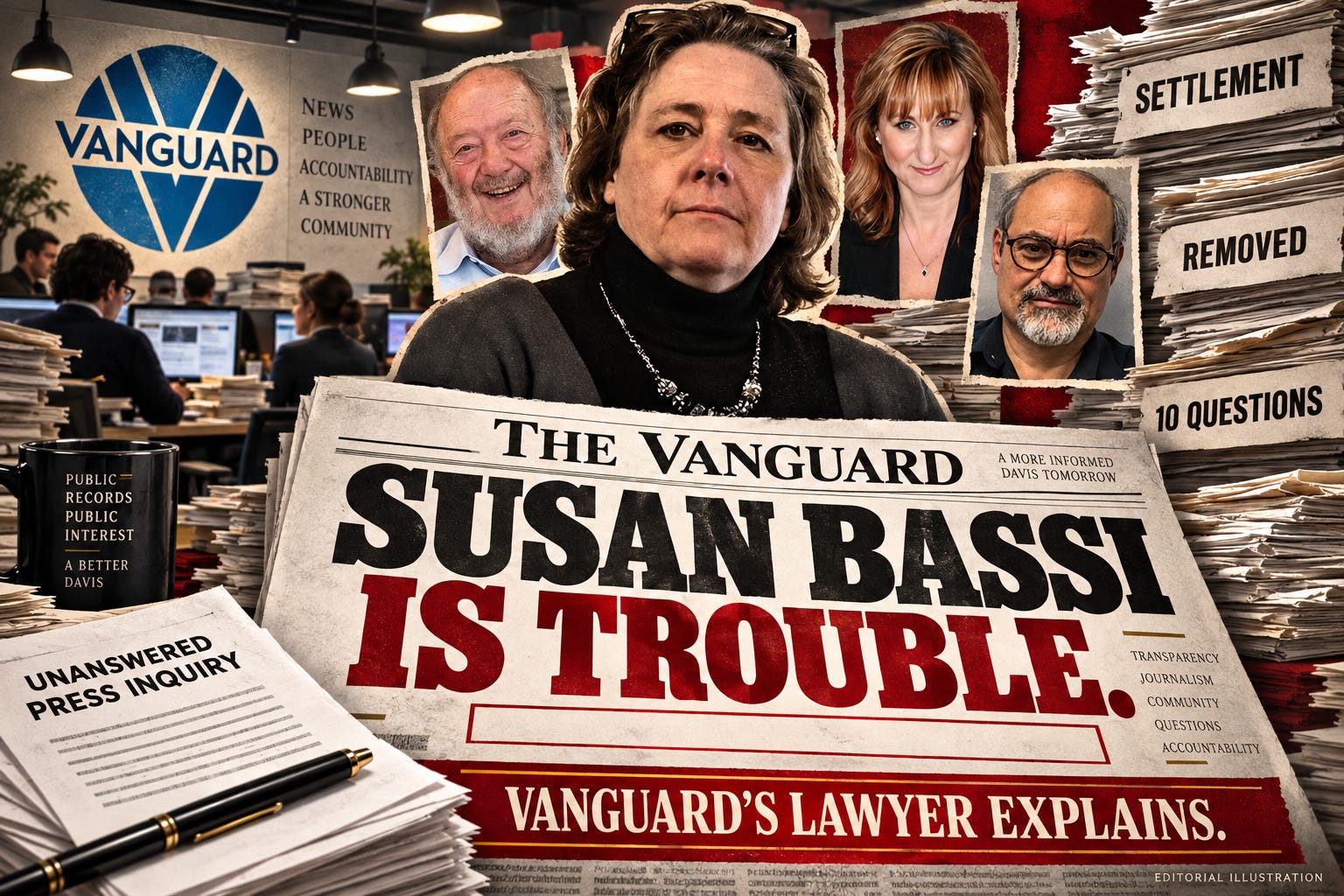
LUTHMANN NOTE: I have fought publicly with Susan Bassi, and readers deserve that disclosure. They also deserve to see the documents and hear Vanguard’s lawyer explain why the publication settles a claim and pulls reporting it cannot confidently defend. I sent Bassi ten questions and gave her the opportunity to answer. She supplied no response. Her silence leaves her lectures about journalistic standards without the explanation this record demands. Families who trust reporters with their lives deserve evidence, fairness, and accountability. Bassi’s byline gives her no exemption from any of them. This piece is “Susan Bassi is Trouble,” first available on The Family Court Circus.
Susan Bassi is becoming an expensive problem for a publication that doesn’t pay her. Davis Vanguard reached a pre-suit settlement over her reporting on attorney Julie Levy, posted retraction notices, and began sweeping removals of her work after its lawyer concluded that defending further claims could threaten the newsroom’s survival.
Meanwhile, Santa Clara County court records show Bassi facing an active misdemeanor prosecution, with a jury trial scheduled for October 26. The criminal case is separate, but the combined picture is unmistakable: the woman who makes a public business of questioning other people’s conduct now has substantial questions to answer herself.
We gave her every opportunity. I sent Bassi ten questions addressing the removals, her reporting practices, and her treatment of colleagues and sources. She has not responded as of publication. That silence becomes especially striking because Vanguard’s lawyer identifies uncertainty about whether subjects of her reporting received opportunities to comment as one reason he cannot confidently defend the work.
In an interview, Vanguard’s pro bono counsel Paul Nicholas Boylan confirmed a negotiated settlement after a prospective plaintiff challenges Bassi’s reporting. He keeps that person unnamed; our reporting identifies Levy, whom Vanguard expressly apologizes to.
Boylan described searching for documentation to support the disputed statements and their damaging implications. “I was unable to come up with enough facts to be able to establish the truth of the statements themselves,” he says. For a publisher facing a defamation demand, that uncertainty carries consequences measured in legal bills, staff time, and the possibility of closing its doors.
Boylan’s review goes to the foundation of the reporting: supporting records, interview documentation, and whether the people being criticized receive a meaningful chance to answer. He says he sought and is continuing to seek information from Vanguard personnel, other reporters, and Bassi herself. His concern reaches beyond explicit accusations to what an article leads readers to believe through context and implication. A stack of documents cannot defend a conclusion those documents fail to support.
That makes the missing assurance about requests for comment central to this story. Boylan cannot confirm that the necessary reporting work, including opportunities to respond, supports the articles sufficiently to manage the litigation risk.
His account raises a concrete question about Bassi’s methods: does she test accusations against the people she targets before presenting them to readers? Our inquiry asks for the questions, deadlines, and replies.
Bassi supplied none.
Boylan acknowledged indications supporting the disputed reporting and emphasizes that Vanguard has not found Bassi defamed anyone. His conclusion concerns the danger of litigating unresolved factual questions. He estimates that even a successful defense could cost $60,000 to $100,000, money the small publication cannot afford. The Vanguard editor accepted his removal recommendation with the board’s consent and authority.
Reviewing the initial complaint also exposes uncertainty about additional articles, prompting the broader removal decision. Notices appear on reporting involving Omar Torres and a Kentucky custody appeal, extending the consequences beyond Levy.
Boylan leaves republication possible; Robert Hansen reports that the original collaborative Tainted Trials series remains online. The decision is sweeping, although that exception prevents an honest account from declaring every page erased. Vanguard’s immediate judgment is that keeping the challenged archive available presents unacceptable exposure.
Bassi knows how to demand that journalism disappear. In her June 27, 2023 email to Vanguard founder David Greenwald and reporter Robert Hansen, she invokes her claimed position as a board member and Tainted Trials project lead, then demands removal of Hansen’s family-court articles.
She wants future California family-court submissions routed through her. She invokes advertisers, donors, and funding, saying his reporting costs her, bringing financial pressure directly into a demand for editorial control.
Hansen’s account of their working relationship credits Bassi’s skill at gathering records while describing his own substantial reporting and writing. He says their disagreements concern accusations the evidence cannot support. Those are Hansen’s firsthand assertions about a collaboration that breaks down, and they deserve credit and examination alongside the correspondence.
In his follow-up, Hansen says Greenwald does not remove his name as Bassi demands. Bassi later does so on her own website, invoking ethical journalism practices while republishing work Hansen says he helps produce. Her published editorial note confirms the attribution change and her stated justification.
Boylan describes her relationship with Vanguard as that of an unpaid contributor. Asked whether she has authority over other contributors’ work, he answers, “Not that I’m aware of.” He does not claim familiarity with the entire 2023 dispute.
The contradiction warrants an answer from management. Bassi asserts power over colleagues, future coverage, and published credits while invoking the publication’s financial supporters. Now Vanguard’s lawyer describes an unpaid contributor whose work creates risks the organization cannot comfortably defend. Readers deserve to know who actually authorizes her earlier demands and what safeguards exist when those demands reach the editor.
As stated above, we afforded Susan Bassi the opportunity to explain herself. She failed to respond. Here is what we asked:
Date: On Sunday, September 6th, 2026 at 5:38 PM
Subject: PRESS INQUIRY: You demanded takedowns. Now your own reporting faces retraction notices.
To: Susan Bassi gilroybassi@gmail.com
CC: RickLaRiviere@proton.me, RALafontaine@protonmail.com, rluthmann@flgulfnews.com, luthmannnews@gmail.com, richard@nynewspress.com, charlotteobservernews1@gmail.com, mvolpe998@gmail.com, frankparlato@gmail.com, frankiepressman@protonmail.com, msully0916@gmail.com, juliea005@proton.me, Hansenrobj@gmail.com, hansenrobj@gmail.com, mikethunderphillips@gmail.com, director@fcvfc.org, amy.d@fraudwarrior.org, meg@standwithmeg.com, maryannpetri3@gmail.com, mthomasnast@protonmail.com
-
What facts in the removed articles can you substantiate today? Provide the records supporting the challenged assertions and identify any statements you acknowledge require correction or withdrawal.
-
How many of your articles face removal, retraction, correction demands,s or threatened legal action? Please identify the stories, the complaints, and your responses, including matters beyond the three articles identified in this inquiry.
-
When did you first learn that Vanguard questioned your reporting, and what did you do about it? Did you submit documentation, propose corrections, contest removal, or agree to the notices? Please provide the relevant correspondence.
-
What opportunity did the people criticized in those articles receive to answer before publication? Provide the questions sent, the response deadlines, the replies received,d and an explanation of how you represented those replies in the stories.
-
Why should readers accept your judgment of other journalists when your own publisher raises concerns about your factual presentation? In your
-
Who are the advertisers and donors you invoke in your June 27, 2023 takedown demand? You also say Hansen’s reporting costs you funding for expansion into Orange County. Which funding, what conditions attached to it, and why does a fundraising loss belong in a demand to remove published journalism?
-
What gives you the authority to demand removal of Hansen’s articles and changes to his association with the series? Identify the contractual provisions and specific reporting failures you rely on.
-
Why did you tell Holburn that your obligation to protect her as a source ended when she published your correspondence? In the
-
Will you publish a full accounting under your own name and submit the challenged reporting to an independent review? Readers deserve to know which claims you defend, which you withdraw, and what you will correct. Will you provide that accounting, or leave Vanguard’s notices as the only explanation?
Writer, Journalist, and Commentator
Tips or Story Ideas:
(239) 631-5957
Substack:
Editor-In-Chief:
Editor-In-Chief:
Editor-In-Chief:
Contributor:
Contributor:
Follow Me on
Sent with
We ask Bassi to explain the evidence behind her reporting and whether she seeks answers before publishing accusations. She does not respond. If she does, we’ll let you know. Believe me.
My earlier confrontation with Bassi centers on Julie Holburn, source treatment, and conduct I believe damages family-court reporting. In my opinion, her conduct constitutes journalistic treason. Readers should know that history, including our public exchange over retraction demands.
In correspondence preserved from June 2023, Bassi tells Holburn that her obligation to protect her as a source ends after Holburn publishes their correspondence.
Bassi invokes professional standards while treating source protection as something she can withdraw when challenged. Anyone who entrusts a journalist with sensitive information should scrutinize that.
The criminal proceeding adds a separate, documented development. The Santa Clara County portal extract identifies The People of the State of California v. Susan Hazlett Bassi, case C2603336, as an active misdemeanor complaint filed March 9, 2026. It lists an October 23 readiness conference and an October 26 jury trial.
The supplied extract does not identify the offense or underlying conduct. Court sources with knowledge said: “[Susan] Bassi can’t behave. They caught her surreptitiously taping court proceedings in violation of the judge’s rules.” Bassi is presumed innocent; nothing in that record connects the prosecution to the Levy settlement.
Nor does the July 13 Sonoma County order supplied for this reporting settle the truth of Bassi’s publications. It denies Levy’s request for temporary relief on prior-restraint grounds. The opposing party’s name is redacted. A ruling rejecting that requested restraint does not resolve the disputed reporting.
What Boylan establishes is a devastating reversal for someone who appoints herself the judge of other people’s journalism. A threatened defamation claim produces a settlement. His examination of the reporting raises broader concerns about supporting evidence and whether the people being accused receive a meaningful opportunity to answer. Vanguard then removes articles to protect itself from legal expenses its lawyer says could shut the publication down.
Boylan stops short of finding that Bassi defamed anyone, but the institutional verdict on risk is clear: the newsroom cannot afford to stand behind work it cannot confidently defend.
That is where Bassi’s lectures about professional standards collide with her own record. She demands that another reporter’s articles disappear, invokes advertisers and donors, and tells a source that her protection has “terminated.” Now her publisher posts retraction notices while she leaves questions about her methods unanswered.
We ask for the evidence, the requests for comment, and her explanation. She provides none. Her silence establishes no admission, but it leaves the public with the documents, her colleagues’ accounts, and a lawyer explaining why the publication needs protection from further exposure.
Families who bring their worst experiences to journalists deserve rigorous reporting and honest treatment. Their pain is no license to turn suspicion into accusation, brush aside contradictory facts, or treat colleagues as subordinates who must obey.
Bassi spent years demanding that powerful people answer for what they do. She gets the same scrutiny, with the same opportunity to respond. If she wants readers to trust her judgment, she can start by producing the records and answering the questions. Her byline is not a badge of immunity, and her contempt for the people asking will not make the questions disappear.