Sydney Sweeney has a new ad. The brilliance behind last year’s American Eagle ad brought us a second installment. It launched just as news broke that there were 62 million monthly users at a seminar on how to rape women. Both these topics are linked by the patriarchal need to commodify women. In promoting sexualized beauty and participating in rape culture, men are attempting to negate the personhood of women.Note: This article talks about sexual violence against women.
Sydney Sweeney is back with another American Eagle ad. Her previous campaign was meant to get people talking. But, when they did, Sydney decided to use the old ‘I don’t want to get political’ line that many a person who errs on the side of fascism uses. As I previously discussed, fascists rarely make good art as art requires thought. So, Sweeney’s desire to be an actor while not engaging in the discourse around her choices is foolish.
While the Housemaid was a hit, Sydney alone hasn’t been a verifiable hit at the box office. Given how quickly startlets are chewed up by the machine, her current acclaim could be waning. The bigger issue for Sweeney is that she’s leaned in hard to what MAGA loves: buxom, blond, and bimbo. Sydney’s looks are a bodily manifestation of MAGA’s desires to return to the good old days. She’s all bombshell and no big ideas.
The bombshell, though, was a falsehood constructed by marketing executives to counteract the unwanted relations of World War II. During war, with young men away, women kept factories and homes going. Not unlike today, when many women are living happily without men, the home fires burned just fine without the soldiers.
In the immediate aftermath of World War II, in August of 1945, over 2 million women were laid off, with women in the industrial manufacturing sector being the hardest hit. Over 75% of women wanted to continue working. Cultural pressure and the desire to make good on veteran sacrifice meant that they were given priority in employment. Many jobs disqualified married women. Women were thanked for their sacrifices by being forced into roles at home that were different than before the war.
Directly after World War II, many officials started being concerned about the spread of communist sympathies. With the addition of millions of unhappy women, the perfect solution is nuclear families separated from their communal networks in suburban homes. The housewife ideal Maga dreams of was constructed by marketing from the 1950s. The idea that women stayed home, didn’t get a future career, and really took care of those children is largely a myth.1
As I’ve written before, suburbia disconnects people from their ethnic roots and cements a kind of artificial community that reinforces very specific norms. In a suburb where everybody’s house is the same, you can tell when somebody doesn’t cut their yard. You can tell when someone doesn’t have a normative house color. These suburban utopias were far from perfect, but they allowed people to police each other’s behavior. Good mothers made food from Campbell’s soup and Jell-O, played bridge, and always had their hair done. Motherhood, in this conception, was therefore tied to both fueling the commercial market and maintaining a society in which women could not easily break free of the norms.
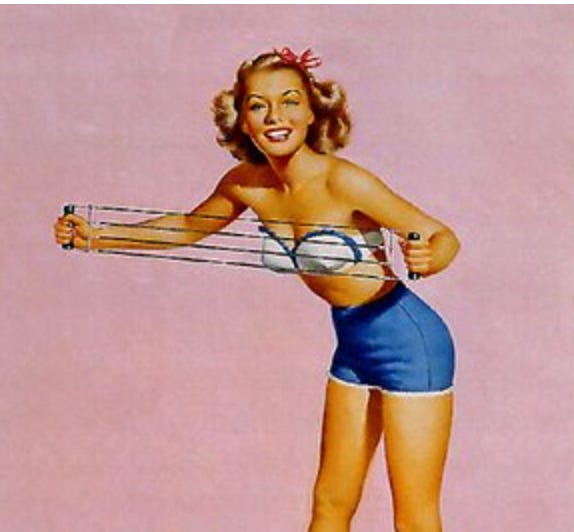
But while women were being told to be good little housewives, men were being sold a sexualized bombshell. Pin-up girls took norms that looked accessible and pumped up the sexuality. In these women, they saw the other side of a woman — a girl you could enjoy but not marry. And this fiction of overtly sexual women in regular spaces allowed men to imagine a fantasy of a wanton woman whom they could have. A lot of this was reinforced by illustrations, and many of these illustrators worked from living models and then just pumped up the sex. Seeing this comparison between a photograph and the final illustration, you can see where it goes from someone you might know in real life to someone you fantasize about.
This 1950s good girl/bad girl duality builds on generations of men sexualizing women outside of marriage and restricting women in marriage. The pin-up model, therefore, was made up and clearly in opposition to actual women and their wives. In writing about the impact of pinups on midcentury men, Maria Elena Buszek writes that "[The pin-up] may have been created as a tantalizing but unreal object for the delectation of heterosexual men." It made women either a thing to lust after or a person who can’t fulfill your lust, but not both.
The sexualized women were also shown as without personality, other than to titillate. Therefore, as objects rather than people, they lived to serve men sexually. As Loughnan, Pina, Vasquez & Puvia point out, “the objectified were perceived to be more responsible for being raped.” Since women are things, they can be used.
Women in this system are also impacted by the commodification of sexuality. Women start to internalize this objectification. As Fredrickson & Roberts point out, “Girls and women are typically acculturated to internalize an observer’s perspective as a primary view of their physical selves.” Women often play into the norms that men like to get validation, and also police women who do not conform.
When women self-objectify within the norms men set, it conforms to patriarchal norms and so isn’t a threat. But in the last few years, women have pushed against the norms. The body positivity movement, or the push for diverse models, seeks to work outside the norms society has set. But, for a lot of people who fear change, the idea that beauty can be expansive, determined outside the rules of patriarchy, and outside the need for commercial products is a threat to the existing order. Beauty is a gilt cage fashioned by patriarchy and locked by capitalism.
In the right’s championing of Sweeney, they see a repudiation of the body-positive movement, where women have greater agency over what is considered attractive. When you look at the online comments about her, it’s usually about her breasts. Rather than an actress, she’s distilled down to tits. Basically, MAGA wants this generation’s pin-up. Someone who doesn’t say enough to indicate there is a brain in her head, but does have the right physicality to turn you on.
American Eagle did see a financial boost when the ad ran, and they needed the win. What’s interesting, though, is someone at American Eagle must have been reading the political climate. When the ad was running, Trump and his policies weren’t quite as despised as they are now. Similarly, Sydney has seen some box office failures and the backlash from her refusal to acknowledge anything to do with the white supremacy connotations. But in the ad's image, both the company and the actress present very different visions. The smiling Sweeney shows no cleavage. If in the previous campaign, she was a white supremacist’s pin-up girl, in this one, she’s a fun girl to be around. Previously, she was objectified for her overt sexuality, and now she is objectified for her likability.
Before we talk about what the shift in the ad framing might signal, I’d like to discuss MAGA and rape culture. MAGA endorses a very strict type of white patriarchy in which men can act with impunity. Look at the President who was convicted of rape. As with many high-control cults, MAGA members cannot think for themselves. Take the number of MAGA Catholics who are siding with the President over the Pope. Given that the Papal infallibility is part of the church doctrine, this gives you a sense of the power Trump holds in their mind. Why? Because he promises a future where they can behave as they wish. Given the number of January 6 insurrectionists who have been charged with sex crimes, what many of them wish to do is attack women.
Rape is a tool that men can use to exert power over women. Its violence is rooted in the patriarchal attitude that men’s needs supersede women’s wishes. However, it’s not a solitary action on the part of one man, but instead part of the cultural norms that make rape normalized. As Buchwald wrote in their 1993 Transforming a Rape Culture, “rape culture condones physical and emotional terrorism against women as the norm.” In a society where women’s bodies are products to possess in marketing, and where men make jokes about harassing women, rape is tacitly seen as acceptable.
Masculinity in our society is highly correlated with power and sexuality. In Rape culture, though, they’re often interwoven. By engaging in sexual violence against women, weak men can show masculinity. It’s a false assertiveness. As I wrote yesterday, men’s fears of losing masculinity have been a great boon for companies.
While the manosphere, which I discussed yesterday, preys on boys’ poor self-esteem to help them harm themselves, “sleep content” helps men rape their wives. An international site, Motherless, hosts 20,000 videos of men drugging and raping their wives. Users can watch for a $20 monthly fee. Additionally, the site hosts lessons on how users can do this to their wives. They have 62 million active users.
In a way, this is the local conclusion of the good girl/ bad girl fantasy. The Madonna-Whore Dichotomy"denotes polarized perceptions of women in general as either 'good,' chaste, and pure Madonnas or as 'bad,' promiscuous, and seductive whores." But, as women have gained more agency and ownership of their sexuality, men who are weak cannot reframe their thinking from object to person. So, by enacting violence against her, he can exert his masculinity and her lack of agency.
Sweeney’s updated ad might offer some good news. The transformed look, particularly with her soft curls and pleasant smile, shows a woman who is more than a sex object. Rather than leaning into white supremacy, she’s offering a neutral blueskied optimism.
Similarly, two sitting elected officials stepped down due to allegations of sexual assault and/ or misconduct. TMZ, always the bastion of something or another, has started offering payments for tips on the wrongdoings of government officials. (If TMZ cracks open Epstein…)
But, in all this, men are the people who need to change. The people who created pinups were men. The people who came up with the American Eagle campaign were men. The rapists were men. But the biggest group of men responsible for transforming society is the one that stays silent. Many people in Washington said Swalwell’s behavior was well-known. If it was, why didn’t a man speak up?
The objectification of women is bad for society. Women are harmed. But, so are men. As I mentioned yesterday, women report wanting men who are emotionally engaged. If these men are not socialized to make emotional connections, they will not find meaningful relationships with women (if that’s their inclination). These emotionally unstable men harm women, themselves, and others. Our society is reeling from the simple fact that many men cannot handle their emotions, and it’s too girly for them to go to therapy. Until men deal with themselves, we will all suffer.
But it’s a myth that underscores the changing nature of white supremacy culture.