Good morning and welcome to Vittles. Hana Loftus’s mother has never spoken about her life in Japan. In today’s piece, Hana seeks traces of this unknown history through food.
Our ** third print magazine, ‘The Influencers’** is in bookstores and available on our website.
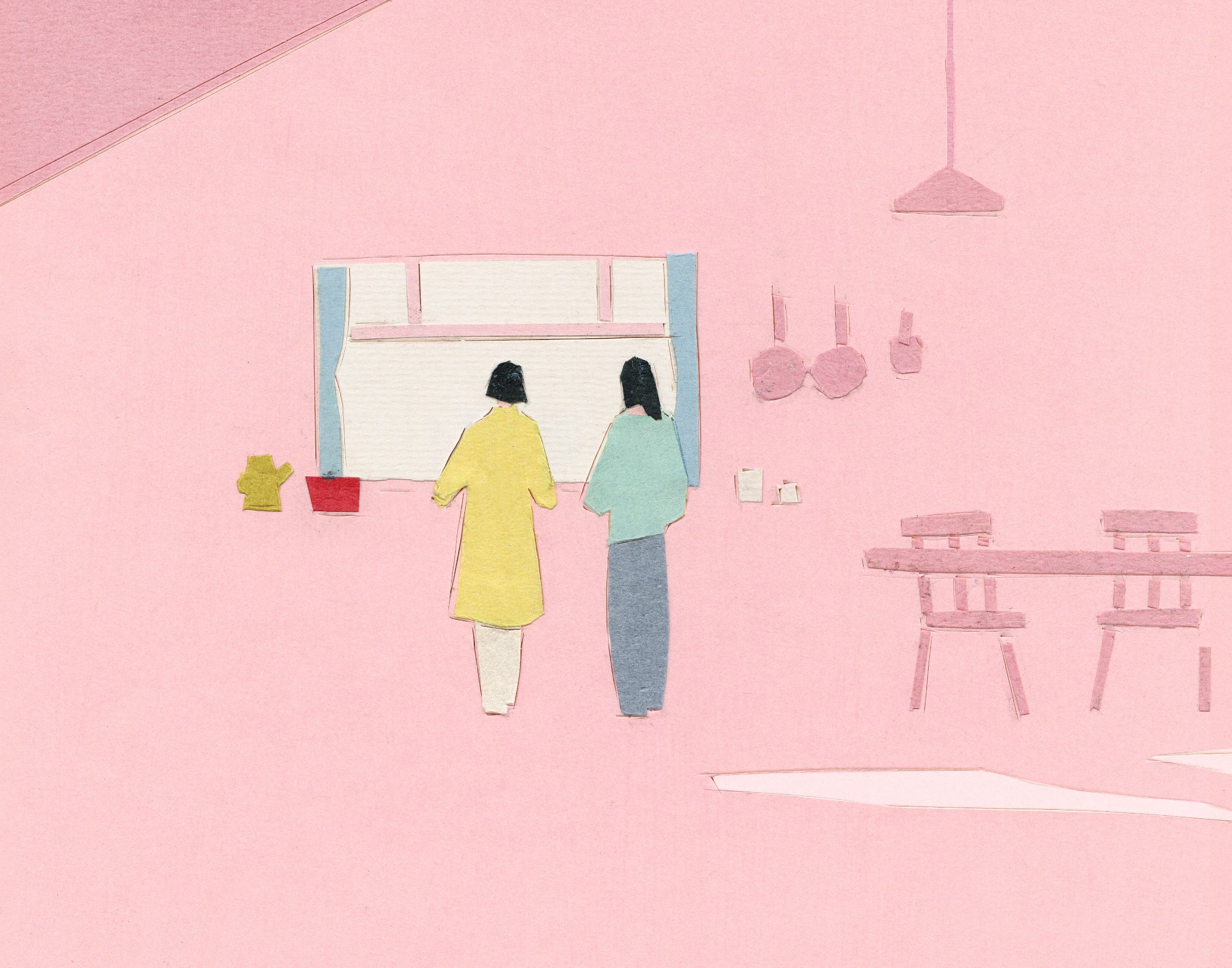
Hana Loftus uncovers clues about her mother’s life in Japan through her food. Illustration by Taku Bannai.
My mother wiped her slate clean when she left Japan half a century ago. She would deflect any questions about her past so deftly that you would barely realise they had not been answered. I always knew that there was a line that could not be crossed, even by me.
She was the only Japanese person for miles around in 1980s rural Suffolk. We did not participate in diaspora community life, we never visited Japan, and the cookbook shelf housed Alastair Little, The River Cafe, Claudia Roden, then Nigel and Nigella. Was I really half-Japanese if I knew nothing about Japan? It felt unfair to get the racial slurs when I had none of the voguish references (Nintendo, manga, sushi) to balance my playground reputation. Instead – and to further dent my credibility – I was sent to school with a small plastic box of lettuce to supplement the greasy mince and lumpy mash of the dining hall, and a snack was some plain rice cakes when everyone else got a Penguin or a packet of Skips. Then there was the ginger she grated into leek-and-potato soup. If she couldn’t be properly Japanese, could she at least not mangle traditional English dishes?
We have not found a way to talk about her first life in Japan, even now. But there are traces in my mother’s food that cannot be erased, which I have learned to read and cherish. This is a story of deliberate and accidental amnesia, taste-prints like tiny clues.
‘We have not found a way to talk about her first life in Japan, even now. But there are traces in my mother’s food that cannot be erased’
You call them silver-dollar pancakes. I think you travelled across the United States on your way from Japan to England, but I cannot remember how or why I know this. You make the pancakes with buckwheat flour, small soft circles topped with plain yoghurt, maple syrup and, in season, raspberries from the garden. You never make crêpes: those my father makes once a year only, on Pancake Day, when we try to toss them in the air. But we eat silver-dollar pancakes every weekend and I wonder who taught you to make them. I imagine you at a midwestern farmhouse table, but I can’t quite make the image match up. After all, you don’t eat bacon, or butter, and your pancakes aren’t bouncy and white.
After I leave home, I try to self-educate in the culture that I wanted you to have taught me. I go to the Japan Centre and walk around the grocery aisles, wishing I knew what brand of tofu to buy and how to read the labels. I find cellophane packets of dorayaki, the exact circular shape and texture of your pancakes. I wonder whether your silver-dollars – which were, after all, somewhat larger than a silver dollar, and softer, and smoother – were actually dorayaki in disguise, but I never ask you.
I go to the Japan Centre and walk around the grocery aisles, wishing I knew what brand of tofu to buy and how to read the labels.
When someone at school first asked me if we ate sushi at home, I asked back, What is sushi? There was laughter and I was embarrassed. But a couple of years later, when the first British conveyor-belt sushi bar – Moshi Moshi – opened in an unlikely spot, tucked above Liverpool Street station, you brought home a box and I realised that it was not entirely unfamiliar. I recognised the seasoned rice rolls wrapped in nori and the little pouches of tofu stuffed with rice: we had made these together, once or twice, at home. It was just that you had called them their specific names – norimaki and inari – rather than the generic label of sushi; made them with brown short-grain rice, not white; and dotted the rice for the inari with hijiki and tiny cubes of carrot. So this is also called sushi, I realised, making a mental note. I do not know whether you registered how happy I was.
The next time somebody asked, I said, proudly, yes: we did eat sushi at home. I felt a small glow appear around my head.
I make chilled soba all the time for my kids, and I allow them to think I learned the methods from you, but really I am making it up, copying bits of dishes from elsewhere: my soba is laced with sesame oil and chilli and Sichuan pepper. I know you fed it to me, but my memories are muddled. Was it cold, with slivers of cucumber and spring onion, or hot, in broth? I remember slatted bamboo trays. I remember miso and leaves of seaweed floating in the soup. I do not remember why you stopped making it for me. Was it something I said?
‘I make chilled soba all the time for my kids, and I allow them to think I learned the methods from you, but really I am making it up’
In 2024, I visit Japan for the first time with my partner and teenage children. I am just a tourist with my family, without you, because you never go back. On our first night in Tokyo everyone is too jet-lagged to eat, and I walk out alone into the dark. There is a tiny soba bar down the street, and through mime and an unfamiliar push-button machine dispensing mysterious paper tickets, I manage to order something to eat and drink. In the back, a man turns a crank-handle and a press spits strands of buff-grey dough straight into a boiling vat of water. A bowl comes, and it is broth, and springy leaves of seaweed, and a sprinkle of spring onion on the rough-textured soba, and it is so, so good.
When the first Wagamama opened in London, I was surprised that you took me there straight away. We went down into the basement near the British Museum and I ate gyoza and yakisoba and bowls of grilled chicken ramen for the first time. This was 1990, long before the company sold out, and it was thrilling: the big star logo T-shirts like a political declaration, the queuing, the communal tables, the Japanese student waiters with spiky hair and tattoos, the spare architect-designed space, the noisy open kitchen, the shouted orders. I was elated: suddenly there was an overlap between your Japan and that of my peers. I was thrilled to sit opposite you – you were actually Japanese, you belonged there and, by inference, so did I.
You taught me to pop edamame into my mouth, the two of us sharing a bowl of pods, the salt dissolving on our lips. You taught me to fold my chopstick wrapper into a chopstick rest, a fold that has now become automatic, and that I have passed on to my daughters. I didn’t ask why you liked it so much when you disdained all other street-food and pop culture. I didn’t want to spoil the treat.
In a small onsen village I go down to breakfast with my partner and kids. Among the dozen or more dishes laid out in the ryokan dining room is a bowl of tender carrot slivers tangled with strings of black hijiki and dotted with white sesame seeds. The colours surface a memory: you cooked carrots like this, too: the chewy black strands soaking up the vinegar and the sweet juice released by the carrots. When I taste the first mouthful, the earthy flavours combining with the comforting base of rice, it tastes of home. I do know this food.
‘You added strands of ginger and a dash of rice vinegar, giving these two very English vegetables a sharp-sweet flavour while retaining their crunch’
You also steam-sautéed carrots with leeks, sliced thinly into pieces of equal length and width. You added strands of ginger and a dash of rice vinegar, giving these two very English vegetables a sharp-sweet flavour while retaining their crunch. They went so well with the roast chicken and roast potatoes that my English father made, and I liked them this way. At other people’s houses, carrots were boiled in discs and slathered in butter; I had to swallow hard in order to be polite. But now I remember: sometimes there were the fat black worms of hijiki in our carrots, when my father was away and there was no roast chicken.
My father is away again. It is summer, and lunch is light. A green salad topped with cubes of tofu, sautéed with ginger and garlic and splashed with soy, which caramelises in an instant before the tofu is scraped out from the cast-iron pan. We don’t eat this food when my father is around; he says that tofu tastes of nothing, but this tofu tastes of salt and garlic and ginger along with the faint sourness of the curd. The burnt bits are my favourite. There is rocket from the garden among the torn butterhead lettuce. You were an early adopter of rocket, growing its spicy leaves long before it became fashionable, and putting it in everything.
On an izakaya menu in Kanazawa, I see a dish of cubes of tofu fried in soy and scattered over a few leaves of mizuna. The rocket in your salad was, suddenly and obviously, a substitute for the mizuna seeds that would not arrive on British shores, or into your garden, for another twenty years.
I asked for the ginger marmalade cake you make so well for my birthday most years. You would reach to the cookbook shelf for a battered cardboard ring-binder, roughly A5 size, with recipes written in various hands on its lined sheets. You brought this ring-binder with you when you moved in with my father: it appears to date to your first months – or were they years? – in London. You occasionally mentioned, with typical vagueness, something about living in Hampstead and making friends with old Jewish ladies. Is this one of their recipes, along with the flourless hazelnut cake you make, and the almond biscuits? But what about the pumpkin pie recipe written in there – is that from America, or from Hampstead?
It’s only years later, when I peer into the binder, that I realise the recipe is for marmalade without ginger: the ginger is your addition, of course, a taste of your home.
Your scones are tiny, just a few bites, moist, with cubes of apple in the dough along with sharp currants, and so light, so light – nothing like the bready baking-powder clods that seem to so deserve the name of rock cakes. We make them together in the kitchen – mixing the dough as briefly as possible, patting it out gently, cutting it into squares. Then we brush the tops with egg wash and sprinkle sesame seeds on top. Nobody else I know makes scones with seeds on top, and everyone else has thick cream or buttery spread with theirs, but we have only some homemade jam.
‘Nobody else I know makes scones with sesame seeds on top’
When I live in the southern United States for a year, I discover biscuits. They are your scones, almost exactly: you used watered-down yoghurt as the liquid rather than regular milk, and of course this works – chemically – exactly like the buttermilk in biscuits, making them light; the size is the same too. I wonder about that journey across America, and when you decided to add the sesame seeds.
It is everywhere, on all the photographic menus in every city. A spongy yellow half-moon with a seal of red sauce marking its fat waist, the English translation reading ‘omurice’. I am slightly revolted – is this a weirdly misconceived food for tourists? – until suddenly, something flashes back into view. I am chest-high to the Aga as you spoon your homemade tomato sauce – made in the classic Italian way, with a sofrito base – over a perfect French-style omelette.
I must have banished it from my memory: another of your wrong-headed ideas of how Western foods should be combined, or so I had thought. You never mentioned that the pairing was a Japanese invention of the Shōwa era and now a national classic. And of course, you evolved it back to Europe again, with a sugo learnt from an Italian friend and an omelette made using Elizabeth David’s technique instead of the spongy yellow domes on the laminated menus. I cannot remember if you served it with rice.
If you don’t like it you know what you can do, by Huw LemmeyEat, play protest: A life with prawns, by Rajkamal M (translated from Tamil by Niranjana M)
Hana Loftusis a writer, architect and planner living in north Essex. Her first book,Sixteen Acres, will be published by Profile Books in March 2027.
is a prizewinning illustrator based in Japan.[Taku Bannai]The full
Vittlesmasthead can be found[here].