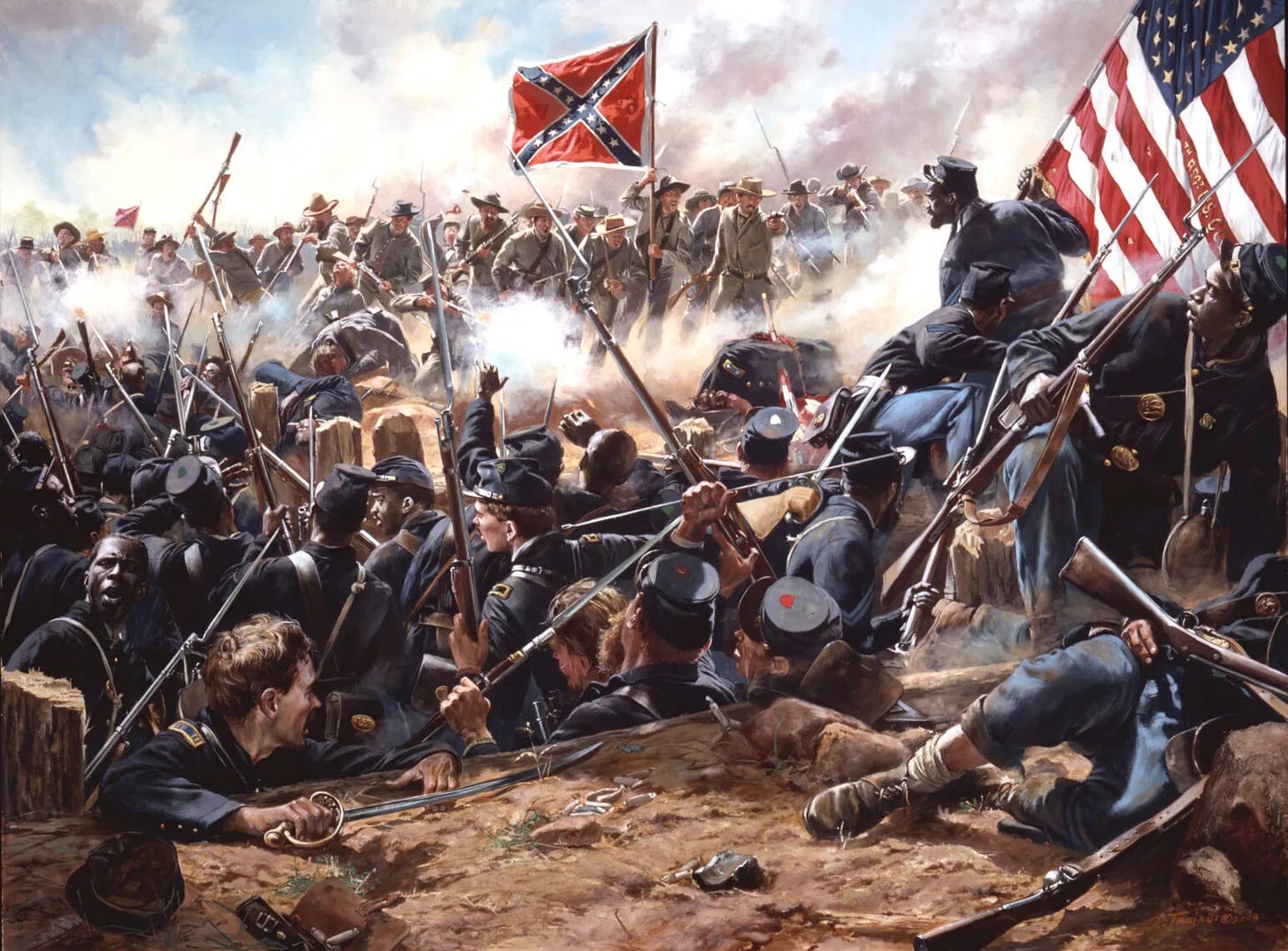
Today is the anniversary of the battle of the Crater, fought on this day in 1864 and, as many of you know, the subject of my first book, * Remembering the Battle of the Crater: War as Murder* (2012).
The battle, which took place on the early morning of July 30, 1864, just east of the city of Petersburg, Virginia, is best remembered for the detonation of roughly 8,000 pounds of black powder beneath a Confederate salient. The explosion, which followed the construction of a mine that eventually measured roughly 510 feet, was intended to punch a hole in the Confederate line, followed by an advance of four divisions of United States soldiers from the Ninth Corps.
The goal was to break the Confederate line, take control of the city, and end what many were coming to view as a “siege.”
The initial explosion crippled a regiment of South Carolinians positioned directly atop the mine. Union soldiers poured into the complex chain of Confederate earthworks that dotted the landscape. The first three divisions made steady progress, but it was a division of United States Colored Troops, under the command of Brig. Gen. Edward Ferrero, that pushed furthest into the Confederate works.
By roughly 9AM they were poised to make a final advance that would likely have resulted in the occupation of Petersburg.
That final push never came. Confederate general William Mahone ordered the first of four brigades from his division to counterattack and by early afternoon Confederates had secured a decisive victory.
While the battle is best remembered for the early morning explosion and the close hand to hand fighting that followed, I have always been interested in the well documented massacre of United States Colored Troops by Confederates that occurred both during and especially after the fighting.
After all these years, I am once again writing about the battle, this time for an essay that will appear in a book about the experiences of Black soldiers, edited by historians Elizabeth Varon and Brian Neumann at the University of Virginia.
My focus is, once again, on the racial nature of the violence, specifically on the evidence that points to the relatively few cases of Black soldiers refusing to accept the surrender of Confederates.
One of the things I find fascinating about this is the extent to which Confederates went to deny Black aggression and anger. As I show in my book, Confederate accounts from the battle itself made no attempt to deny that a massacre had taken place. In fact, they emphasized it.
On June 15, 1864, a division of over 3,500 Black soldiers, serving in Major General William T. “Baldy” Smith’s XVIII Corps, took part in the opening assault on Petersburg. But this was the first time that Robert E. Lee’s men, specifically the division commanded by William Mahone, had met a large number of Black soldiers on the battlefield.
One of the most insightful accounts, written in the immediate aftermath of the battle, comes from Colonel William Pegram, who wrote the following to his sister:
There were hardly less than six hundred dead—four hundred of whom were negroes. As soon as we got upon them, they threw down their arms to surrender, but were not allowed to do so.
Every bomb proof I saw, had one or two dead negroes in it, who had skulked out of the fight, & been found & killed by our men. This was perfectly right, as a matter of policy. I think over two hundred negroes got into our lines, by surrendering & running in, along with the whites, while the fighting was going on. I don’t believe that much over half of these ever reached the rear. You could see them lying dead all along the route to the rear. While there was a temporary lull in the fighting, after we had recaptured the first portion of the line, & before we recaptured the second, I was down there, & saw a fight between a negro & one of our men in the trench. I suppose that the Confederate told the negro he was going to kill him, after he had surrendered. This made the negro desperate, & he grabbed up a musket, & they fought quite desperately for a little while with bayonets, until a bystander shot the negro dead.
It seems cruel to murder them in cold blood, but I think the men who did it had very good cause for doing so. Gen. Mahone told me of one man who had a bayonet run through his cheek, which instead of making him throw down his musket & run to the rear, as men usually do when they are wounded, exasperated him so much that he killed the negro, although in that condition.I have always said that I wished the enemy would bring some negroes against this army. I am convinced, since Saturday’s fight, that it has a splendid effect on our men.
Confederates, regardless of whether they were slaveholders, understood what was at stake that day. They were defending a small civilian population, which remained in the city, from what they perceived as slaves in rebellion. These men wanted their families to know what they might face at the hands of Black soldiers.
During the postwar period, Confederates largely steered clear of the massacre and instead fell in lockstep with a Lost Cause narrative that denied Black manhood and aggression. Many assumed that the African American soldiers were drunk and or uncommitted to fighting their former masters.
One of the most insightful accounts comes from George Bernard, who fought with the 12th Virginia, under Mahone, at the Crater. He took part in the Confederate counterattack that was largely responsible for the Confederate victory that day and he was perfectly positioned to witness the racial violence in and around the crater.
Bernard was an incredibly prolific writer throughout the postwar period, most notably as the author of * War Talks of Confederate Veterans*.
In writing about one close encounter with a Black soldier, Bernard observed “the countenances and rolling eyes of the terror-stricken negroes. I particularly noticed in the hands of one of the frightened creatures the new silk of a large and beautiful stand of colors, the staff swaying to and fro as the color-bearer, his eyes fixed in terrified gaze at his armed adversaries, was being pushed and jostled by his comrades.”
In another encounter, Bernard writes, “Just as I got into place, I discovered near me, at my feet, a negro soldier, who immediately began to most earnestly beg me not to kill him. ‘Master, don’t kill me! Master, don’t kill me! I’ll be your slave as long as I live. Don’t kill me!’ He most piteously cried, whilst I was rapidly loading my gun—and he doubtless supposed that its next shot was intended for himself. ‘Old man, I do not intend to kill you, by you deserve to be killed,’ was my reply. I addressed him as ‘old man,’ as he was apparently over the military age, and to my then young eyes seemed old.” (Address to A.P. Hill Camp of Confederate Veterans [1890], reprinted in War Talks)
Bernard was one of the few Confederate veterans who openly acknowledged the execution of Black soldiers at the Crater, but that is not what I find interesting right now. Notice the language that Bernard uses above. Black soldiers were “terrified,” while another soldier begged for his life by promising to voluntarily return to slavery.
There is no mention of the bravery of Black soldiers or the fact that they managed, along with scattered white regiments, to advance furthest on such a confusing and deadly landscape. Even white Union soldiers had difficulty acknowledging the bravery and skill of their Black comrades.
While there can be no doubt that their assessments were clouded by racial prejudice, white Southerners at the turn of the century also had an interest in depicting African Americans as compliant and subservient, with second class status in a Jim Crow culture.
In short, it was better to depict African Americans as knowing their place than as fighting for political and racial equality.
If you enjoy Civil War Memory and want to fuel the next post with a cup of coffee, feel free to toss a few bucks my way on Venmo. You can find me @Kevin-Levin-37. No pressure and no obligation, just a nice way to say thanks if the writing has been worth your time.
But this distortion pushes us further away from fully understanding the racial nature of the fighting that took place at the Crater and elsewhere. African Americans born into slavery, who took part in the assault, had lived with its violence for years.
They had heard reports of the massacre of Black Union soldiers at Fort Pillow, Tennessee, in April of that year. The Confederacy had made its position clear on what would happen to captured Black soldiers on the battlefield.
Ferrero’s men also succumbed to the vortex of racial anger that swirled through the crater and adjacent earthworks. Their charge was animated by the goals of freedom, the promise of a reunited nation, the future of their families, but their battle cry of “Remember Fort Pillow” also reflected a dark underbelly, a desire for revenge for the murder of their comrades and an understanding of what would likely happen in the event of their own capture.
The initial assault on Petersburg that took place in June 1864, involving Black soldiers, received a great deal of attention in the press and in the ranks as well. Alongside praise of their battlefield prowess, stories of the execution of prisoners spread. The Republican Tribune headed its dispatch “The Assault on Petersburg—Valor of the Colored Troops—They Take No Prisoners, and Leave no Wounded.”
The commander of the 30th USCT informed his family that the black soldiers “fought splendidly” and “took no prisoners.” One white soldier noted that “the rebs were shown no mercy.” “I saw some of them to-day,” wrote another soldier. “They said the white folks took some prisoners, but they did not.”
While much more limited in scope compared to what they faced at the hands of Confederates, this violence continued at the Crater. Lt. Richard M. Gosney of the 28th USCT recalled that black soldiers went into battle at the Crater “not expecting any quarter, nor intending to give any.” One soldier claimed that a Confederate prisoner was killed by a black soldier with a bayonet and “in an agony of frenzy.”
Taken together, these accounts remind us that the violence at the Crater cannot be reduced to a single story. Confederates who witnessed and took part in the killing of Black soldiers left a record that, in the moment, made no effort to hide what had happened, only to bury it decades later beneath a Lost Cause narrative built on denial.
And the anger of Black soldiers, forged by years of bondage and news of massacres like Fort Pillow, was not incidental to their courage that day but bound up with it.
Recovering that fuller picture remains part of the work.