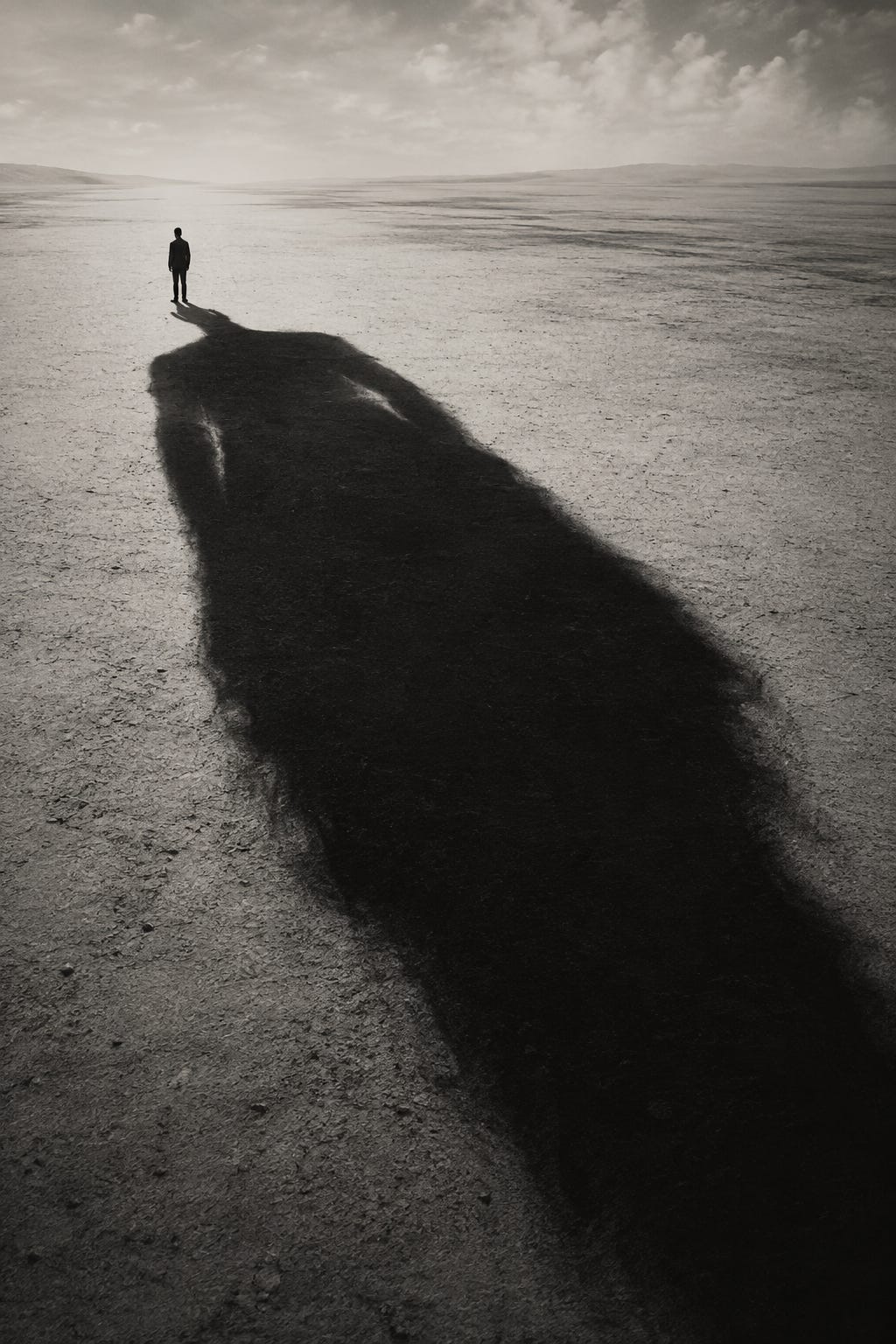
There is something strange about the authority we have given death.
We speak of death as though the end of life reveals something that living itself cannot. We imagine that our ending somehow discloses the truth of our existence, that mortality exposes what ultimately matters, and that the certainty of our disappearance provides the proper scale against which everything else should be measured.
Religious traditions have built entire architectures of salvation around human mortality. Philosophers have treated finitude as the horizon that awakens us to authentic existence. Nihilism invokes our eventual extinction as evidence against ultimate meaning. Even secular self-help regularly summons the end to discipline us into living more deliberately: remember that you will die, imagine yourself in your final days, ask what you will regret when they arrive.
Across otherwise incompatible worldviews, death keeps receiving the final word.
I want to question that arrangement.
Death is one of the deepest facts of being alive. It shadows every attachment because everything we love is vulnerable to disappearance. It limits our time and makes certain losses irreversible. Any account of human existence that refuses mortality eventually becomes dishonest about the conditions under which we live.
But taking mortality seriously is different from making it the interpretive center of existence.
I use the word thanatocentrism for this tendency: placing death at the center of our understanding of life and granting it disproportionate authority over meaning, value, urgency, and significance. Thanatocentrism does not simply acknowledge that we die. It turns our ending into the standpoint from which life is understood.
Beneath much of Western thought sits an assumption we rarely examine: mortality somehow possesses special authority over life. We have spent centuries asking what death means for existence, and far less time asking why we granted the ending that authority.
Human beings have always lived among the dead. Long before systematic theology or philosophy, people buried bodies, mourned losses, preserved memories, tended graves, told stories about ancestors, and imagined continuities between the living and those who had disappeared. Mortality is not an intellectual discovery. It is among the oldest realities of human consciousness.
Something consequential happens when death moves from being a condition of being human to becoming the central problem life must overcome.
Much of Christianity developed within this architecture. Human experience became situated inside a larger drama in which mortality was not merely biological cessation but a theological crisis, entangled with sin, judgment, salvation, resurrection, heaven, hell, and eternal destiny. The stakes of earthly life extended infinitely beyond its temporal boundaries. What happened during a few decades in this world could determine what happened forever.
This arrangement gave the ending extraordinary interpretive power. Living became preparation. Decisions became eternally consequential. Belief became a matter of ultimate destiny. The present acquired meaning partly through its relationship to what supposedly awaited beyond it.
Christianity is hardly alone in developing responses to mortality, and its traditions contain far richer understandings of incarnation, creation, justice, love, community, and embodied existence than any single characterization can hold. Still, one strand of Western religious consciousness became deeply organized around the proposition that our ending presents a problem requiring metaphysical resolution.
The promise of eternal life answers that problem brilliantly. Death does not win. Separation is temporary. The self survives. Love continues. Justice eventually arrives. The grave loses its finality.
Yet notice what remains unquestioned beneath the consolation: mortality is still setting the terms.
Life requires eternity because its ending would otherwise threaten its ultimate significance.
The decline of traditional religious authority did not remove mortality from the center of Western consciousness. In many cases, it intensified the problem.
When heaven disappears, death does not disappear with it.
The secular person inherits the same biological ending without the metaphysical architecture that once contained it. There may be no continuation of consciousness, cosmic reunion, resurrection of the body, divine judgment, or ultimate restoration. The person dies, the body decomposes, generations pass, memories disappear, civilizations vanish, stars exhaust their fuel, and eventually even the physical conditions that made human existence possible cease to exist.
Against this scale, an old question returns with greater force: if everything ends, what was any of it for?
The question feels almost self-evident because thanatocentrism is already embedded inside it. The ending is assumed to possess the authority to determine the value of everything preceding it. Permanence becomes the hidden criterion of significance. What does not last forever begins to appear vulnerable to the accusation that it never ultimately mattered.
This is an astonishing standard.
Almost nothing we value is held to this standard. Music does not need to play forever to matter, and a conversation can alter the course of a life in an hour. Childhood retains its significance after it has passed, just as decades of friendship remain real after one person dies. Even civilizations that eventually disappear leave behind consequences woven into lives they will never see. Impermanence does not reach backward and cancel what occurred.
Experience occurs within time. Its impermanence belongs to its structure.
Yet when the scale expands toward cosmic extinction, we often abandon the standards by which significance ordinarily functions and demand something impossible: permanence as proof of meaning.
Death has once again been invited to judge life.
Nihilism often presents itself as the courageous willingness to face what religion cannot: there is no cosmic guarantee that human life matters.
That insight deserves to be taken seriously. The universe does not appear obligated to provide us with a metaphysical certificate of significance. Stars explode without consulting human values. Species disappear. Geological time dwarfs civilizations. The cosmos seems largely indifferent to whether human beings flourish, suffer, love, create, destroy one another, or disappear altogether.
The difficulty begins when cosmic indifference is converted into existential insignificance.
The argument frequently proceeds almost unnoticed. Human beings are temporary. Humanity will eventually disappear. The universe will continue without us. Therefore, nothing possesses ultimate significance.
But the conclusion contains a criterion that the premises never establish. Why should permanence determine significance? Why should cosmic recognition be necessary for human value? Why must the universe validate something for it to carry significance within the lived reality where value actually arises?
Nihilism can therefore preserve the architecture it believes it has escaped. Religion says death must be overcome for life to possess ultimate meaning. Nihilism says that because death cannot be overcome, ultimate meaning collapses. Their conclusions differ dramatically, but the deeper premise remains surprisingly similar.
Death gets the final vote.
Existential Health begins somewhere else. It asks whether the entire referendum was necessary.
Any serious discussion of death and existential thought eventually encounters Martin Heidegger.
Martin Heidegger (1889–1976) was a German philosopher whose work profoundly shaped existentialism and phenomenology, particularly through his exploration of being, mortality, and the conditions of human existence. His analysis of Being-toward-death remains one of the most influential attempts to understand mortality as fundamental to being human.
For Heidegger, death is not simply an event waiting at the chronological end of life. Awareness of mortality shapes the structure of existence in the present. My death is uniquely mine. No one dies it for me. Confronting this possibility ruptures the anonymous habits through which I disappear into what “one” does, believes, values, and expects. Mortality individualizes. It exposes the borrowed nature of a life and confronts a person with the responsibility of existing as their own possibility.
There is tremendous insight here. Mortality does interrupt abstraction. The recognition that our time is finite exposes forms of existential deferral in which we endlessly postpone participation in our own lives. Death clarifies.
But clarification does not establish sovereignty.
Why should mortality possess greater revelatory authority than birth? Why should the impossibility of my continued existence reveal more about being than my radical dependence upon others? Why privilege death over embodiment, consciousness, attachment, vulnerability, desire, play, suffering, creativity, relationship, ecological belonging, or the sheer contingency of finding oneself here at all?
Being-toward-death captures something essential about human existence. The danger arises when an essential dimension becomes the privileged interpretive horizon.
Human beings are beings-toward-death. We are also beings-from-birth, beings-in-bodies, beings-with-others, beings-dependent-upon-worlds, beings-capable-of-love, beings-vulnerable-to-loss, beings-who-create, beings-who-destroy, beings-who-participate.
Death tells the truth about us.
It does not tell the whole truth.
Psychology approaches the problem from another direction. Terror management theory, drawing partly from Ernest Becker’s work, argues that awareness of mortality generates a distinctive psychological predicament. Human beings possess enough cognitive capacity to understand that they will die while simultaneously carrying powerful biological impulses toward survival.
Culture helps manage this contradiction.
Worldviews locate individuals inside systems of significance larger than their biological lives. Religions promise literal immortality. Nations, families, institutions, movements, artistic works, reputations, achievements, and historical identities can provide forms of symbolic immortality. Something bearing our name, values, genes, influence, or story continues after the organism disappears.
Becker’s great insight was that much human striving cannot be understood apart from mortality consciousness. Civilization itself carries traces of our attempts to become significant enough to withstand disappearance.
Yet the insight becomes even more interesting when reversed.
What if some of our immortality projects reveal not only our fear of death but our assumption that death possesses the power to invalidate us?
The desperate need to leave something behind makes sense only if disappearance has been granted enormous interpretive significance. Legacy becomes a negotiation with extinction. Achievement becomes evidence submitted against oblivion. Fame promises continuation in other minds. Children become carriers of identity. Institutions preserve names. Monuments resist erasure.
None of these things are inherently pathological. Creating something that survives us can be beautiful. Caring about future generations is among the most expansive capacities human beings possess. The difficulty begins when continuation becomes necessary to justify having existed.
A human life should not have to defeat disappearance to earn the right to have mattered.
Our culture contains a softer version of the same logic.
Imagine yourself on your deathbed.
The exercise appears everywhere in contemporary discussions of purpose, asking us to imagine which regrets will remain, what will have mattered, whether we spent our time well, which risks were worth taking, and which relationships will still seem important when everything else falls away.
There is wisdom in allowing finitude to disrupt triviality. A limited amount of time changes the structure of choice. We cannot pursue every possibility, maintain every relationship, inhabit every identity, or indefinitely postpone difficult decisions. Mortality places boundaries around participation.
But the deathbed is not an infallible tribunal.
The dying version of me is still one version of me, situated within extraordinary circumstances. Why should that person’s perspective possess greater authority than the person who loved breakfast with his children, became absorbed in meaningless play, spent an afternoon reading a novel, wandered through a city without accomplishing anything, or devoted years to something that eventually failed?
We have turned the imagined final moments into a courtroom where everything that came before appears for judgment.
A human life is larger than its final evaluation.
Some things possess significance simply because they were lived.
Beneath thanatocentrism lies another assumption: significance must somehow survive the destruction of the thing that carries it.
We rarely state this explicitly because doing so exposes how strange it is.
Suppose two people love each other deeply for forty years. Their relationship shapes their identities, bodies, memories, decisions, friendships, families, vulnerabilities, and experience of the world. Eventually both die. Centuries later, no living person remembers their names.
What exactly has been invalidated?
Nothing about their eventual disappearance changes the reality that existed between them. Their love does not require an eternal witness to certify that it happened. The universe does not need to remember them. Their relationship participated in reality while they were here.
The same applies to suffering. If someone experiences cruelty, the eventual extinction of humanity does not make that suffering less real. We would find it morally grotesque to tell a tortured person that their pain does not ultimately matter because the sun will eventually consume the earth. Cosmic scale is irrelevant to the reality of experience.
Strangely, we understand this more readily with suffering than with joy, love, beauty, or significance.
Pain is allowed to possess significance without permanence.
Why isn’t love?
An Existential Health approach does not need to solve death.
For much of human history, our systems of meaning have attempted to place mortality inside an explanation. It becomes transition, punishment, liberation, reunion, reincarnation, passage, transformation, return, awakening, or entry into another dimension of reality. Even secular philosophies sometimes convert finitude into instruction, insisting that death teaches urgency, authenticity, gratitude, or perspective.
We seem uncomfortable allowing mortality to remain what it is: an immense and partially unknowable feature of being alive.
There are things we know. Organisms die. Bodies cease functioning. Relationships are severed. Those who remain experience absence. There are also things we do not know with the certainty our metaphysical systems often claim. The ultimate nature of consciousness, whether anything continues beyond biological death, and whether reality possesses dimensions unavailable to our present forms of knowing remain unresolved questions.
Existential Health does not require premature closure.
Symbolic sobriety is important here. We are capable of inhabiting mortality without forcing it into either religious certainty or materialist certainty beyond what our knowledge supports. Grief does not need to become a lesson, nor must finitude provide a philosophy.
Death is difficult enough without requiring it to explain life.
The alternative to thanatocentrism is not life-centrism in the sentimental sense. It is not an insistence that life is beautiful, that every moment should be treasured, or that awareness…