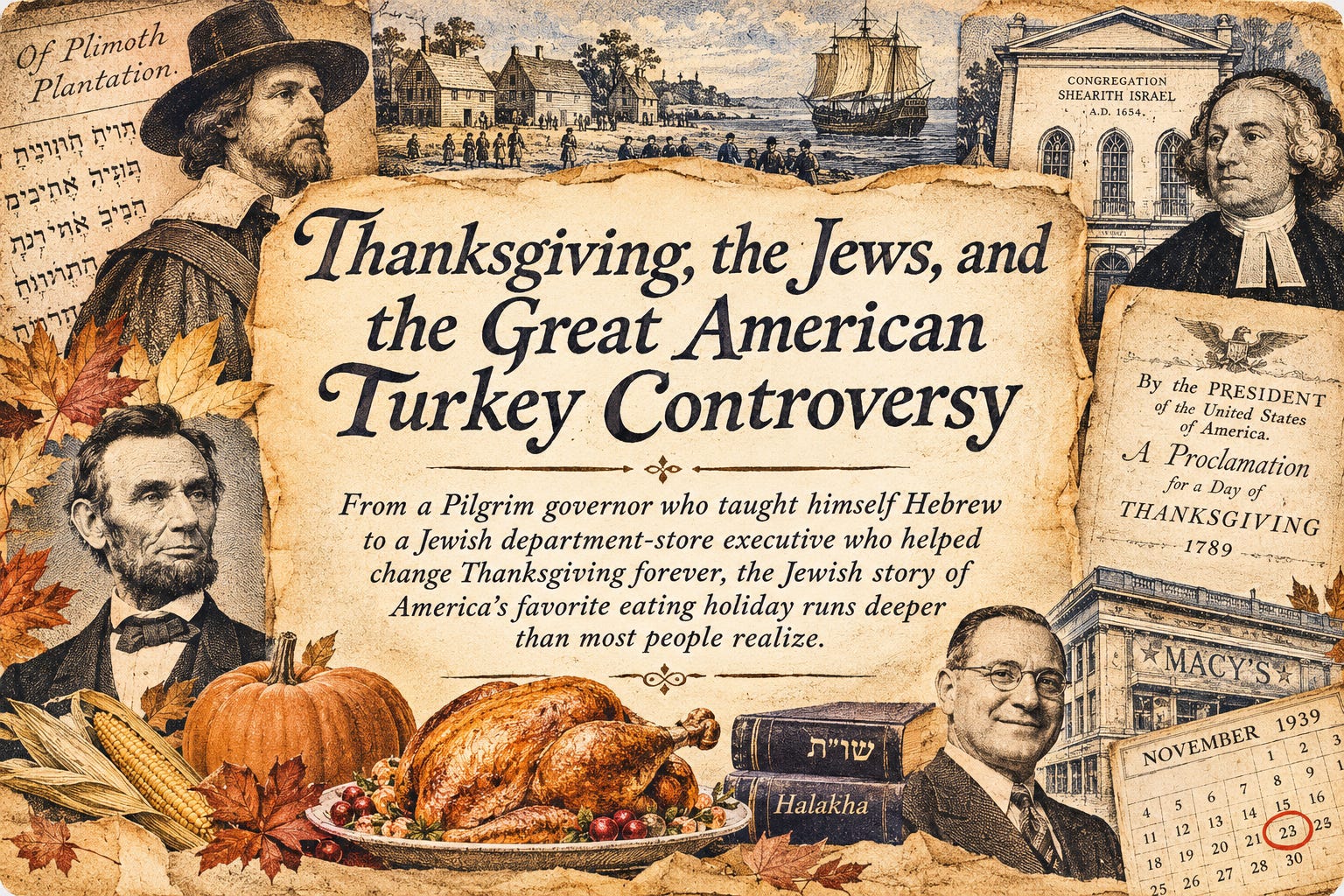
However your table looks this Thanksgiving—whether it’s packed with three generations talking over each other or a quieter dinner with the people who matter most—may it be filled with good food, loud laughter, and the kind of gratitude that lasts well past the leftovers. Happy Thanksgiving to you and yours. May the turkey stay moist, the kugel disappear quickly, and the only real debate at the table be over who gets the last piece of pie.
Thanksgiving is one of those American holidays that Jews jumped into with both feet. Jewish families already know how to organize a gathering around an excessive amount of food, argue over who’s bringing what, and spend three days preparing a meal that everyone will finish in twenty minutes. Add a turkey, some cranberry sauce, and a football game, and the formula is second nature.
Behind the familiar traditions sits a much older story. Jews have been part of Thanksgiving for centuries—from the Pilgrims, George Washington, and Abraham Lincoln to a Jewish businessman who convinced Franklin Roosevelt to change the calendar and rabbis who had to determine whether eating turkey on the fourth Thursday of November was permitted under Jewish law. Yes, there was a rabbinic debate about Thanksgiving turkey, and the story begins long before anyone put marshmallows on sweet potatoes.
When the Pilgrims arrived in Plymouth in 1620, they brought a religious worldview shaped by the Hebrew Bible. These English Separatists saw themselves through the stories of ancient Israel, particularly the Exodus, the wilderness journey, and the search for a place where they could worship freely. The Israelites had Moses; the Pilgrims had William Bradford, a dangerous Atlantic crossing, and a Massachusetts winter that made Egypt sound appealing.
Bradford became governor of Plymouth Colony in 1621, the year of the harvest celebration that Americans later associated with the first Thanksgiving. A deeply religious man who spent his life studying Scripture, he decided in his later years that reading the Bible in English wasn’t enough. He wanted to understand the original Hebrew.
Bradford taught himself the language from scratch. His manuscript, Of Plimoth Plantation, contains pages of handwritten Hebrew vocabulary, complete with English translations and the errors of a seventeenth-century Englishman working without a Hebrew school, a tutor, or a Jewish mother reminding him to practice. His devotion to the language lasted until his death: his gravestone on Burial Hill in Plymouth bears a Hebrew inscription expressing that God is the help of his life, an unusual detail in a Puritan cemetery that underscores how deeply the Hebrew Bible shaped early New England.
Sukkot, the Jewish harvest festival, celebrates the agricultural harvest while remembering the Israelites’ years in the wilderness. Thanksgiving also developed around harvest, gratitude, and the acknowledgment that survival depended on forces beyond human control. While the historical record doesn’t show that the Pilgrims deliberately modeled their 1621 feast on Sukkot—their celebration grew from English harvest customs and included Wampanoag guests—the biblical traditions that shaped the Pilgrims came directly from Jewish Scripture. Centuries later, Jewish families would fold that same American harvest holiday into their own kitchens, complete with sweet potato kugel and enough leftovers to feed Plymouth Colony.
In 1789, the United States had a new Constitution, George Washington was president, and the country was still defining what it meant to be a republic. On October 3, Washington proclaimed Thursday, November 26, a national day of thanksgiving and prayer. New York City’s Jewish community responded immediately.
Related articles: