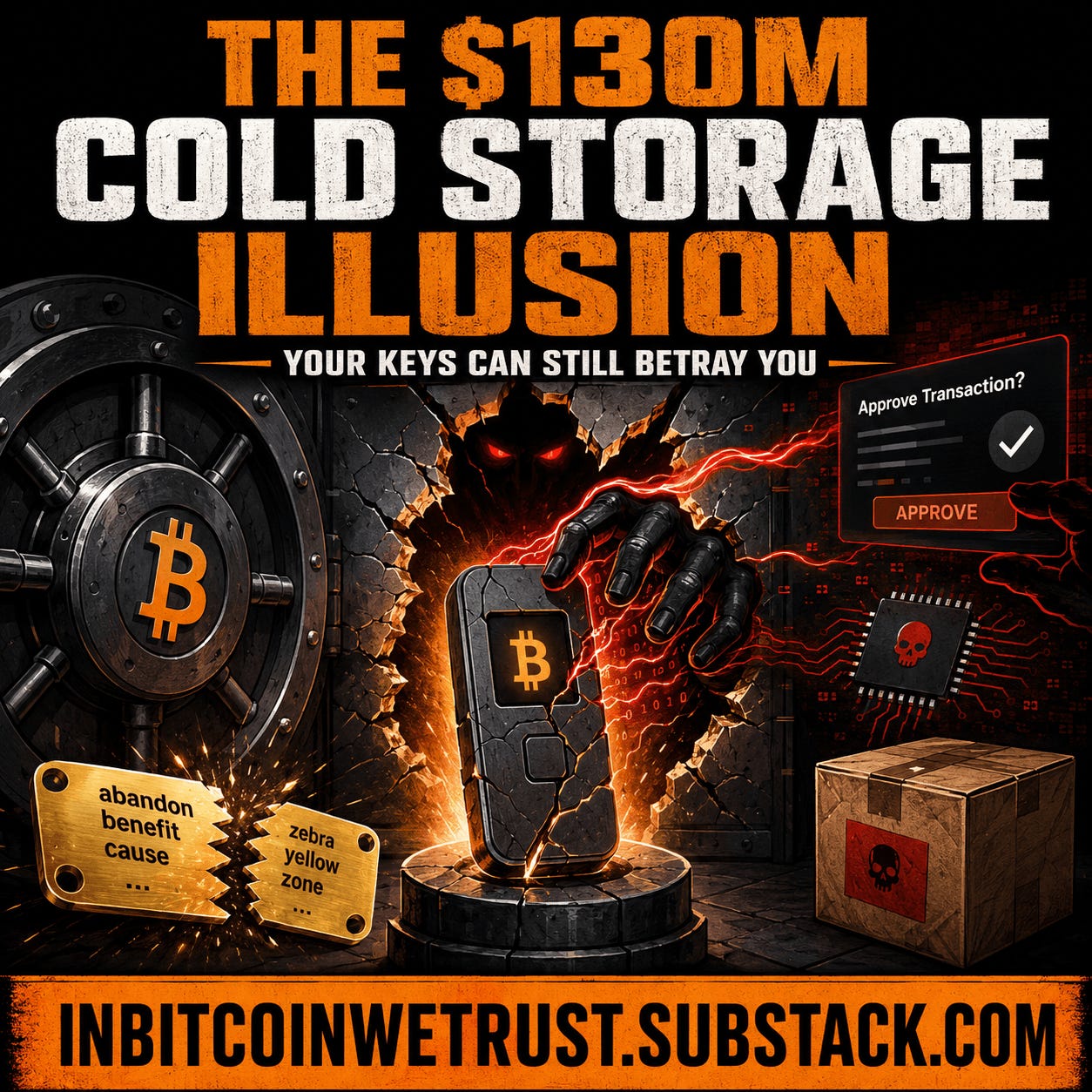
Buying a hardware wallet doesn’t make you secure — it just changes how you can be attacked. Here is the brutal truth about blind signing, supply chains, and why single-signature setups are failing high-net-worth Bitcoiners.
For over a decade, the Bitcoin community has lived by a comfortable, almost sacred dogma:
Get your coins off the exchanges. Buy a hardware wallet. Write down your twenty-four words on a piece of paper or stamp them into stainless steel. Put that device in a drawer, and you are untouchable.
We turned hardware wallets into digital talismans. We treated them like unbreakable titanium vaults that magically shield our wealth from hackers, governments, and rogue actors. The narrative was simple, clean, and empowering: Be your own bank.
Then came the headline that shattered the illusion: $130 million worth of Bitcoin systematically drained from cold storage.
Not from an exchange hack. Not from a high-yield DeFi lending scam. Not from an obscure hot wallet left connected to a suspicious decentralized exchange. The funds were drained from an environment that the owner believed was impenetrable.
If a sophisticated, security-conscious holder can lose nine figures while following what the industry universally touted as “best practices,” what does that mean for the rest of us?
It means the honeymoon phase of naive self-custody is over.
It means that purchasing a $150 piece of plastic and microchips does not automatically confer sovereign security.
And most importantly, it means that the attack surface of Bitcoin has fundamentally evolved. Attackers are no longer wasting time trying to break SHA-256 or crack the underlying elliptic curve cryptography. They are exploiting the cognitive vulnerabilities of the human operating system, the fragile compromises of consumer supply chains, and the fatal design flaw at the heart of modern crypto custody: the single-signature point of failure.
If you hold a meaningful amount of Bitcoin, this is the most critical wake-up call you will read this cycle. Let’s dismantle the myths of hardware security, examine how cold wallets actually fail, and construct a battle-tested blueprint for true sovereign custody.
Banks say yield-bearing stablecoins could drain $1.3 trillion from deposits. Now we know what they’re really afraid of.
To understand how nine-figure fortunes evaporate from cold storage, we have to examine the psychology of hardware wallet ownership.
When you unbox a hardware wallet — whether it’s a Ledger, Trezor, Coldcard, BitBox, or Foundation Passport — you experience a profound psychological shift. You are engaging with a dedicated physical object designed for a single purpose: keeping private keys isolated from an internet connection.
The hardware wallet acts as an air-gapped cryptographic signing machine. The private key lives in an isolated microchip (often a Secure Element). When you want to send a transaction, the unsigned transaction is sent to the device, the device signs it internally using the key, and it spits back only the cryptographic signature. The private key theoretically never touches your computer, your phone, or the open web.
+-------------------------------------------------------------+
| THE AIR-GAP PROMISE |
| |
| [ Internet / PC ] <---> [ Hardware Wallet ] (Private Key) |
| | | |
| Unsigned Tx Signs Tx |
| | | |
| Signed Tx <------------------+ |
+-------------------------------------------------------------+
This mental model creates a dangerous condition known in risk analysis as the Lindy Security Paradox: The longer an individual uses a specific security setup without suffering a loss, the more invulnerable they believe that setup to be, even as hidden risks compound over time.
**Investors treat their hardware device like a magic shield. **They assume that because the seed phrase is generated offline, every action executed through that device is inherently safe.
This assumption is entirely wrong.
A hardware wallet is not a vault. A hardware wallet is a blind execution tool. It possesses no inherent moral agency, no contextual awareness, and no ability to determine whether a transaction signature is being authorized by a calm investor in their home office or an attacker who successfully manipulated the interface.
If you command the device to sign a malicious payload, it will execute that command with perfect, mathematical precision. It does not care if that transaction sends 0.001 BTC for a software license or transfers your entire life savings to a multisig escrow controlled by an extortion syndicate in Eastern Europe.
The $130 million breach did not happen because Bitcoin’s mathematics failed. It happened because the security architecture surrounding the mathematics was fundamentally misunderstood.
How does an attacker drain a cold wallet without physically kicking down your door with a wrench? They exploit the invisible friction points where cold storage touches the warm, messy real world.
Let’s break down the four primary vectors that modern attackers use to breach supposedly impenetrable setups.
+-----------------------------+
| HOW COLD STORAGE FAILS |
+--------------+--------------+
|
+-----------------+-------------+-------------+-----------------+
| | | |
v v v v
[ 1. Blind Signing ] [ 2. Supply Chain ] [ 3. Firmware ] [ 4. Backup & Seed ]
Malicious payloads Interception & Compromised API Phishing, iCloud,
& spoofed displays tampered chips & rogue updates & steel theft
The most prevalent vector in high-value thefts is Blind Signing.
In the early days of Bitcoin, transactions were simple: Input A sends X amount of BTC to Output B, with the remainder going back to Change Address C. You could easily verify the destination address on your hardware wallet’s tiny OLED screen.
Today, the transaction environment is vastly more complex. Users interact with Layer-2 channels, smart contracts, multisig aggregators, and cross-chain bridges. When a transaction contains complex data payloads, the tiny screen of a hardware wallet cannot render the full cryptographic parameters in human-readable plain text.
Instead, the device displays a truncated string of hexadecimal garbage: 0x7f9a...3b21
.
The user looks at the screen, sees their companion app (e.g., Ledger Live, Trezor Suite, or a browser extension) telling them “Approve Transaction to Update Node Capacity,” and blindly clicks the two physical buttons on the device.
By clicking those buttons, the user didn’t approve a node update. They signed a cryptographic transaction that transferred full ownership of their UTXOs (Unspent Transaction Outputs) or delegated signing authority to an attacker’s script.
The hardware wallet worked flawlessly. It kept the key safe. But it signed a death warrant for the funds because the human operator couldn’t verify what was inside the digital envelope.
Consider the physical journey of a hardware wallet before it reaches your desk:
[ Silicon Foundry ]
↓
[ Component Assembly ]
↓
[ Packaging Facility ]
↓
[ Global Shipping Hub ]
↓
[ Customs Inspection ]
↓
[ Local Courier ]
↓
[ Your Mailbox ]
Every single node in that physical supply chain represents a point of potential interception.
Sophisticated threat actors have repeatedly demonstrated the ability to intercept shipments of popular hardware wallets, carefully open the tamper-evident packaging, flash modified firmware onto the microcontroller, or implant an analog hardware bridge inside the casing, and repackage the unit with factory-grade shrink-wrap.
When the customer receives the device, everything looks pristine. They plug it in, follow the setup wizard, generate what they believe to be an offline, cryptographically random 24-word seed phrase, and deposit their funds.
In reality, the device was pre-programmed to generate a deterministic seed phrase from an entropy pool known only to the attacker. The moment the deposit reaches a certain threshold, the funds are swept automatically.
Even if you buy directly from the manufacturer, you are trusting the physical integrity of every postal worker, customs official, and warehouse employee who handled that parcel. For a $1,000 portfolio, this risk is negligible. For a $10 million or $130 million treasury, relying on a consumer package delivered via standard courier is operational negligence.
Hardware wallets do not talk to the blockchain directly; they rely on companion software running on a host computer or mobile device.
If your host computer is infected with sophisticated, memory-resident malware, the attacker doesn’t need your private keys to steal your wealth. They manipulate the information presented to you:
**Address Swapping Clipboard Hijackers:**You copy a legitimate cold storage receive address. The malware detects the address format in your operating system’s clipboard and silently replaces it with the attacker’s address. If you don’t manually verify all 62 characters on the hardware screen, your transaction is gone.**Malicious Companion App Updates:**Attackers compromise the update server or DNS routing of a wallet manufacturer. The user receives a notification:*“Firmware Update 2.4.1 Required to Maintain Network Compatibility.”*The user installs the update, and the new firmware contains an exfiltration routine that leaks the seed phrase via side-channel timing variations or non-standard signature parameters (R-value leakage).
The hardware device is only as secure as its physical recovery backup.
The vast majority of catastrophic self-custody losses do not happen via physical microchip exploitation. They happen because the user compromised the physical 24-word recovery sheet:
**The “Digital Snapshot” Blunder:**The user writes down the words on paper, then takes a photo with their smartphone “just in case.” The photo instantly syncs to Apple iCloud or Google Photos, where it is indexed by automated scrapers or exposed in a credential-stuffing breach.**The Cloud Backup Compromise:**Many modern wallet providers now offer “cloud seed recovery” features that split the seed into encrypted shards stored across third-party cloud providers. While convenient, it destroys the air gap and creates attack vectors across traditional Web2 authentication systems.**Physical Theft and Extortion:**Stamping your seed phrase onto a steel plate protects it from fire and flood, but storing that plate in a home safe makes you completely vulnerable to a targeted home invasion or physical extortion.
Why are multi-million-dollar thefts still possible in a mature ecosystem? Because the overwhelming majority of participants are still relying on Single-Signature (Single-Sig) Architecture.