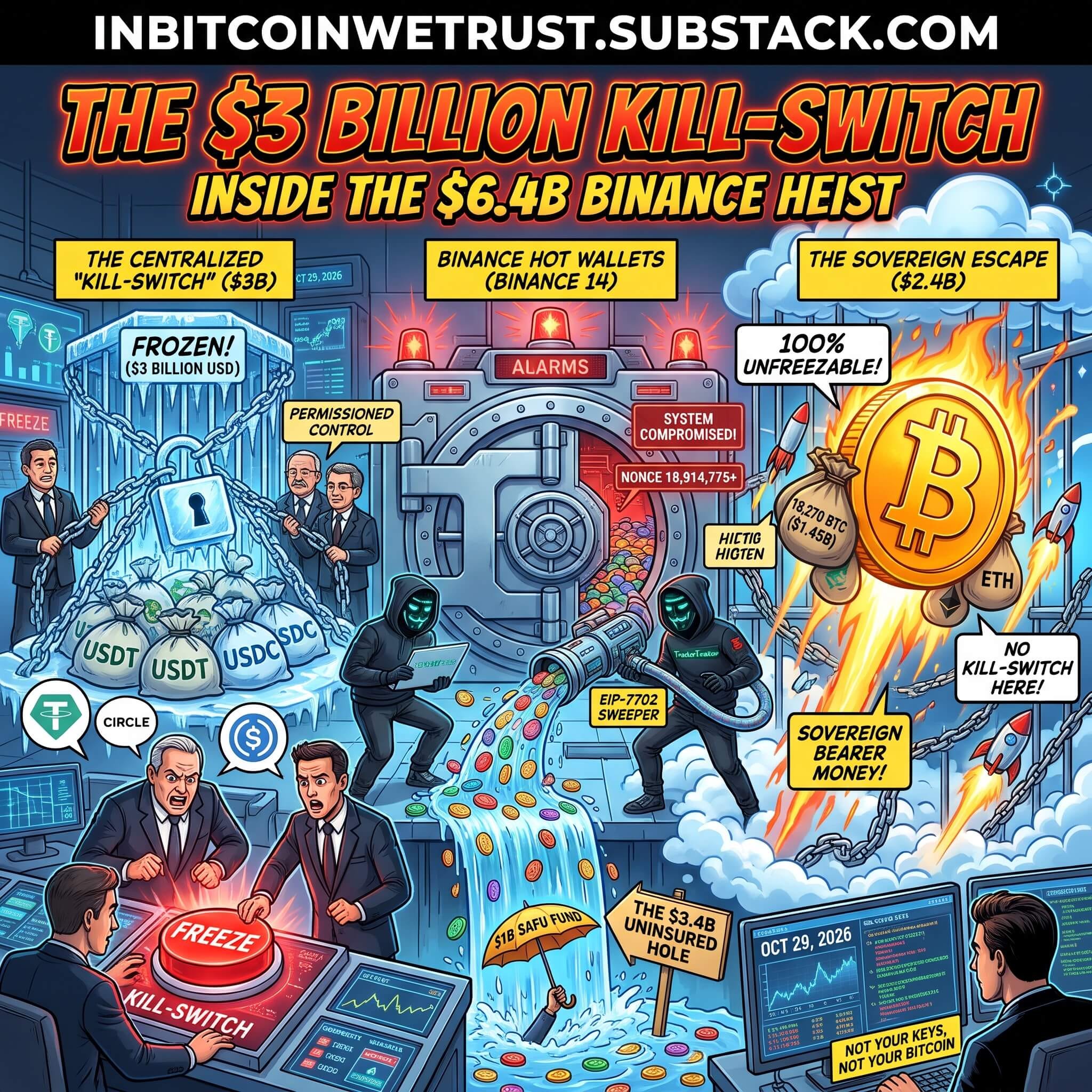
In twenty minutes on October 29, 2026, hackers drained $6.36 billion from the world’s largest crypto exchange without leaking a single private key. What happened over the next sixty minutes exposed the fatal flaw of custodial hot wallets, the illusion of “decentralized” stablecoins, and the unforgiving reality of 18,270 sovereign Bitcoin.
At 20:05 UTC on Thursday, October 29, 2026, the automated hot-wallet machinery of Binance—the largest cryptocurrency exchange on the planet—was humming along like a Swiss watch.
Inside the exchange’s cloud infrastructure, service containers were processing thousands of routine customer withdrawals per minute across Ethereum, Bitcoin, Tron, Solana, and half a dozen other networks. On Ethereum alone, the flagship hot wallet known on-chain as Binance 14 was incrementing its transaction counter—its cryptographic nonce—almost every second as user requests flowed through the signing pipeline.
Nobody on the security desk knew that for the past forty-eight hours, an intruder had already been sitting inside the walls.
Starting from a compromised laptop belonging to a DevOps engineer—alongside additional internal breach points that investigators are still unearthing—elite operators linked by TRM Labs and Chainalysis to North Korea’s TraderTraitor (Lazarus Group) had reached the holy grail of modern custodial infrastructure: the internal service container authorized to submit withdrawal requests to Binance’s signing engine.
They did not need to crack a 256-bit elliptic curve. They did not need to pry a seed phrase out of a hardware security module. They simply needed to tell the machine to sign.
At 20:20:59 UTC, the trap snapped shut.
Because Binance 14
was firing off legitimate user withdrawals every second, its nonce was a moving target. If the attackers submitted a single malicious delegation request tied to one specific nonce, a routine customer withdrawal would likely beat it to the block and invalidate the signature. So the attackers did something cold, surgical, and breathtakingly audacious: they tricked the signing service into pre-signing 50 consecutive EIP-7702 authorizations spanning nonces 18,914,775
through 18,914,824
, and bundled them into a single Ethereum Type-4 transaction.
Forty-nine of those authorizations missed the moving target and failed. One hit the bullseye.
**In that fraction of a second, without a single private key ever leaving Binance’s servers, **Binance 14
** was cryptographically hijacked.** Using Ethereum’s EIP-7702 smart-account delegation standard, the attackers attached a malicious smart-contract “sweeper” directly to the exchange’s hot wallet. Three minutes and twenty-four seconds later, at 20:24:23 UTC, the newly installed sweeper contract opened the floodgates—draining $2.5 billion in its first gulp, and then automatically emptying Binance 14
three separate times as Binance’s oblivious internal treasury software kept refilling the hot wallet to meet customer demand!
Simultaneously, across nine other blockchains—Bitcoin, Tron, XRP Ledger, Solana, Arbitrum, Optimism, Base, Avalanche, and Polygon—the compromised signing container rubber-stamped wave after wave of massive outbound transfers.
In roughly twenty minutes, $6.36 billion (initially estimated by Binance at $6.3 billion and tracked up to $6.4 billion at peak prices) vanished out the front door. It was more than four times the size of the $1.5 billion Bybit heist of February 2025. In dollar terms, it was the single largest financial robbery in human history.
Yet what happened during the next sixty minutes—between 20:30 UTC and 22:00 UTC—is far more important than the theft itself.
Because in the chaotic aftermath of those twenty minutes, the $6.36 billion loot split neatly down the middle into two completely different monetary universes:
Roughly $3 billionsat in centralized stablecoins and corporate tokens (USDT, USDC, RLUSD, XRP). Within hours, a handful of executives picked up their phones, pressed a central administrative kill-switch, and froze those $3 billion dead in their tracks.Roughly $2.4 billion—led by18,270 Bitcoin(~$1.45 billion) andover 420,000 to 508,000 Ether—escaped into the wild, where no CEO, no central bank, no security council, and no government on earth could freeze a single satoshi.
This is the complete forensic and philosophical autopsy of the October 29 Binance heist: how a $6.36 billion fortress was robbed without leaking a private key, how a 60-second cat-and-mouse race exposed the lie of “decentralized” finance, why a $1 billion SAFU fund cannot paper over a structural custody flaw, and why—seventeen years after Satoshi Nakamoto mined the Genesis Block—the world just received a $6.4 billion reminder of what makes Bitcoin unique.
The world’s richest man thinks AI and robots will make money irrelevant by 2036. It’s a dazzling economic forecast—and a catastrophic retirement strategy.
When Binance executives—including CEO Richard Teng, co-founder Yi He, and former CEO Changpeng “CZ” Zhao—addressed the stunned market on the morning of October 30, one sentence in Binance’s official incident report stood out above all others:
“We have found no evidence of any wallet private key leak.”
To an outsider, that sentence sounds reassuring—as if the vault doors held firm and only a window was broken.
To any systems architect or cryptographer, however, that sentence is ten times more terrifying than a leaked private key.
Think about what “no private key was leaked” actually means. It means you can build the most expensive Multi-Party Computation (MPC) cluster or Hardware Security Module (HSM) enclave on earth, shard the private keys across multiple continents so that no human being ever sees the raw 256-bit number, and still lose $6.36 billion in twenty minutes.
Why? Because of the fundamental architecture of a centralized exchange hot wallet.
When an exchange processes tens of thousands of withdrawals an hour across ten blockchains, a human executive cannot sit in an air-gapped Faraday cage manually verifying and signing each transaction on a hardware device. To give users the instant withdrawal experience they expect, the exchange builds an automated signing pipeline:
An internal
withdrawal service containeraggregates user requests, checks internal database balances, and formats raw unsigned transactions.That container passes the payload across an internal API bus to the
signing enclave (HSM/MPC).If the request comes from the authenticated service container with valid internal credentials, the HSM/MPC blindly produces a mathematically valid cryptographic signature.
Look at the fatal flaw in that chain: the HSM protects the key from being copied, but it does not stop the key from being used if the upstream orchestration container is compromised!
THE ANATOMY OF THE OCTOBER 29 BINANCE SIGNING BREACH
================================================================================
[1] INITIAL INTRUSION (48 Hours of Preparation)
• Compromised DevOps engineer laptop + "additional points of breach."
• Attackers pivot into internal production environment.
│
▼
[2] THE ORCHESTRATION HIJACK
• Attackers gain control of the internal Withdrawal Service Container.
• Private keys remain locked inside the HSM/MPC enclave—never leaked!
• Instead, the compromised container feeds unauthorized withdrawal &
delegation requests directly into the legitimate signing engine.
│
┌───────────────────┴───────────────────┐
▼ ▼
[3A] ETHEREUM: THE EIP-7702 TRAP [3B] BITCOIN & 8 OTHER CHAINS
• Signing engine pre-signs 50 • Signing engine signs 11 massive
consecutive nonces (18,914,775 BTC outputs totaling 18,270 BTC,
to 18,914,824) in a Type-4 tx. plus drains across Tron, Solana,
• Turns `Binance 14` into a self- XRP, Arbitrum, Base, Optimism,
draining sweeper contract. Avalanche, and Polygon.
• Drains `Binance 14` THREE TIMES • 18,270 BTC immediately enters
as automated scripts refill it! an automated peel chain.
================================================================================
Look closely at [3A]
in that diagram, because the way the attackers combined the signing-container hijack with EIP-7702 on Ethereum is a textbook case of complexity acting as an attack surface.
**Before Ethereum’s Pectra upgrade (which activated EIP-7702), an Externally Owned Account (EOA) like **Binance 14
** was just a simple public/private key pair**. If an attacker compromised your signing container for ten minutes, they could only steal whatever sat in the wallet during those ten minutes. Once you shut down the compromised container, your wallet address was safe again.
EIP-7702 changed the rules of Ethereum accounts so that a regular wallet address can sign a special Type-4 authorization tuple delegating its code execution to a smart contract.
When the TraderTraitor operators fed those 50 consecutive EIP-7702 authorizations into Binance’s signing engine at 20:20:59 UTC, they didn’t just sign a withdrawal—**they rewired **Binance 14
** itself**.
**By pointing **Binance 14
’s code pointer to their malicious sweeper contract, the wallet became a persistent trap. Minutes later, when Binance’s automated treasury management bots noticed that Binance 14
was running low on funds and dutifully transferred fresh waves of tokens from warm storage into Binance 14
to replenish it, the attacker didn’t even need access to the DevOps laptop anymore! The hijacked wallet automatically vacuumed the refills straight into the hacker’s coffers—emptying the wallet three separate times before engineers finally pulled the plug and suspended all exchange withdrawals at 22:15 UTC.
Compare that Rube Goldberg machine of cloud containers, DevOps laptops, automated refill bots, and smart-account code delegation with Bitcoin cold storage.
On Bitcoin, there is no EIP-7702. You cannot “delegate” a Bitcoin UTXO to a persistent sweeper contract that hijacks future incoming deposits. And when you store Bitcoin properly—in an air-gapped, multi-vendor, multi-signature cold vault where Partially Signed Bitcoin Transactions (PSBTs) must be physically verified by human eyes on independent hardware screens across geographically separated locations—a compromised DevOps laptop in an office building cannot steal a single satoshi.
Binance didn’t lose 18,270 BTC because Bitcoin’s cryptography failed. They lost 18,270 BTC because they kept $1.45 billion worth of sovereign bearer money wired up to an internet-connected, automated signing hose.
If the first twenty minutes of the heist were a masterclass in cyber-intrusion, the next forty minutes were the most revealing monetary experiment ever conducted on a public blockchain.
At 20:25 UTC, the North Korean operators looked at their freshly drained $6.36 billion haul across ten blockchains and knew they had a massive problem.
More than half of what they had just stolen wasn’t actually decentralized cryptocurrency. It was permissioned corporate IOUs:
Over
$1.6 billion in Tether (USDT)across Ethereum, Tron, and L2s.$823 million in Circle’s USD Coin (USDC).$88.5 million in Ripple’s RLUSDstablecoin.Millions more in centralized tokens and XRP.
Every single one of those smart contracts contains a hard-coded administrative function—addBlackList()
, freeze()
, or pause()
—controlled by a corporate legal department. The attackers knew that the moment alarms went off at Binance, urgent messages would fly to Tether CEO Paolo Ardoino and Circle CEO Jeremy Allaire.
So began a frantic, sixty-second-by-sixty-second race between North Korean laundering scripts and corporate compliance desks: