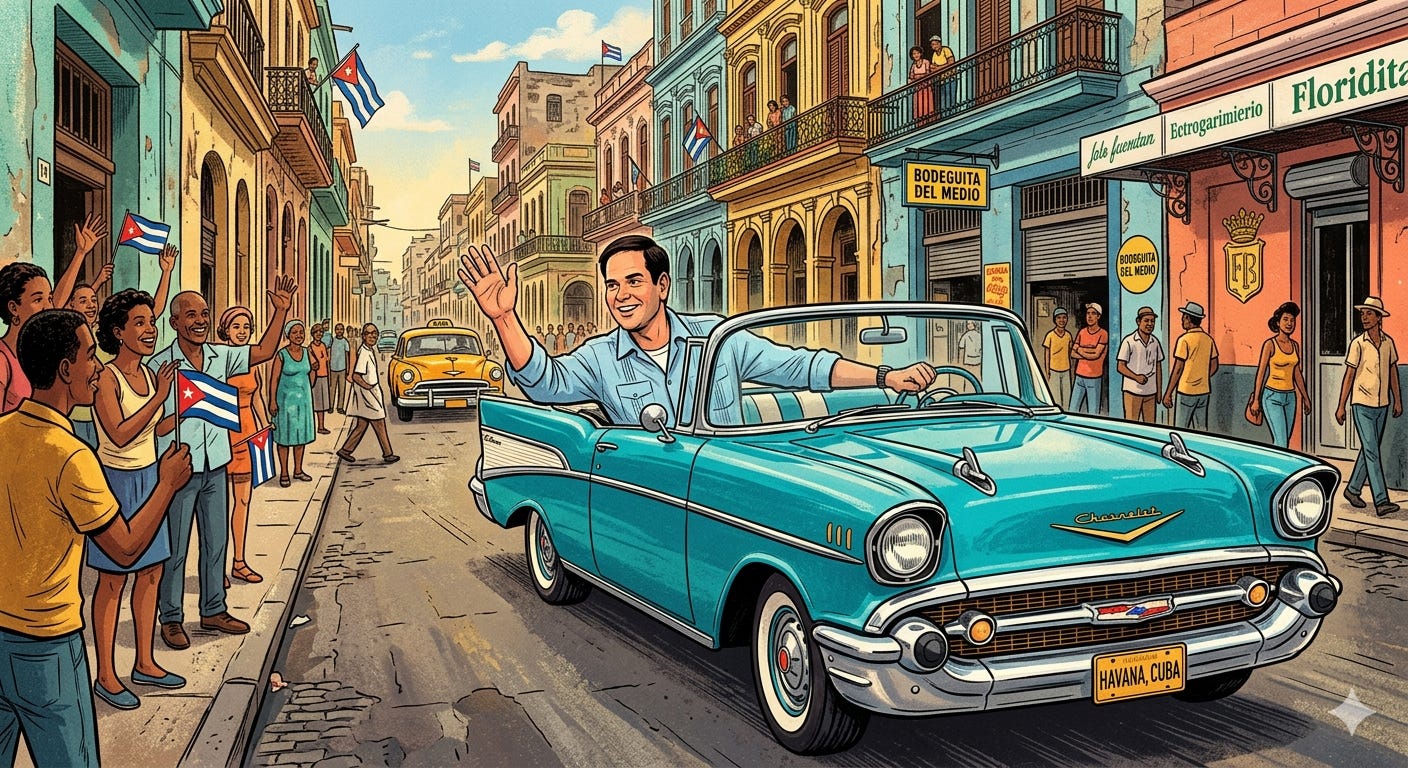
I’ve been to Havana twice. The last time was about ten years ago, and it is the saddest thing I have ever seen in my life.
It reminded me of Italy in the 1970s — except Italy had an escape valve. The family. The church. The black market. The sheer Italian will to find a way around every broken system. Cuba had none of that. What I saw was a magnificent people — talented, warm, resilient beyond any reasonable measure — ground down by 68 years of a system that delivered nothing but promises and darkness.
Literal darkness. The kind that now lasts 20 hours a day.
The ’57 Chevy is turning the corner. I can see it from here.
I’m telling you today, as someone who has stood in Revolutionary Square, walked those streets, looked those people in the eye: the liberation of Cuba is not a dream anymore. It is a timetable. And I’m putting my track record behind that call.
The Sequence I Called — And It’s Happening
I called Venezuela. I called Iran. I called the hemisphere realignment. Readers of FSN and my Substack know I’ve been documenting this geopolitical sequence in real time, with timestamps.
In January 2026, the United States military removed Nicolás Maduro from Venezuela in a pre-dawn operation. Marco Rubio — son of Cuban exiles, architect of the entire hemisphere strategy — emerged as the operational mastermind. Venezuela now does whatever Marco says. Delcy Rodríguez put herself “at the disposal” of the White House. The oil that used to flow to Cuba stopped the same day.
Then the blockade. Then the grid collapse. Three nationwide blackouts in March alone. As of Easter Sunday, Cuba was generating less than half the power its people need. Twenty-hour blackouts in tropical summer heat. Garbage piling up because the trucks have no fuel. Hospitals running on generators — when fuel is available. Families cooking on coal and wood in 2026.
The Cuban Communist regime is not being pressured. It is being switched off.
Marco Rubio’s Parents Left in 1956
One year before the last great Chevrolet rolled off the assembly line in Detroit.
Think about that. The cars that Cuba froze in time — the rolling sculptures that became the island’s most iconic image — are the same vintage as the year the Rubio family departed. Marco’s parents fled the gathering storm. They never went back as free people.
Their son is about to ride through Revolutionary Square in a ’57 Chevy.
I want you to hold that image. Because it is coming. And when it does, it will be the single most powerful political and human image of our lifetimes. Revolutionary Square — where Castro gave his marathon speeches, where Soviet missiles were paraded, where Che Guevara’s image stares down from the Interior Ministry — reclaimed in a single convertible ride by the son of Cuban exiles.
Every Cuban American who came over on a raft. Every family that lost everything. Every 90-year-old in Hialeah who has waited their entire American life for this moment.
The ’57 Chevy is finally turning the corner.
Why September — Before Early Voting Begins
I’m not just making a geopolitical call. I’m making a political one.
The Trump administration understands that a Cuba liberation headline in August or September — before early voting opens in October — is worth more than any jobs number or tax cut. This is the capstone. The finishing move. The thing no president since Eisenhower has been able to deliver.
Trump goes into the midterms with: Iran neutralized. Venezuela captured and in transition. Cuba liberated after 68 years. The Western Hemisphere essentially reclaimed. Brazil the only significant holdout left standing alone.
That is a wartime president’s foreign policy record compressed into two years. The political jolt for Republicans doesn’t just boost the midterms — it reshapes the entire electoral landscape. It electrifies the Hispanic vote in Florida, Texas, and beyond in ways no pollster has modeled.
The forcing functions all point to summer. The Cuban grid cannot survive another tropical summer at half capacity. The regime cannot function without fuel. The military — and this is my key analytical call — has already lost its will to fight.
The Cuban Army Watched Venezuela
The expert community keeps telling us the Cuban military is more loyal, more centralized, more ideologically committed than Venezuela’s. They are making an institutional analysis. I am making a human one.
Those Cuban generals watched what happened in Caracas on January 3rd. They watched Maduro’s personal security detail evaporate overnight. They watched Venezuelan generals who cut deals survive. They watched the ones who didn’t end up in American custody or exile with nothing.
Then they looked at their own families — suffering the same blackouts as everyone else. Their own salaries — worthless in a fuel-starved economy. Their own business interests through GAESA — just sanctioned directly by Rubio this week, who called it “the heart of Cuba’s kleptocratic communist system.”
The message to the generals was not subtle. Deal now, and your assets are protected. Wait, and they are seized.
An army that cannot feed its own families is an army already doing the math. The Cuban military has done the math.
The Blackouts Are Operational Cover
Here is the insight the think tanks in their air-conditioned Washington offices have completely missed:
The blackouts aren’t just political pressure. They are active force multiplication for whatever comes next.
Twenty-hour blackouts mean surveillance systems go dark. Communication networks degrade. Command and control breaks down. Radar and air defense require continuous power. The internal security apparatus — which depends entirely on surveillance — is functionally blind for most of every day.
The Maduro operation succeeded with a functioning Venezuelan grid. Cuba’s grid is already doing the operational preparation work — 24 hours a day, seven days a week, getting more degraded by the hour.
You don’t need to create the conditions for a successful extraction. The blockade already created them.
The Day After: America Arrives With the Lights
The day the extraction happens, the aid convoy is already moving. American power companies and grid contractors pre-positioned in South Florida. USAID and FEMA on standby — State Department personnel are already being detailed to US Southern Command in Miami right now. Food, medicine, generators flowing within hours.
The Cuban people don’t experience a military operation. They experience the lights coming back on.
And here is the question I want every skeptic to answer: Who else is going to do it?
Russia is broken by Ukraine costs. China has been specifically excluded by Rubio’s hemisphere strategy. Mexico backed down when threatened with tariffs for supplying oil. Venezuela is under American management. The EU will issue statements and attend cocktail parties.
Cuba has one option. One. And that option speaks Spanish, grew up in Miami, and is named Marco.
The grid cannot be restored. It must be replaced entirely — Soviet-era infrastructure, decades beyond its operational lifespan, cannibalized for parts, incompatible with modern technology. Which means American energy companies own the new grid. American firms rebuild Havana’s water and sewage. Florida ports become the logistics hub for the largest American construction project in the Western Hemisphere. And 1.4 million Cuban Americans — bilingual, capitalized, emotionally invested, connected — become the human bridge of reconstruction.
This is not charity. This is the opening of the most exciting emerging market in the Western Hemisphere, 90 miles from our coast, staffed by a highly educated population that has been desperate for opportunity their entire lives.
What I Saw In Those Streets
The Cubans are extraordinary. Musically, athletically, intellectually — the human capital on that island is remarkable. Doctors, engineers, artists, entrepreneurs — produced under impossible conditions, with zero resources, against every structural headwind imaginable.
Imagine what they produce with the lights on and freedom intact.
I witnessed the demoralization ten years ago — the beaten-down exhaustion of people who had learned not to expect anything to improve. That is the deepest wound. Harder to heal than the grid. Harder than the economy. You restore a people’s belief in tomorrow by delivering a better today, consistently, until the conditioning of 68 years finally breaks.
It will break. These people are indestructible. They kept those 1957 Chevrolets running through sheer ingenuity and desperation for seven decades. That is not a broken people. That is a restrained people.
The restraints are coming off.
The American Psyche Needs This Too
Since Reagan left office, America has won battles and lost eras. Gulf War — Saddam stayed. Iraq — won the war, created chaos. Afghanistan — 20 years, nothing. The cumulative weight of those incomplete victories on the American national psyche is profound and almost entirely unacknowledged.
Cuba is unambiguous. No asterisk. No quagmire. No “yes but.” The most enduring symbol of American Cold War failure — 90 miles off our coast, outlasting ten presidents — finally resolved.
For every American who grew up doing duck-and-cover drills. Who lived through the Missile Crisis. Who watched the Bay of Pigs humiliation. Who heard the word “Cuba” their entire lives as the thing we could never fix.
This closes a wound that has been open since 1959.
Trump gets the credit. Rubio gets the glory. America gets its hemisphere back. And a magnificent people — who kept the faith and kept those Chevrolets running against all odds — finally get to drive into their own future.