Danielle with the write-up of today’s Democracy-ish episode!
We are witnessing an unprecedented shift in modern political sentiment—a realignment so rapid and vast that the political apparatus is struggling to contain it.
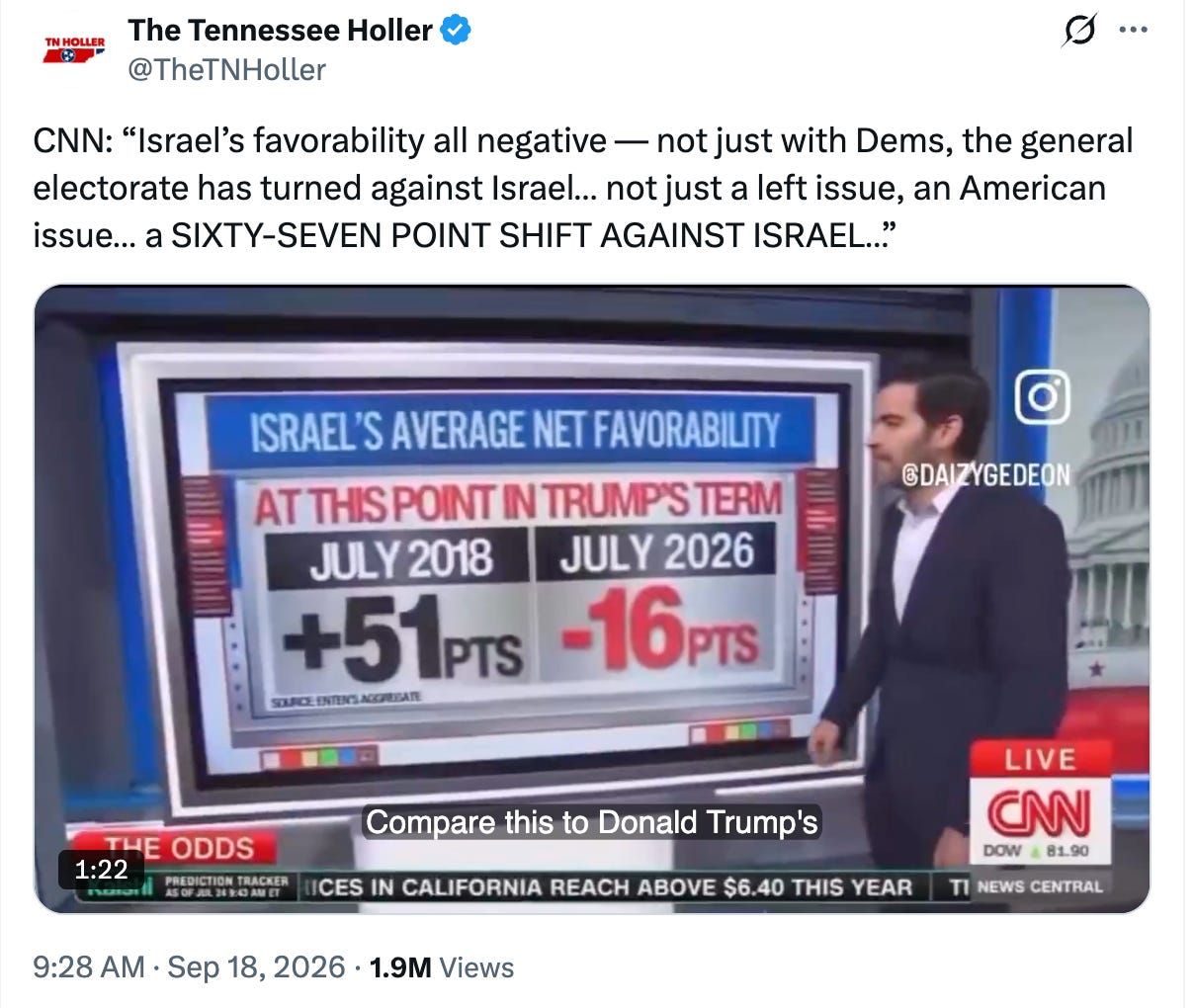
Data from major polling organizations, including Pew Research, Gallup, and Marquette University Law School, highlights a dramatic shift in public opinion. In less than a decade, net favorability for Israel among the American public shifted by 67 points—moving from +51 points to -16 points.
Shift in American Net Favorability (2018 vs. Present)
+51 [========================================] 2018 Baseline
-16 [============] Present Sentiment
This is not a localized trend confined to progressive circles; it represents a broader structural recalibration across the general electorate.
Political shifts often follow broad cultural realignments. Historically, when a geopolitical stance loses traction among younger generations and cultural influencers, official policy changes eventually follow.
For decades, the dominant political narrative surrounding foreign policy relied on a manufactured bipartisan consensus. Today, that consensus is fracturing. The proliferation of real-time digital media has bypassed traditional gatekeepers, allowing the public to witness events directly rather than through curated political framing.
When cultural figures, artists, and digital creators openly reject established political talking points, the traditional enforcement mechanisms of consensus begin to fail.
Despite this clear public shift, the institutional core of American politics remains largely unchanged. High-ranking leadership within both major parties continues to operate under rules established decades ago, backed by traditional campaign finance structures and PAC funding.
This creates a growing divide:
The Electorateincreasingly questions why billions in foreign aid are prioritized while domestic needs—healthcare, housing, infrastructure, and relief from inflation—remain unmet.The Leadershipdoubles down on legacy allegiances, viewing any departure from established policy as a political threat to be suppressed rather than an electorate to be answered.
Power structures rarely yield quietly. As institutional narratives lose credibility, enforcement becomes more explicit. We see this in the increasing pressure applied to media figures, political candidates, and cultural icons who challenge the status quo.
Yet, these defensive maneuvers often backfire. When institutional pushback becomes overly aggressive, it signals anxiety rather than strength, further alienating younger voters who view the old political guard as disconnected from reality.
We are entering a transitional period. The old paradigm can no longer command organic public support, but a new policy framework has not yet fully replaced it.
Over the next several election cycles, the tension between public opinion and institutional inertia will reach a breaking point. Politicians who rely on the old playbook will face mounting primary challenges and declining engagement from younger demographics. The collapse of the consensus is no longer a future possibility—it is already happening.
***Because I’m a terrible capitalist, here’s a great 25% off discount for new paid subscribers. It’ll only be about $3.75/month or $38/year.
There are no paywalls, and The Left Hook continues depending on the kindness of our readers
Thank you , , , , , and many others for tuning into my live video with ! Join me for my next live video in the app.