The agentic commerce stack separates into distinct layers:
**Commerce & Settlement:**Visa (including OpenAI partnerships), Google (UCP/AP2), Stripe (ACP/MPP), and x402 handle transactions and authorization.**Discovery:**The Agent Name Service (ANS)—moving under Linux Foundation governance—handles finding agents.**Context:**Model Context Protocol (MCP) provides the context interfaceafteran agent is found.
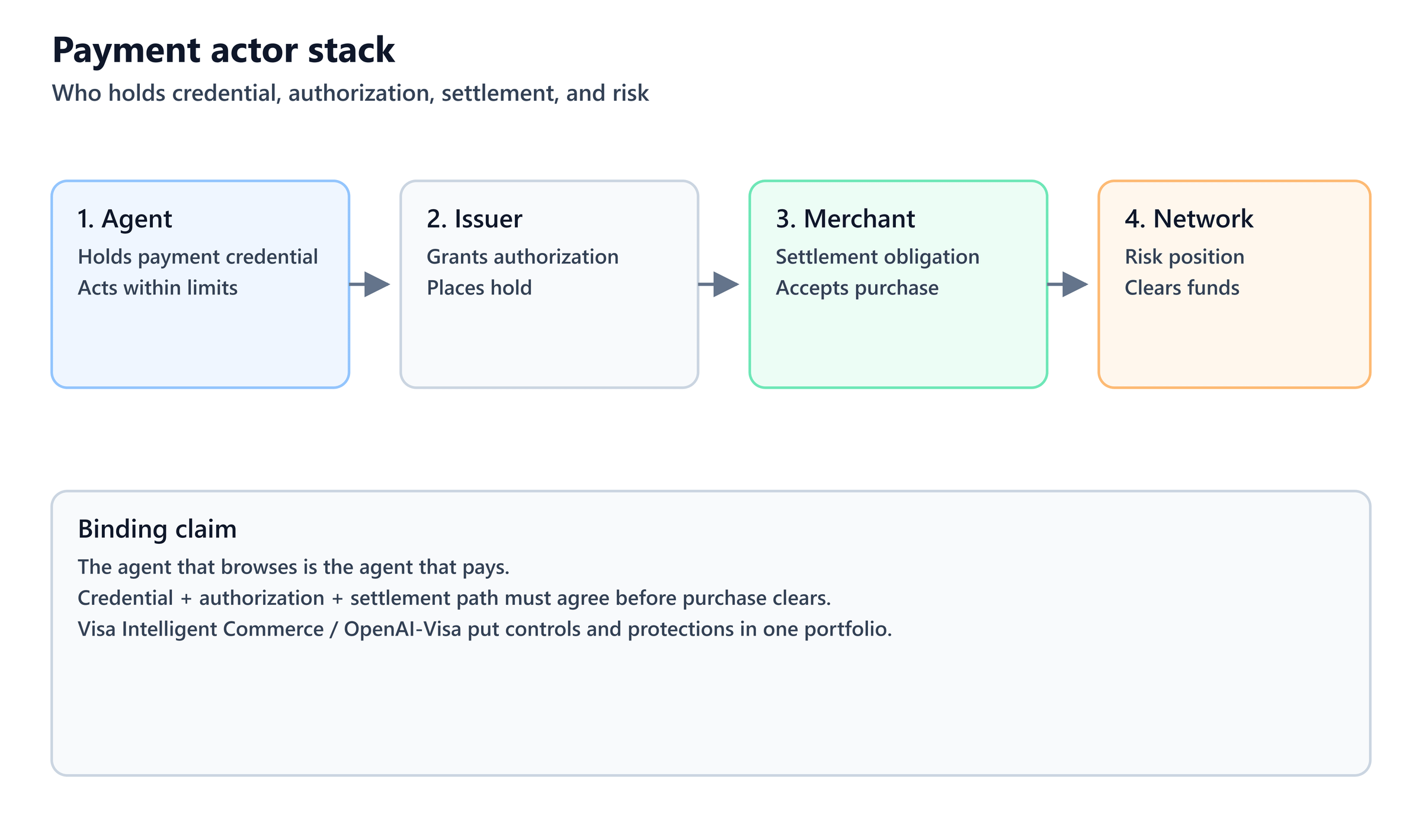
The buyer agent now acts as a payment actor. The agent holds a payment credential or payment token, the issuer or mandate layer holds the authorization, the merchant holds the settlement obligation, and the network holds the risk position.
Figure 1 is the payment actor stack: the agent, the issuer, the merchant, and the network.
Figure 1: Payment actor stack
The industry now splits by layer, not by a single winner protocol.
The roadmap ahead:
**The buying agent as a payment actor.**Stake: who holds the authorization and where settlement risk sits.**The protocol stack.**Stake: ANS discovers, MCP provides context, ACNBP binds capabilities, then ACP/UCP, AP2/TAP/Agent Pay, and x402/MPP finish the purchase.**The checkout gap.**Stake: four failure points between browse and settlement.**Fraud and agent identity.**Stake: Visa Trusted Agent Protocol, Mastercard Agent Pay, and the risk models behind them.**The merchant integration.**Stake: merchant API plus MCP context providers after ANS resolution.**The settlement rail.**Stake: authorization is a promise, and the promise is not the payment.
Visa Intelligent Commerce is Visa's strategic portfolio for the age of AI agents. It treats agents, issuers, merchants, and developers as the actors in a purchase, and it embeds payment credentials, controls, authentication, and protections into automated buying.
The portfolio exists because digital commerce shifted toward AI-agent-driven purchases, and companies faced a gap between automation, security, and a checkout path the merchant can settle. Visa opened that portfolio to AI platforms in 2025 and then deepened the OpenAI collaboration in June 2026: Visa supplies network, tokenization, authorization, agent identification, and fraud monitoring; OpenAI surfaces agent-initiated Visa payments inside user-set limits, merchant-category controls, and required approvals.
The OpenAI-Visa partnership puts two of the largest actors in the agent economy on the same rail. Visa partners with OpenAI on agentic commerce. Jack Forestell, Chief Product and Strategy Officer at Visa, said that as agents enter payment flows, trust and security are the infrastructure that makes the system work. That framing matches Visa's Trusted Agent Protocol release and the Intelligent Commerce product line. The public materials describe a strategic collaboration and network integration. They do not describe a Visa equity investment in OpenAI, so this post does not claim one.
The buying agent now settles payments on production paths, not demo paths alone. Instant Checkout in ChatGPT, powered by the Agentic Commerce Protocol (ACP) co-developed by Stripe and OpenAI, put in-chat purchase into US retail flows starting September 29, 2025. Salesforce announced ACP support with Stripe on October 14, 2025. Google launched the Universal Commerce Protocol (UCP) for agentic shopping across Search AI Mode and Gemini, with AP2 as the paired authorization layer. The question moved from whether an agent can buy to whether an agent can buy safely, within limits, with a merchant that remains merchant of record, and with settlement that does not break the order.
The Visa portfolio covers pieces that used to sit in separate systems. The agent holds a tokenized payment credential. The issuer holds the authorization. The merchant holds the settlement obligation. The network holds the risk position. Visa Intelligent Commerce puts the controls in one place so the agent can act inside buyer rules, and it puts the protections in one place so the agent cannot act outside those rules.
The measured base is large on the card-network side and early on the machine-payment side. Visa reports 4.8 billion payment credentials across its global network, more than 175 million merchant locations that accept Visa, and 300 billion-plus transactions processed annually on the Visa network. On the HTTP-native side, x402.org reports 75.41 million transactions, $24.24 million in volume, 94.06 thousand buyers, and 22 thousand sellers in its last 30 days. CoinDesk's July 15, 2026 coverage of the x402 Foundation launch used the same public 30-day band. Those x402 numbers measure micropayment traffic, not Visa-scale retail settlement.
The settlement path remains the binding constraint after authorization. An authorization is not a settlement. The agent can hold an authorization within a limit and still fail when funds must move. The merchant holds the settlement obligation until the funds clear.
The credential and the authorization are different objects. The credential is what the agent presents. The authorization is what the issuer, mandate layer, or payment handler grants. The settlement is what clears funds to the merchant. The agent needs all three to complete a purchase, and the merchant needs all three to remain whole.
See Visa Intelligent Commerce and the Visa-OpenAI partnership note for the public trust-layer framing. The work moved from research talk to integration work across Visa Intelligent Commerce, ACP checkout, UCP surfaces, and machine-native settlement protocols.
The single authorization question does not have three competing answers. A complete agent purchase crosses six layers, and each layer has its own protocols. Discovery is not MCP. Discovery is ANS.
Figure 2 is the protocol stack: ANS discovery, MCP context providers, ACNBP negotiation and binding, commerce, authorization, and settlement.
Figure 2: Protocol stack with ANS discovery and ACNBP binding
The first layer is discovery and agent identity. The Agent Name Service (ANS) is the DNS-inspired directory for secure AI agent discovery, registration, renewal, and capability-aware resolution. The May 2025 ANS paper and OWASP GenAI Agentic Security Initiative resource define PKI-backed identity, structured ANSName records, and a protocol adapter layer that can surface A2A, MCP, and related endpoints after resolution. On June 23, 2026, the Linux Foundation announced its intent to launch ANS as an open standard anchored to existing DNS infrastructure, with federated identity, verification, and discovery without a proprietary central registry. ANS is the public name and trust lookup. It answers who the agent is, what it advertises, and where a verifier can reach it.
The second layer is context providers. Model Context Protocol (MCP) is how an agent calls tools, resources, and prompts once it already knows which server to open. Anthropic donated MCP to the Agentic AI Foundation under the Linux Foundation in December 2025. MCP is not a global agent directory. An MCP server exposes context and actions for a known endpoint. Commerce profiles and .well-known
server cards can help bootstrap an MCP session, but they still assume the agent already has a candidate host. Confusing MCP with ANS collapses lookup into tool invocation and leaves open-market agent discovery unsolved.
The third layer is capability negotiation and binding. This is the missing middle of today's production stacks, and it is where the Agent Capability Negotiation and Binding Protocol (ACNBP) matters even while it remains a research protocol. ACNBP, published on arXiv as 2506.13590 on June 16, 2025 by Huang, Sheriff, Narajala, and Habler, and later appearing in IEEE AIXDKE 2026 proceedings, defines a 10-step path that starts with ANS capability discovery, then runs candidate pre-screening, secure session negotiation, capability attestation, and cryptographically signed binding commitments. ACNBP integrates directly with ANS. It does not replace ACP checkout or AP2 payment mandates. It answers a different question: after ANS returns candidate agents, which provider can actually deliver the required capability under attested terms, and what verifiable binding commits both sides before commerce or settlement begins.
That gap is operational today. Closed agent commerce works because ChatGPT Instant Checkout, Google AI Mode, Shopify Agentic Storefronts, and Visa/Mastercard registered-agent programs preselect partners. Open agent markets do not. Without a negotiation and binding layer, a buyer agent that resolves a merchant or specialist agent through ANS still has no standard way to verify capability claims, reject unsuitable candidates, or produce a non-repudiable capability contract before it opens ACP/UCP checkout or spends against an AP2 mandate. ACNBP is not production infrastructure yet. It is the clearest public specification of the layer the rest of the stack assumes exists inside proprietary partner onboarding. Treat it as a research control plane for heterogeneous agent collaboration, not as a settled retail standard.
The fourth layer is commerce and checkout. ACP, the Agentic Commerce Protocol, and UCP, the Universal Commerce Protocol, compete here. ACP is an open standard maintained by OpenAI and Stripe, with Meta listed among lead maintainers in Stripe's ACP documentation. It defines agentic checkout, cart and feed, delegated payment handlers, delegated authentication, and order webhooks. UCP is Google's open standard for the broader shopping journey from discovery through post-purchase, co-developed with Shopify, Etsy, Wayfair, Target, Walmart, and a large partner council that includes Visa, Mastercard, Stripe, and Salesforce. UCP is designed to work with AP2, A2A, and MCP. Both keep the merchant as merchant of record. Merchants pick a checkout surface, or they let a platform such as Shopify abstract both.
The fifth layer is authorization and agent trust. AP2, the Agent Payments Protocol, is Google's open protocol for cryptographically signed mandates that prove a user authorized an agent to buy and to pay. Google announced AP2 in September 2025 with more than 60 organizations, then donated AP2 to the FIDO Alliance on April 28, 2026, and released v0.2 with Human-Not-Present autonomous payments based on pre-authorized instructions. Mastercard co-developed Verifiable Intent as an AP2-compatible evidence standard, also moving into FIDO. Beside AP2 sit the network trust protocols: Visa Trusted Agent Protocol and Mastercard Agent Pay. Those protocols identify the agent to the merchant. They do not replace ANS discovery, MCP context access, ACNBP binding, checkout semantics, or settlement rails.
The sixth layer is settlement. Card rails remain the default for consumer retail checkout through ACP and UCP. Machine-native settlement sits on HTTP 402 Payment Required. x402, contributed by Coinbase and now stewarded by the x402 Foundation under the Linux Foundation as of July 14, 2026, makes 402 the payment primitive for software-to-software micropayments. MPP, the Machine Payments Protocol, co-authored by Stripe and Tempo and launched March 18, 2026, uses the same 402 challenge pattern for agents paying APIs and services, with Shared Payment Tokens for cards and stablecoin methods for crypto. MPP belongs with x402 on the settlement layer. AP2 belongs on the authorization layer.
The disagreement that matters operationally is layer-local. ANS and MCP disagree only if someone forces MCP to do directory work it was not designed to do. ACP and UCP disagree about commerce semantics and surface reach. AP2, Visa TAP, and Agent Pay disagree about how trust and mandates travel. x402 and MPP disagree about machine-native settlement packaging while sharing the HTTP 402 pattern. ACNBP sits between ANS resolution and those production commerce rails. A merchant that publishes only an ACP checkout still needs discovery, context exposure, authorization, and settlement. A merchant that sits behind an x402 server still needs agent identity if it wants to tell a trusted buyer agent from a bot.
The field will not collapse to one acronym soon because no single protocol spans discovery, context provision, capability binding, commerce, authorization, and settlement. A realistic future path resolves agents through ANS, opens context through MCP, negotiates and binds capabilities through an ACNBP-class protocol when the counterparties are not pre-integrated, runs checkout through ACP or UCP, attaches an AP2 mandate or network trust signal, and settles over card rails or, for machine-to-machine cases, x402 or MPP.
Primary references for that stack include the ANS paper, the Linux Foundation ANS announcement, the ACNBP paper, MCP's AAIF move, Stripe's ACP docs, Google's UCP guide, AP2, x402, and Stripe's MPP launch.
The checkout gap is four points wide. The first is the exposed surface. The second is the record. The third is the funds. The fourth is the decision.
Figure 3 is the checkout gap: four failure points between browse and settlement.
Figure 3: Checkout gap