ChatGPT began as a consumer sensation, creating the illusion that this cycle would unfold like the web: new entrants would rapidly create new categories and use them to disrupt established players.
Instead, AI has revealed something fundamental about real intelligence. It depends on context: localized, proprietary, and often tribal knowledge.
Most of that knowledge is trapped inside enterprises, fragmented across dozens of systems, buried in operating processes, or held tacitly in the minds of the people who understand how the business actually works.
This is the central paradox of the cycle. The web advanced by democratizing distribution. AI can only continue advancing by unlocking the contextual intelligence held inside the enterprise vault.
But unlocking it is not merely a technical problem. Enterprises must be given a reason to participate without surrendering the core logic, knowledge and identity that make them valuable. They need to co-opt AI without allowing AI to absorb and ultimately replicate the entire business.
That is the essence of the transition: turning enterprise knowledge into machine intelligence without dissolving the enterprise itself.
Companies are not entering Enterprise AI. It is being entered by alliances.
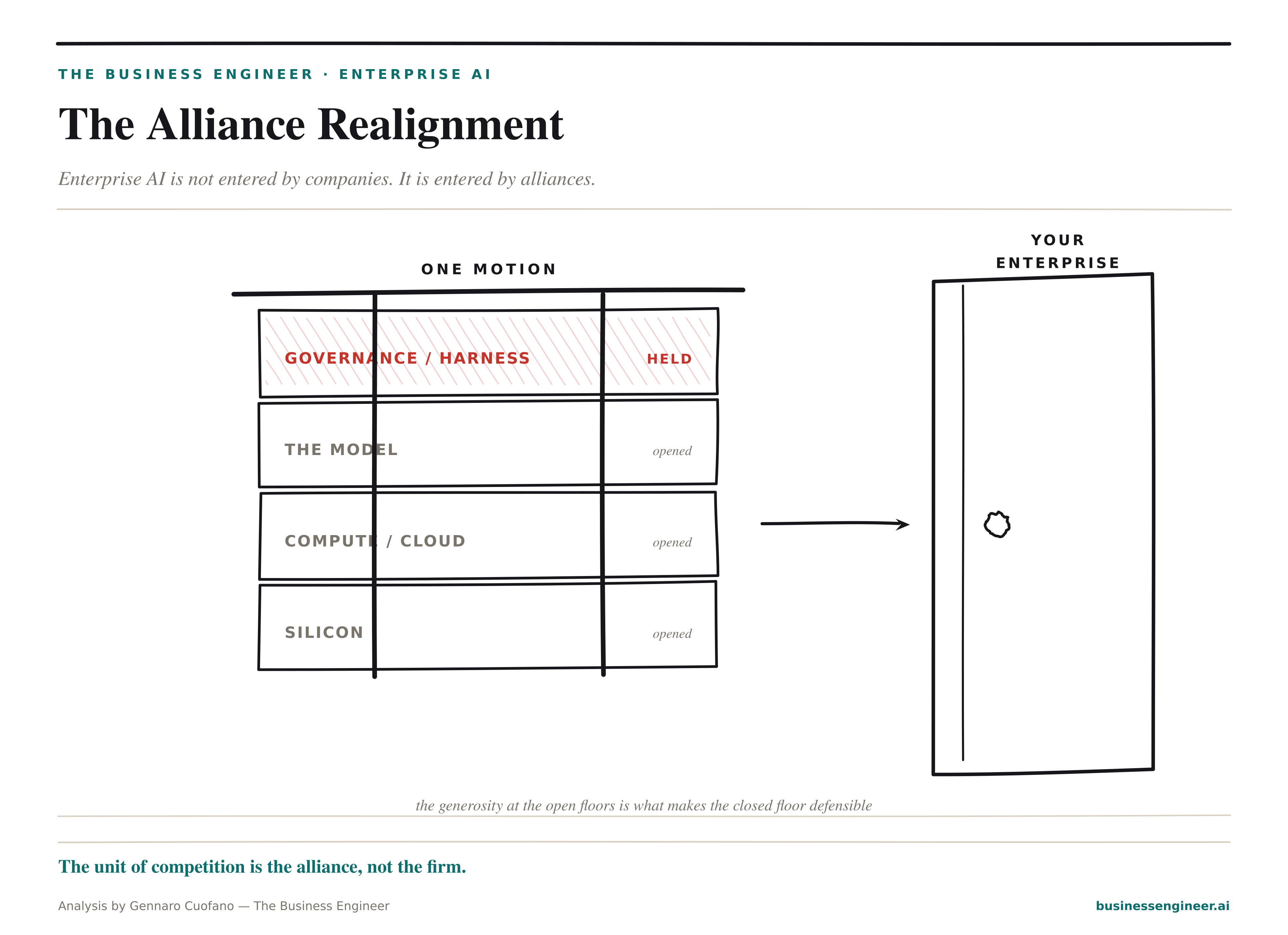
A stack arrives as one motion. Compute underneath, a model in the middle, a governance layer on top, an integrator to wire it in. Each ally opens the floors below its hold and keeps the hold itself. This summer those alliances reordered in public. One player took the lead by naming the buyer’s deepest fear and giving it a single word. The largest model labs conceded the point — then started copying the motion they had just conceded to.
The mistake is to treat the vendor as the unit. Which model won. Which platform leads. Which chip is fastest. That is a category question. It cannot tell you the two things a purchase turns on: where value pools, and where you get locked in.
No enterprise buys a model. It buys a stack that has already decided how its members fit together.
**The unit of competition is the alliance, not the firm.**Every player in that alliance is also playing its own book. The coalition is the gift. The book is the price.
A junction, here, is the layer everything routes through and leaving costs a fortune. An end is the layer you rent and swap. Score both from the buyer’s seat, not the pitch deck. You do not need the rest of the map.
They do different work. Read them together and you have the board.
The vendor-to-vendor stack. Two or more companies at different layers, entering as a single offer. A multi-layer stack, sold as one decision. The buyer is not choosing a model, a cloud, and an integrator in three meetings. The buyer is choosing a coalition that has already decided how those parts fit.
Nvidia and Palantir on a sovereign engine. Microsoft and OpenAI. Amazon and Anthropic. ServiceNow wiring Claude into workflow. Oracle and Palantir on sovereign cloud. Same species. Different books, visible the moment you ask the reading-rule question of each.
Identify which layer each ally opens, and which it holds. The generosity at the open floors is what makes the closed floor defensible. Partner today, rival at renewal.
Work it. Nvidia/Palantir: Nvidia opens the silicon and the open-weight model; Palantir opens the model too; neither opens the Ontology.
Microsoft/OpenAI: Microsoft opens the cloud and the identity plane the model runs through; OpenAI holds the model — and, as of this year, is climbing into the harness above it.
Amazon/Anthropic: Amazon opens the operational substrate; Anthropic holds the model, and now a services firm that puts it in.
ServiceNow/Claude: ServiceNow holds the workflow control plane; Anthropic opens the model into it.
Oracle/Palantir: Oracle opens sovereign cloud; Palantir holds the decision layer that lands on it.
The open floor is why the meeting happens. The held floor is why the renewal is expensive. If you cannot name both, you are reading the press release.
The substrate coalition. A signed industry structure whose membership list is the argument. The open-weights advocacy letter. The security alliance formed around shared agent-auditing tooling. These are not products. They are not stacks. They are declarations of whose economics depend on a given layer staying open or staying closed.
A vendor-to-vendor stack sells you a motion. A substrate coalition tells you which motion is even allowed. Who signed the security alliance told you which firms can live with a cheap, inspectable model layer. Who did not sign told you which firms cannot.
The most informative thing about a substrate coalition is never who signed. It is who didn’t. The absences draw the counter-coalition with more precision than the signatures draw the coalition.
This summer the absences were the closed frontier core. That was not a social fact. It was a map of who still needs the model layer to stay proprietary — and, as the rest of this piece shows, of who then spent the summer trying to occupy the floor above it anyway.
The enterprise-as-co-designer alliance. The customer is not a buyer. It is a member. Kirkland & Ellis, Centrus, McCarthy, a national health service, an integrator like PwC embedding at scale. The asset produced is not a licence. It is the customer’s own codified expertise — the judgment, the objects, the decision rights — written into a system the customer is told it controls.
Told. That word is doing the work. Co-design is the most flattering of the three species, and the easiest to misread. The enterprise arrives with its data and its hardest problem. It leaves having built. The asset has its name on it. Whether the asset can leave is a different question, and it is the only one that decides if membership was sovereignty or a very expensive onboarding.
The Sovereignty Bootcamp is this species, industrialised: a thirty-day cadence in which co-design is the sales motion, and the thing co-designed lives, from that day, in the vendor’s typed graph.
The summer ran through all three at once. Vendor-to-vendor stacks reordered around who holds the floor above the model. Substrate coalitions drew the line between firms that need the model closed and firms that need it cheap. Co-design became a demand engine. The through-line is a word. And a fact: every ally is playing a different book inside the same motion.
The coalition agreed on the entrance. It does not agree on the furniture.
Palantir holds the typed operating model of the business — the Ontology — and the decision surface that writes back into it. It opens everything beneath that floor: the model, the silicon, even the cloud in a sovereign configuration. It sells the open floors as sovereignty. It grows the held floor until the held floor is the company’s essence. The FDE was its invention. The bootcamp is the industrialised version. The vocabulary is alpha. Palantir does not need to win the model layer. It needs the model layer to become cheap.
OpenAI has rewritten its book in public. For two years the book was: hold the scarce model, let Microsoft open the cloud, let the API be the product. That book is no longer enough, and OpenAI knows it. The new book is two-track. Keep the model. Climb into the floor above it. In February it shipped Frontier — in its own language, “the underlying intelligence layer governing all of a company’s agents,” a “unified operating layer” whose Business Context connects warehouses, CRMs and internal apps and builds “durable institutional memory.” In May it stood up the OpenAI Deployment Company, majority-controlled, seeded with more than four billion dollars, and acquired Tomoro for roughly 150 forward-deployed engineers on day one. In July the same vehicle agreed to acquire Northslope, founded by former Palantir FDEs, adding hundreds more. OpenAI is no longer only selling tokens. It is trying to own the harness those tokens run inside, and the people who wire that harness in.
Anthropic is adjacent, not identical. Hold the model. Differentiate on trust. Let partners open the workflow — ServiceNow, the clouds, the integrators. The new chapter is implementation. In May a joint venture with Blackstone, Hellman & Friedman and a PE consortium acquired Fractional AI. In July it launched as Ode: Claude-first, not Claude-exclusive, a services firm whose job is to put Claude into companies that cannot staff the implementation themselves. Anthropic is not, yet, shipping a named ontology. It is buying the human layer that used to sit between the model and the customer’s operating system. Labour and pattern, not a typed graph. Still a junction.
Nvidia opens the weights and the sovereign engine, convenes the security alliance, and keeps the floor that does not travel: the instruction set. It can sit on every coalition because the silicon is downstream of every one of them. The open-weight letter is substrate politics in service of that book.
Microsoft and Amazon hold the control plane of the cloud they already own. Identity, tenancy, the governance catalog, the bindings that make a “portable” model operationally immovable. Microsoft’s alliance led with OpenAI and now runs Palantir on Azure as well. Amazon’s led with Anthropic. Both have stood up their own forward-deployed motions. They do not need to win the model. They need whichever model you pick to run inside a control plane that does not export.
The alliance is how they enter. The book is what they keep.
For two years, the center of gravity was the frontier lab. The model was scarce. The labs held it. Every stack organized itself around whose model sat in the middle. Microsoft led with OpenAI. Amazon led with Anthropic. The lab was the sun.
Palantir refused to organize around a model at all.
The Nvidia partnership is the cleanest expression. A sovereign engine, open-weight Nemotron, on the customer’s own hardware, air-gapped and classified, the customer owning the resulting weights and the training data. Read it through the rule. Nvidia opens the silicon and the model. Palantir opens the model too — swap it freely. What neither opens is the layer that binds the customer’s data into a typed, live operating model of the business, and the decision surface built on top of it.
That layer is Palantir’s. It does not travel.
Everyone else organized the alliance around the layer they wanted to hold. Palantir organized it around the layer the buyer most fears losing, then opened everything else, so the held layer would look like sovereignty rather than lock-in.
The Ontology is a live, typed model of the business — objects, relationships, action types, decision rights — that the rest of the stack writes against. The model underneath is interchangeable. The Ontology is not. Swap OpenAI for Anthropic for an open-weight model on your own iron. Nobody cares. You cannot take the decision graph with you when you walk.
The model is a decoy. Palantir hands you the one freedom that no longer matters, and keeps everything that compounds.
That is a genuine improvement on what the labs were selling two years ago. It is also, still, a lock-in. Both facts have to be held at once.
Score Palantir against the closed-frontier default, honestly.
The first lab offer was a gravity well. The model was the product. Context, memory, and a meaningful share of enterprise state lived, at least in part, on the lab’s infrastructure. Retention was justified as safety — catching attacks that span many requests — and had the convenient property of keeping the company’s working memory on the vendor’s side of the wall. The switching cost was not a contract. It was judgment, migrating.
Palantir’s offer is better than that, and it is not subtle. The model is portable by design. The sovereign engine can run on the customer’s hardware. The FDE and the bootcamp build on the customer’s own data. Relative to “your alpha lives in our model, on our servers, metered by our tokens,” this is a structural upgrade. Anyone pretending otherwise is arguing from a prior.
Then look at where the company’s essence goes.
The Ontology is not a dashboard. It is the place the business is rewritten as objects, links, action types and write-backs. Once that rewrite is done, the Ontology is no longer a view of the company. It is the company, as far as the operating system is concerned. New decisions execute against it. New agents read it. New employees learn it. The longer it runs, the more the enterprise’s alpha — the codified judgment, the proprietary data model, the operational know-how — lives there, rather than in the heads and systems of record it was extracted from.
Palantir’s proposition is a real improvement over full lab lock-in. The model is no longer the cage. The cage moved one floor up.
So the honest question is not whether Palantir is better than OpenAI. It is whether the Ontology is portable.
Palantir’s own documentation is more precise than the pitch. There is an export. Ontology Manager dumps a working state to JSON and imports it back — to edit in code, or to copy one Ontology to another Ontology. On the same page, Palantir tells you not to depend on the exported schema, because it may change. Conditional formatting cannot be imported to an Ontology other than the one it came from. This is a Foundry-to-Foundry working-state tool. It is not an exit.
What does not travel as a running system: the action-types and validation engine, the write-back path, the decision graph as a live object, the Workshop surfaces, the accumulated operational state that makes leaving cost more every day you stay. You can, with enough engineering, recover a picture of the objects and links. You cannot pick up the company’s essence and set it down on a competitor’s platform on Monday.
**There is an export. It is not a portable Ontology.**If the layer that holds your alpha cannot leave, you have not bought sovereignty. You have chosen a better landlord.
Against the original lab offer, Palantir is the less extractive deal. Against the standard the sovereignty pitch itself sets — your alpha stays yours — the Ontology fails the test. The doctrine is correct. The implementation is the junction the doctrine told you not to cede.
An API is an end. A pilot is a conversation. Production is a person sitting inside the customer’s mess — the identity graph, the legacy systems, the approval chain, the data that is not in the warehouse — and building a system that writes back.
Palantir named that person a forward-deployed engineer more than a decade ago. Until 2016 it had more of them than software engineers. The industry spent two years pretending the model had made that job obsolete. This summer it spent billions admitting it had not.
OpenAI’s Deployment Company launched in May, majority-controlled, seeded with more than four billion dollars, and acquired Tomoro for roughly 150 FDEs from day one. In July it agreed to acquire Northslope, its second such deal, adding hundreds more. Northslope was founded by former Palantir FDEs. OpenAI is not approximating Palantir’s labour model. It is importing it, including the people who used to perform it for Palantir. The official post even leaves the door open to joint commercial engagements with Palantir after close. Copy, hire, and partner, simultaneously. That is not confusion. That is a player paying to hold all three options.
Anthropic made the same admission on a different structure. The May joint venture acquired Fractional AI as its operating core. In July it launched as Ode: standalone, Claude-first, not Claude-exclusive, aimed at companies that cannot staff the implementation. Anthropic’s internal team keeps the strategic deployments. Ode industrialises the rest. The book is still the model. The new chapter is that the model does not enter the enterprise without a human layer Anthropi…