"The first principle is that you must not fool yourself, and you are the easiest person to fool." Richard Feynman
Twenty-five years ago this Friday. Second day for me on the news equities trading floor at Lehman; seventh floor, facing east; so, looking right at the Twin Towers. Felt the impact of the first plane, saw the black billowing smoke. We were told to stay in place because the initial reports were that it was a Cessna. Trust me, it sisnt look like that. A few minutes later, the second plane flew into the other Tower, and we evacuated. I headed straight for the ferry, even though my car was four floors below in the subterranean parking. Many of my co-workers turned right out of the building—despite the triage in our atrium—because it was ‘just a fire.’ I still cant go down there without getting flashbacks of things I saw, and I left before the towers collapsed.
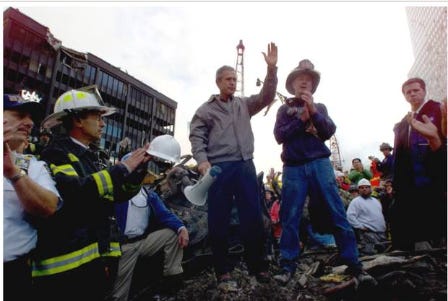
The 9/11 photograph above is from the fourteenth, three days after, and it is the one everybody remembers. What almost nobody remembers is the sentence that ran alongside it for the next ten months.
‘The air is safe to breathe.’
It’s funny, in a very not-haha funny way; 2 weeks after we evacuated, we were in Jersey city when we began getting calls that the cars were actually fine and we could come, 2 at a time, to retrieve our cars. We went to Police Precinct ! and were driven into the forzen zone by the police, walked down four floors of the heliz ramp and there were the cars- not wet, not dusty. Drove out, and followed the cops back out. When we got to Chambers, there were men in
full hazmat gearsteaming off the cars. I remember thinking, ‘what the hell was I just breathing if they are doing that’. Thankfully, I was there for maybe 15 minutes.The Mamdani administration releases 170,000 pages today. Air quality reports, contamination records, correspondence among city officials, sitting in 68 boxes in a city office for twenty-four years, found last year, published this morning through a portal that cost $34 million to build. Ten months after the towers came down, inspectors were still finding asbestos half a mile out. A November 2001 audit submitted to the EPA had benzene spiking at the footprint and asbestos concentrations RISING at the Fresh Kills landfill. Deutsche Bank at 130 Liberty tested above the one percent threshold throughout the building. The city told people to clean up with wet mops and rags.
Giuliani, late October 2001: ‘I come down here in the morning and sometimes the odor is terrible. You smell it and you feel there must be something wrong with it. But what I’m told is that it is not dangerous to your health.’ Bloomberg, four months later: ‘Every test that has been done says the air quality was in acceptable limits. I think some people are just never going to want to believe that.’
Jerry Nadler, this week: they knew, and all they cared about was getting Wall Street reopened.
More people have now died of what they breathed than died on the day. Lung cancers, blood cancers, respiratory disease. Michael Verzi was a New York City firefighter and he died of lymphoma in 2022, and his wife says they were told the air was fine, and that they would have gone anyway, and that maybe different precautions would have been taken. Read that last clause twice.
The president, for his part, spent Labor Day at Bedminster posting a video of himself at Ground Zero in an immaculate black suit and a pressed white shirt without a speck of dust on him, captioned as what he saw ‘hours after’ an attack the footage postdates by two days. Hours later he told Trey Gowdy he went down ‘the following day’ and ‘we worked long and hard.’ In the same interview the towers grew to 115 stories. They were 110. He accepted $150,000 from a federal recovery program for a building he had told German television was unaffected, and the Comptroller found no record of the $10,000 he pledged to the Twin Towers Fund. On Friday he will be at the Pentagon rather than at Ground Zero, because the Memorial does not let politicians speak at its ceremony and the Pentagon is a venue he controls. Vance goes downtown in his place. Biden, Obama, Clinton and Bush will all be standing there.
He spent Sunday posting more than sixty times, including a demand that New Mexico be renamed New America, a map annexing Canada and Greenland, and a claim on the moon. His son’s opposite number launches a meme coin called $LAPTOP on Base tomorrow, 30 percent to founders, part of the airdrop routed to wallets that lost money on $TRUMP. Both men are selling proximity to an event. Neither is selling the event.
One man inflating his proximity to a disaster. A city minimizing one. Opposite directions, same failure: the readout was not the thing.
Only one thing gives a market letter any business near this anniversary, so let me draw it once and then leave it alone. Every instrument you are going to look at this morning is a readout. Brent under a hundred. The VIX in the fifteens. Technology is holding the index up. Each of those is a quote, and behind each of them is a physical fact that disagrees. The barrel that actually changes hands in the Gulf is above 105. Hedging sits in the sixteenth percentile. Technology momentum just ran a 60-day drawdown of 57 percent, deeper than 2008, 2020 or 2022 in the same series.
The tests came back within acceptable limits.
And we are all going to go down there anyway... which is rather the whole difficulty.
REGIME· Paper crude is the quote. Physical crude is the price. Cash Dubai near 105 against Brent 98.74 is the trade.I’M WRONG IF· Dubai and Oman November premiums compress from $19 to $20 back inside $8 while Hormuz transits clear 20 a day.THE SEAM· Index hedging sits at the 16th percentile of five years into a live meeting. Cheaper than the VIX suggests.I’M WRONG IF· SPX put delta as a share of market cap climbs back through its five-year median before 16 September.THE TECH TELL· Nasdaq strength is short covering, not sponsorship. Tech CDS at 310 against banks at 50 is the credit market disagreeing with the screen.I’M WRONG IF· Tech five-year CDS tightens through 200 with equal-weight technology outperforming the cap-weighted index for two weeks.THE BOOK· Nine factors, 14.50 units, and it behaves as two. One bet. Good manners.
Houthi missiles and drones hit Aramco sites at Abha, Najran and Jazan overnight, wounding 73 and halting operations at multiple southern facilities. Brent 98.74, overnight high 99.45, WTI 94.51.
Hormuz ran seven vessels Monday against eight Sunday, roughly 10 a day against 130 before the war, and no VLCC has cleared the strait since 2 September.
Cash Dubai is around 105 and Oman futures are above 104, with November loading premiums at $19 to $20. The physical market is not where the screen is.
The 10Y sits at 4.80 and the 30Y at 5.27, +2bp and +3bp, long-end led for the first time in nine sessions with two thirds of the move in real yield.
Retail diesel prints 5.901 and gasoline 4.151, both records, into a CPI release on Friday that decides a meeting eight days out.
Start with the thing that actually happened overnight
Iran-backed Houthis put ballistic missiles and drones into Saudi Aramco facilities at Abha, Najran and Jazan. Seventy-three wounded. Fires at energy sites. Operations halted at several of them, and the 400,000 barrel a day Jazan refinery has been down since a strike in July. Riyadh has promised a firm response. Separately, and on the same water, CENTCOM has been striking Iranian crude tankers after IRGC missiles were fired at a carrier and a destroyer, and Tehran is preparing a Gulf exclusion zone and a vessel blacklist. Call it what it now is. Not military interdiction any more.
Economic warfare, conducted against a fleet.
Brent responded by going to 98.74.
Ninety-eight. Not a hundred and twenty. Not a hundred and ten.
Ninety-eight, on the morning a NATO-armed ally had its energy infrastructure set on fire by a proxy war nobody has a plan to end.
WHISTLING PAST THE GRAVEYARD? Maybe. Or maybe the screen is measuring something else entirely.
Three other things went live overnight. Canada’s retaliatory tariffs on roughly 700 US products took effect at 12:01 this morning, 15 to 50 percent, steel and aluminum at the top... and the president answered by threatening to bar Bombardier from selling aircraft here unless it builds them here. Half its customers’ fleet is based here. Carney has called his cabinet to Banff for Thursday and Friday.
Russia resumed strikes on Kyiv overnight, ending a pause that lasted exactly as long as the Witkoff and Kushner visit. Funny, that. Zelensky says Washington is exploring winter de-escalation. Israeli strikes killed at least eleven in south Lebanon. Takaichi will prioritize continuity in her reshuffle, which matters only because the Bank of Japan now outranks the cabinet.
None of it moved the tape.
All of it moves the distribution. And copper printed a fresh record at 6.70, the one commodity here whose bid owes nothing to the Gulf.
Here is the number set, once, and everything downstream references it rather than restating it.
Look at the first two rows together. The gap between them is the whole note.
Six dollars. Between the barrel you can quote and the barrel you can buy.
A benchmark future is a contract on a specific grade delivered to a specific place, and it is deep and liquid and it is on every screen in the world, which is exactly why it is the last place a shortage shows up. The barrel that a refiner in Asia actually has to buy for November is bid at nineteen or twenty dollars over the Dubai quote. Oman futures are through 104. The Brent December to December spread is in backwardation, wider than at any point since the 2022 invasion year. And the gasoil crack has gone to 77.82 while US retail diesel prints 5.901, which is not a forecast of tightness, it is tightness, arriving in a truck stop.
So the physical market is pricing a shortage and the screen is pricing a headline, and the reason the screen can do that is a genuinely good one, which is the second half of this argument. Tehran told Oman a Hormuz transit deal is days away, and Araghchi has now said publicly there is ‘significant progress’. If that lands, the corridor reopens, the premiums compress and Brent gives back six dollars in a session. A real branch, and I weight it at 35.
But notice what a corridor deal actually restores and what it does not. It restores transits. It does not restore a Jazan refinery, and it does not un-ship the insurance premium, and it does not rebuild the routing decisions that owners, charterers and underwriters have already made. Once an underwriter reprices a lane, reopening the lane does not reprice it back on the same afternoon.
Insurance has a memory. Futures do not. Which is why the product crack is the instrument that matters here and the barrel is not. So let me name the expression rather than gesture at it. The energy leg the book wants is the refiner and the crack, and the book owns it whole through the refining long. The one energy line whose argument does not run through the strait at all.
Three of them, and the second is the one that worries me.
The first is the corridor. Covered above, weighted at 35, and it takes the barrel and it takes the tanker owner and it does very little to the refiner.
The second is that I may be reading a composition into the curve that is not there. The long end moved three basis points against the two-year’s one, two thirds of it in real yield, and I am calling that long-end led and treating it as supply-shock confirmation. The innocent read is duller and it may simply be right. The JGB 10-year is at 2.90, back below three percent after clearing it for the first time since 1996, the Bund 10-year is at 3.39 on a fifteen-year high with the ECB hiking Thursday, and the UK is marketing a January 2056 gilt at its worst borrowing cost since at least 1998. The Bank of Japan is reportedly going to 1.25 on the 17th, Japan sold roughly $87.8 billion of foreign securities including Treasuries to fund its intervention, and a forced seller of duration produces exactly this shape without anybody in the market having formed a view about American inflation at all. Apollo’s own term premium work argues the same direction from the other side. Twelve months of sideways US term premium, sitting BELOW Japan’s and Germany’s, which says higher long rates are Fed expectations rather than a verdict on solvency.
I hold the view anyway (and to do otherwise on this evidence would be a fool’s errand), and the reason is Friday, not today.
August CPI lands Friday morning. Consensus is +0.4 percent m/m and 3.4 percent y/y, headline, and core is the number that decides it. Waller has said in terms that his vote is heavily influenced by this print and that he does not want to raise rates into disinflation. Hammack, who dissented in July, says it is time to act. Barr says hike if it does not cool. Headline PCE held at 3.7 percent y/y in July. Fed funds upper is 3.75 and the September 16 meeting prices near 60 percent for a hike.
Two things sit under that print and neither is in the consensus number.
ISM Services Prices Paid, pushed forward six months, is back at levels last seen in 2021 and 2022, and it has led CPI reliably enough that Apollo publishes the overlay.
One more thing sits on that meeting, and it is not economic. Friday the 4th, on Truth Social: ‘LOWER THE RATE OR I’LL STOP TRADING WITH COUNTRIES WITH WHICH WE HAVE A DEFICIT’, claiming authority under recent Supreme Court jurisprudence and calling an embargo better than tariffs. Addressed to Warsh and the Board by name, who were told to ‘get smart’ and ‘BE PATRIOTS for a change’. Hike odds went from 49.4 to 60.4 around it, which is the market’s answer. A chairman who went hawkish at Jackson Hole, publicly ordered to cut eight days out, has one cheap way to establish he is not taking instruction.
And the energy pass-through has not hit the print yet. The barrel is up more than nine percent this month, retail diesel is at a record, and PPI on Thursday carries a consensus near 5.2 percent y/y, headline. A soft core on Friday has to be produced against all of that. Good luck.
And the August payroll that started this was not the clean beat the headline implied. The gains concentrated in food services, local government and health care while the information sector shed high-paying jobs. Cyclicals were decent. Red hot they were not. The Fed may be tightening into a headline rather than into an economy, which is the strongest argument the doves have and nobody on the committee is making it out loud.
The trap underneath all of it: hiking worsens the fiscal arithmetic into a midterm, cutting is unavailable while the long end is repricing, fiscal restraint would require entitlement reform nobody will touch in an election year, and hyperscaler borrowing keeps arriving at the long end regardless. Amazon mandated banks for a debut sterling deal this morning to fund exactly that.
7I, plainly. Sixty percent hike odds means the duration short is not paid for the meeting. It needs the PATH: tonight’s official 10Y close on the add line, 4.80, and 30Y through 5.337 to make the target. The energy sleeve does not need a hundred-dollar barrel, it needs the crack to hold, and the crack is at 77.82. The volatility sleeve needs nothing to happen at all beyond the 18 September expiry, which is two days after the meeting.
And the reason volatility is the cleanest of the three is the next section. It needs nothing at all, which is the whole appeal.
**06:00 ET · NFIB Small Business Optimism.**Printed 98.7 against 99.3 survey and 99.8 prior. Third consecutive monthly decline, and small business is where a fuel shock shows up in a survey before it shows up in a payroll.**11:00 ET · NY Fed one-year inflation expectations.**Survey 3.60 against 3.63 pr…