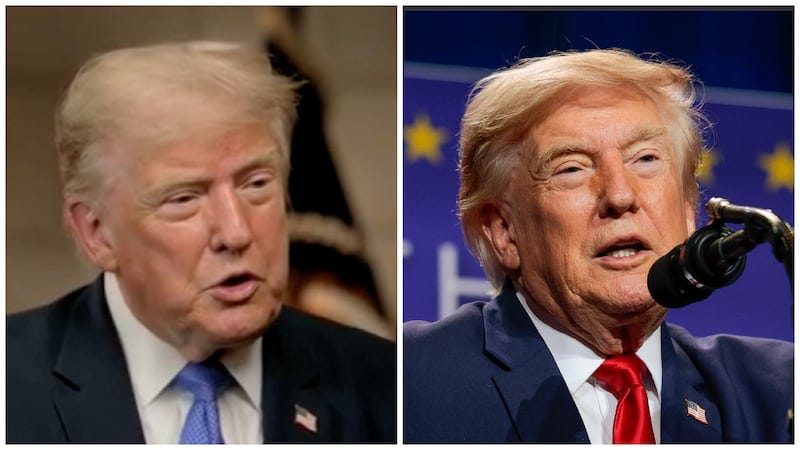
Donald Trump’s a nepobaby, a conman, a buffoon, a TV Star, and a two-term president. Through all his eras, his two constants are mendacity and idiotic hair. Of the latter, what can we glean from his looks? Given his 80 years on earth, this also matches a growing income inequality; let’s use him as a measuring stick for how we got here. He might as well have some utility to the general public, as we know his presidencies have largely impoverished our nation.
Donald Trump was born to wealth in Queens, New York, to a family that made money from brothels and segregation. His father’s family had skipped out on World War I. While not all immigrants found the roads paved with gold, the Trumps did. The Trumps tried hard to show off their wealth. Donald’s parents spent much of his childhood flashing their money, keeping a chauffeur and a chef. As part of their status consciousness, the family regularly dolled up for family pictures, with neatly pressed clothes and carefully combed hair. Their wealth was largely based on the government; Fred increased his inheritance by building FHA-sponsored housing.
But even common workers had benefits from the economic boom. The dollar was strong. The dollar in 1946 has the same purchasing power as about $17.12 today. Companies were not only hiring but also training people. This increase in personal buying power came with a national push toward nuclear families and suburbs. Marketing and films offered saccharine happy families with not a single hair out of place, as if free-flowing hair might signal free thought.
The 1960s saw many divisions in the American populace. There was an increased push for rights, including women’s rights and equal rights for Black Americans. The Pill, released in 1960, offered women more autonomy, though they often needed to have their husband’s permission for a prescription. While cultural forces pushed many Americans to demand change, many white men, in particular, tried to resist it.
Donald Trump’s iconic swooped-back hairstyle as well as his attitude seem to have been trapped in this particular era. In a family photograph when he was 20 years old, we see the beginnings of his classic style. His younger brother sports something similar. In this era that Trump now idolizes, the dollar had about $10.31 in purchasing power. The era had strong wages and strong union membership. And the top federal marginal income tax rate in the United States in 1966 was 70%. The rich paid their share, and the workers got paid fairly. He’s kept the hairstyle from that era, but completely missed what made it successful.
The 1970s enjoyed much of the free love and style that we now associate with the 1960s. The Pill was much more freely available. Title IX, from 1972, opened many more opportunities for women. But the economy had slowed. The dollar had become weaker, with the same buying power as about $8.24 today. Nixon ended the gold standard in 1971, a move that was popular at first but might have exacerbated inflation by the end of the decade.
Trump had been made CEO of his father’s firm. He maintained his 1960s hairstyle and many of his family’s age-old practices. Fred had made much of his money building housing for only white people. After 1968, racial discrimination in housing became illegal. They were sued by the government in the early 1970s for continuing the practice. The Trumps settled rather than admit wrongdoing.
Reagan won in a landslide promising tax breaks. The wealthiest people like Trump, who had benefited from government spending and taxing the rich, voted to keep their wealth. But Reagan had also convinced the majority of Americans that making the rich richer would help everyone. He did make a few people wealthy, but as it turns out, not Trump. In the 1980s, Trump tried to wheel and deal like his father, but with poor results. He was often demanding tax breaks and yet still losing money. (Scholars looking back at Trump’s business career point out that he’d have been much wealthier if he’d just invested his inheritance).
Trump’s hair was decidedly unstylish for the 1980s, but his use of hair as a signature speaks to the ethos of this moment. New money and big personalities took off in the 1980s due to the excess Reagan’s policies afforded them. Selling yourself became as important as selling something. Andy Warhol’s art was matched by his wig and person. Being iconic meant standing out. Donald loved the attention of standing out, and his sort of old-fashioned hair, now in an idiosyncratic swoop, helped him with recognition.
He would hold on to that 1980s hairstyle and boisterous attitude through many downturns, including in 1991 when he declared bankruptcy. In this era, the dollar had the same purchasing power as about $2.45 today, reflecting cumulative inflation of about 145.17% over the last 35 years. Much of Donald’s policies are holdovers from Reaganomics, when many people made big money, forgetting that his business failures couldn’t even be saved by those policies. His style, though, goes back to the 1960s. In many ways, this is the challenge the US faces. Since the 1980s, the rich have finagled sweeter and sweeter deals; the wealth gap has widened, but a sector of Americans has held on to hope that the trickle-down will actually drip. Those people, like Donald’s hair, are stuck in an era they don’t actually want to put into place, one in which the government invests in people and where the rich get taxed.
Today, Prices today are about 17.12 times higher than they were in 1946. The U.S. dollar has lost about 94% of its purchasing power since 1946. While we joke about Donald’s new hairdos, the truth is he profited off a system that he helped destroy. His bad haircuts will not keep people from seeing the failures of his Presidency. One cannot comb over losing wars, destroying the economy, and tanking public opinion abroad. But if his hair makes you think of anything, think of what made America strong: when you pull back the curtain (of hair), it was a society where the rich paid taxes and the worker got paid fairly.
For a Longer Discussion of Trump’s Life and the Policy History that Has Created this Economy: