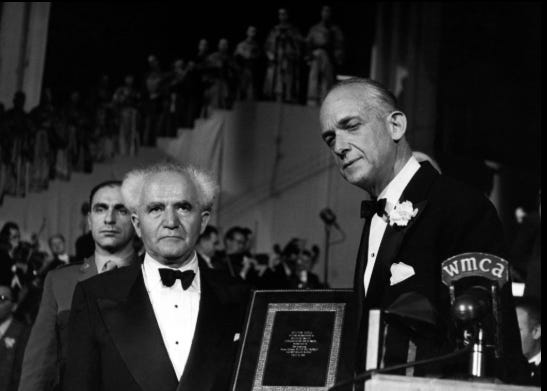
On July 1, 1945, about twenty American Jewish businessmen made their way to Rudolf Sonneborn’s apartment at 455 East 57th Street in Manhattan. The war in Europe had been over less than two months. Six million Jews were dead, hundreds of thousands of survivors were still living in displaced-persons camps, and Britain still controlled Palestine.
David Ben-Gurion was there to meet them. He kept the men in Sonneborn’s apartment for most of the day, from 9:30 that morning until five in the afternoon. They had come from New York, Pittsburgh, Philadelphia, Baltimore, Cleveland, Los Angeles, Minneapolis and Atlanta. They had factories, warehouses, money, industrial contacts and access to the mountains of machinery and military surplus left behind by the American war effort.
Ben-Gurion believed another war was coming, this one in Palestine. There was no Jewish state yet, no Israeli army and certainly no Israeli Air Force. But he was already thinking about what they would need when the fighting came.
His diary entry from that day was brief. He recorded who had attended and what the men had agreed to do. They would help with everything. Ben-Gurion called it “the best Zionist meeting I had in the United States.”
Three years later, “everything” would include airplanes painted with the markings of a Panamanian airline, machine guns packed into crates in Hawaii and a schooner sitting dangerously low in Los Angeles Harbor.
The first shopping lists weren’t nearly that exciting. Ben-Gurion needed machine tools, industrial equipment and raw materials, the kinds of things American businessmen could buy without attracting much attention.
The Haganah already had a clandestine arms industry in Palestine known as Ta’as. Hidden workshops were producing weapons and ammunition, but they needed better machinery and more of it. The network that grew out of the Sonneborn meeting began finding that equipment in the United States.
Machine tools and industrial equipment could cross the ocean looking like exactly what they were: machinery for manufacturing. Once in Palestine, some of it went into an underground industrial system making ammunition, weapons and other military equipment.
By 1946 and 1947, the network was helping the Yishuv prepare to manufacture more of what it might soon need. Ben-Gurion had started putting those pieces together before the United Nations had even decided what would happen to Palestine. On November 29, 1947, the UN voted for partition and the preparation stopped being theoretical.