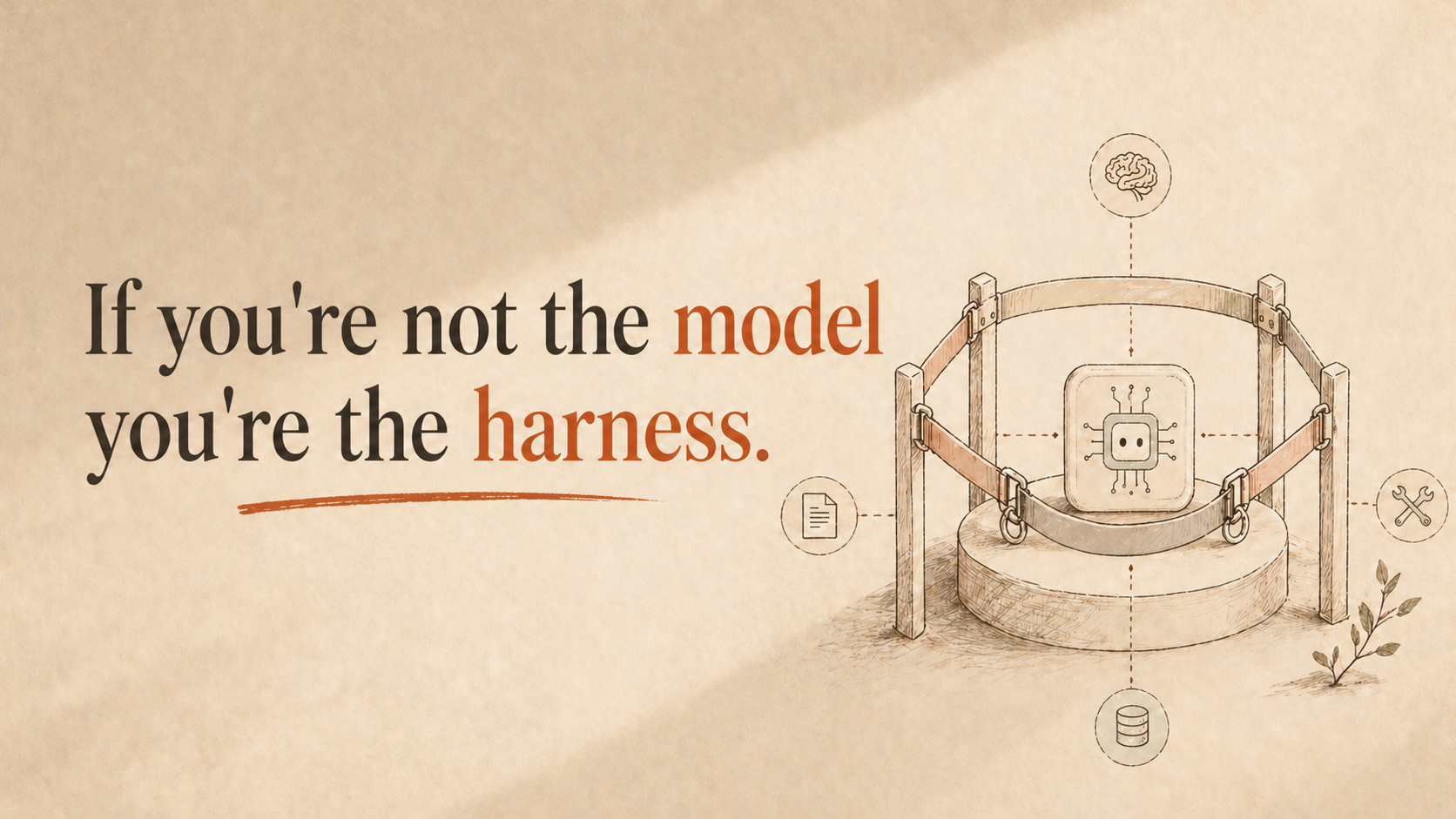
I had one of those strange moments recently where an AI tool looked smart for five minutes, then suddenly looked confused.
The first task was easy. It understood the request, wrote a clean answer, and felt almost effortless.
Then I asked it to do something longer.
Read files. Make a plan. Remember what it changed. Run checks. Fix errors. Continue from the last step. Don’t break the old work.
That is where the magic started leaking.
The model was still powerful. The problem was the space around it. It had no proper workspace. No memory it could trust. No clean way to verify the work. No rule for when to stop. No strong system to catch mistakes.
That surrounding system is now becoming one of the most important ideas in AI:
the agent harness.
Not the model.
Not the prompt.
The harness.
And once you understand it, you start seeing AI agents very differently.
An agent is not just a model with tools
A raw language model is not really an agent.
It can read input and generate output. That is powerful, but it is still limited. It does not automatically remember past work. It does not run commands by itself. It does not know your project files unless something gives them to it. It does not decide safely which actions should be allowed.
So when people say they built an AI agent, what they usually mean is this:
They connected a model to a system that gives it memory, tools, context, rules, and feedback.
That system is the harness.
A simple way to say it:
Agent = Model + Harness
The model is the brain.
The harness is the working environment around the brain.
The references shared at the end describe the harness as the software infrastructure around the model: orchestration loop, tools, memory, context management, state, error handling, guardrails, and verification.
Anthropic also describes the Claude Agent SDK as a general-purpose agent harness for tasks where the model must use tools, gather context, plan, and execute across longer work.
That is the shift.
The future is not only about which model is smarter.
It is also about which system helps the model do real work without falling apart.
Subscribe now
In the locked section, I go from idea to actual build: the agent loop, tools, memory, files, context control, verification, guardrails, hooks, subagents, stopping rules, cost limits, common mistakes, and a simple starter harness using AGENTS.md, task.md, progress.md, and verification.md. This is where the article turns practical: how agents really work, why they break, and how to build one that can keep moving without losing itself.
Read more