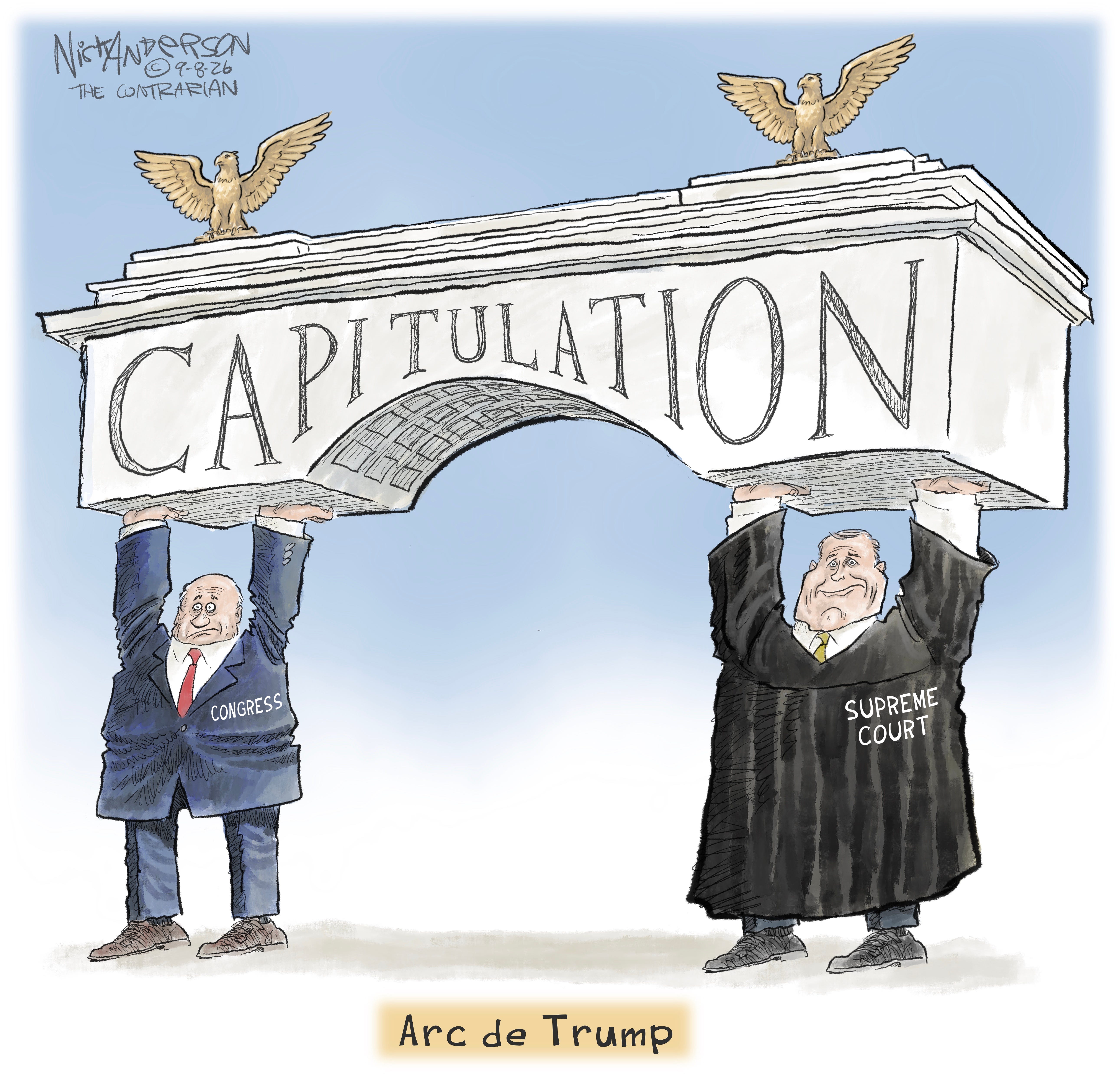
President Donald Trump’s proposed 250-foot triumphal arch is still missing something that would ordinarily seem fairly important before excavation begins: final approval. The National Capital Planning Commission—stacked with Trump appointees—has given the project preliminary approval but not its final blessing, Congress has neither specifically authorized nor appropriated money for the project under the process its opponents say applies, and a federal lawsuit argues that the administration lacks legal authority to build it. Nevertheless, Interior Secretary Doug Burgum announced that excavation work at Memorial Circle, between the Lincoln Memorial and Arlington National Cemetery, would begin this month. Reuters reports that the arch also faces a dispute over Washington’s height restrictions and whether an old 1925 authorization for the Arlington Memorial Bridge provides the administration with authority to erect an entirely different monument a century later.
That apparent contradiction—we don’t yet have final permission, but we’re starting anyway— reveals the administration’s strategy. Trump has spent his second term rapidly remaking prominent parts of Washington: the White House ballroom, the Kennedy Center, the Reflecting Pool and other federal spaces. In several instances, critics have gone to court only after physical or institutional changes were already underway. At the Kennedy Center, for example, Trump’s allies have changed leadership and programming and pursued extensive renovations; a Trump-appointed board even reinstated Trump’s name after a federal judge had ordered it removed. The administration is ramming through projects faster than institutions designed to review or restrain executive action can stop them.
The White House ballroom may provide the most important precedent, not necessarily as a matter of law, but as a matter of tactics. Recently, the Supreme Court allowed ballroom construction to continue after concluding that the preservation group challenging it probably lacked standing. The Court did not broadly declare that presidents may build whatever they want on federal property. Nevertheless, Justice Department lawyers are already citing that decision in an attempt to dismiss the lawsuit against the arch. As attorney Greg Werkheiser told The Washington Post, the administration is attempting to transform a narrow ruling about one plaintiff’s standing into what he called a “universal immunity card for presidential construction projects.”
That distinction matters. The Supreme Court has not ruled that Trump’s arch is legal, nor has Congress affirmatively surrendered its constitutional authority over federal spending and property. What has happened is more subtle: the administration has learned that procedural victories can sometimes accomplish much the same thing as victories on the merits. If opponents cannot establish standing, obtain an injunction or get Congress to intervene before construction advances, the substantive question—does the president actually have authority to do this?—may never be resolved in time to stop it.
Congress therefore represents the other half of Trump’s apparent calculation. Rep. Chellie Pingree of Maine, the ranking Democrat on the House subcommittee overseeing Interior Department funding, is urging Speaker Mike Johnson to have the House sue the administration. “Congress has neither appropriated funding nor granted authority for this project under the Commemorative Works Act,” she wrote, accusing the administration of betting that lawmakers will do nothing. Republican congressional leaders have so far shown no inclination to challenge Trump’s construction projects. Reuters likewise reports that Pingree is asking Congress to act before construction produces irreversible changes.
The administration is also employing a familiar distinction between preparation and construction. Although Sec. Burgum publicly announced “excavation work necessary for the Great Triumphal Arch,” Justice Department attorneys subsequently told the court that the imminent digging is merely information gathering—not construction or demolition in preparation for construction. Judge Tanya Chutkan has ordered the government to provide 48 hours’ notice before undertaking anything beyond information gathering at Memorial Circle. Reuters reports that the immediate work involves four test pits that the government says will be restored afterward. That gives the administration room to begin altering the site while maintaining that the moment requiring judicial intervention has not yet arrived.
And that may be the central issue surrounding the arch. Trump does not necessarily need Congress or the courts to formally endorse his interpretation of presidential power. He needs them not to stop him before facts on the ground become difficult to reverse. Once excavation progresses, contracts are signed, foundations are poured and millions of dollars have been spent, the political and practical cost of stopping the project rises dramatically. That dynamic has concerned opponents of several of Trump’s Washington projects. Residents challenging his planned transformation of the public East Potomac golf course, for example, have cited previous rapid changes elsewhere in Washington as a reason they fear waiting for the normal review process could mean waiting until significant alterations have already occurred.
The arch raises particularly consequential questions because of its location and scale. At 250 feet, it would stand roughly 86 feet taller than Paris’s Arc de Triomphe and occupy Memorial Circle on the axis connecting the Lincoln Memorial and Arlington House. The National Park Service’s own review has acknowledged effects on historic sightlines, while veterans opposing the project argue that years of construction—and a proposed observation deck—could interfere with the solemnity of nearby Arlington National Cemetery. AP reports that the project is part of Trump’s broader effort to leave a permanent architectural imprint on Washington.
None of this means the arch is certain to be built. Chutkan could still intervene, plaintiffs could establish standing on grounds different from those rejected in the ballroom case, the planning commission could impose conditions or withhold final approval, and Congress retains substantial constitutional and statutory powers if lawmakers choose to exercise them (don’t hold your breath). Legal experts quoted by The Post specifically dispute the administration’s contention that the ballroom ruling automatically controls the arch litigation.
But the experience of the ballroom helps explain why the administration appears willing to proceed before those questions are settled. The relevant precedent may ultimately be less about architecture than about executive power: announce the project, begin whatever work can plausibly be characterized as preliminary, fight challengers over standing and procedure, rely on congressional allies not to intervene, and keep moving while everyone argues over whether you are allowed to move.
By the time Washington’s institutions finally answer the question, Trump is counting on the foundation already being in the ground.