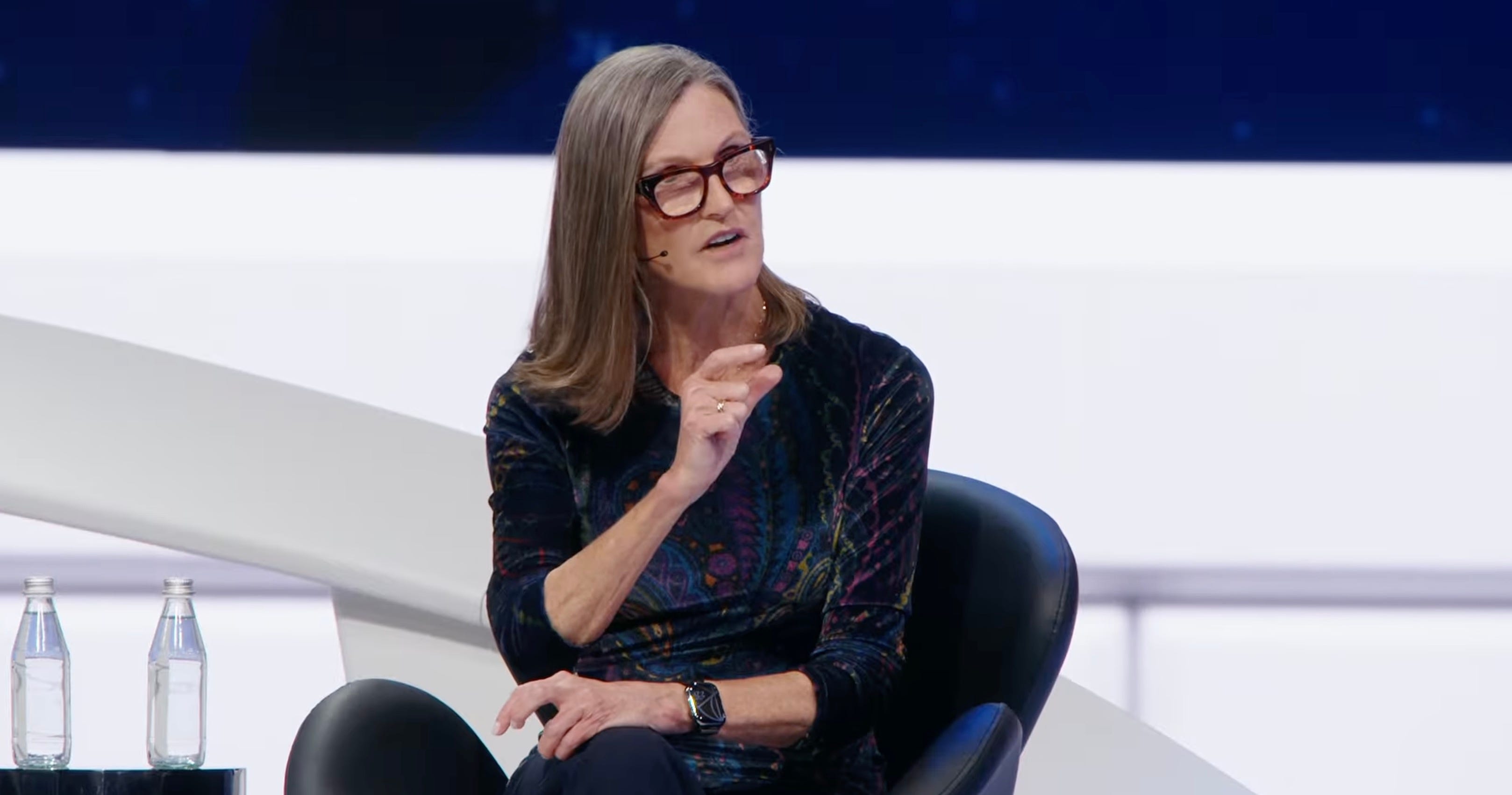
Cathie Wood is not a new topic on this blog. I have written about Wood and ARK Invest plenty of times over the years, largely because I remain fascinated by the seemingly endless free pass she gets from the financial media despite underperforming tech indexes and what I believe are batshit insane price targets she has become known for setting on companies.
Yet Wood routinely appears on financial television and has spent years being treated as something of a tech stock oracle for being the right place at the right time when Tesla stock somehow spiked more than 10x in a year heading into the Covid pandemic. I give Wood credit for that call…the numbers don’t lie.
I also give Wood credit for her on-air charisma, the relationship she has built with media and retail investors, and the financial success she has amassed for herself.
You can see Wood’s year/two years of brilliance in the chart below. It’s the big spike in the purple line where ARKK outpaces the NASDAQ between 2020 and 2022.
You can also see that heading out of 2022, compared to the NASDAQ, Wood’s Flagship fund beefed it hard and has significantly trailed the tech index. Now, dating back to January 1, 2019, Wood has underperformed the NASDAQ ETF by about -249%.
Yet the TV appearances and undying adulation for Wood in financial media hasn’t stopped. Nor has Wood been called out for this underperformance by anyone other than Morningstar, who estimated in 2024 that ARK had destroyed approximately $14 billion in investor capital and listed Wood as one of the top 15 funds that have destroyed the most wealth over the past decade.
Slicing up her performance in various ways tells different stories, but most of those are stories of underperformance. But let’s be fair. For the year 2025, her funds bounced back some and were named to Morningstar’s “The Top-Performing Stock ETFs of 2025”. That’s a solid year.
But zooming out, and looking at ARKK’s performance over other time periods puts the picture in perspective. According to data provided by YCharts, over the trailing five year period, as of today, ARKK is still underperforming the NASDAQ by about -129%.
Over a trailing three year period, ARKK is outperforming the NASDAQ by about +22.5%, thanks in part to 2025’s role, but over the last 12 months, ARKK is lagging the NASDAQ by about -26%.
For 2026 YTD, ARKK is lagging the NASDAQ by an estimated -6%.
So despite a lengthy record of underperforming the NASDAQ over the last 5 years, the interviews, forecasts and television appearances have continued, while remarkably few people have seemed interested in asking the most obvious question imaginable: what about the returns compared to the NASDAQ?
Well, somebody finally did. At Robinhood’s HOOD Summit ‘26 an audience member asked Wood about ARK’s performance relative to QQQ and asked why she was being presented as an authority to an audience full of people putting money at risk. He asked, paraphrased:
“Cathie Wood’s ARK Invest funds have underperformed the QQQ since their inception. So, based on what credentials did you invite her, given that there are many people putting their money into her funds expecting great returns?”
To which Wood responded:
“Now, you are comparing us to the QQQs. That is an
incorrect comparisonbecause we are focused on technologically enabled innovation across all sectors. Roughly 25% to 30% of our portfolio right now is in healthcare, which we believe is going to be the most profound application of AI. The QQQs are not involved in healthcare or in financial services. They’re barely involved in financial services. So there’s no comparison.”
Now the broader discussion here appears to be about all ARK Funds. But let’s just focus on ARK’s flagship “Innovation” fund, ARKK, since Wood is waxing poetic about “enabled innovation”.
There are two immediate problems with Wood’s answer, other than the fact that she sounds like Moira Rose from Schitt’s Creek after a couple of glasses of wine.
First, the claim that the QQQs “are not involved in healthcare” is false. The Nasdaq 100 currently contains a substantial collection of healthcare companies, including Intuitive Surgical, Gilead Sciences, Alnylam Pharmaceuticals, Amgen, DexCom, IDEXX Laboratories, Vertex Pharmaceuticals, Regeneron Pharmaceuticals and GE HealthCare. You can find them right on QQQ’s “Holdings” page, tucked in with names like SanDisk, Intel and others.
Invesco’s own data, meanwhile, showed healthcare representing roughly 4% of the Nasdaq 100 in September. Obviously that is considerably less than the 25% to 30% healthcare weighting Wood says ARK currently carries, but “QQQ has less healthcare exposure than ARK” is a very different argument from “the QQQs are not involved in healthcare.” They objectively are.
And also, Wood and ARK apparently had no philosophical objection to comparing ARKK with the Nasdaq 100 when the comparison made ARKK look good.
In a July 2024 letter written by Wood herself, she highlighted that ARKK gained 68% in 2023 and specifically boasted that it “outperformed the Nasdaq 100 by 1300 basis points.”
In another 2025 report, ARK trumpeted ARKK’s 73.54% rebound from April 8 through June 24 against the Nasdaq 100’s roughly 29.74% recovery.
And as recently as its Q1 2026 commentary, written by Wood, ARK compared ARKK’s 12.22% decline directly with the Nasdaq 100’s roughly 6% decline.
So the Nasdaq 100 seems to become an “incorrect comparison” maybe only for *all *of her funds and not just ARKK? Or only when someone uses the comparison to criticize Wood’s long-term performance? I don’t know and I don’t care to.
Wood 𝕏then made a savvy PR move by voluntarily posting the clip to X, without including the question that prompted it, and then adding her own response to try to get ahead of the story. Kudos to her for that move.
Putting the technicalities of whether we are talking ARKK or all of ARK Invest aside I just find her response ridiculous. ARK’s official investment materials define “disruptive innovation” as:
“the introduction of a
technologically enabled product or servicethat changes an industry landscape by creating simplicity and accessibility while driving down costs.”
So if QQQ is an inappropriate comparison for a fund whose entire identity has been built around owning the future of technology and disruptive innovation, what exactly are we supposed to compare it to? A Latvian textile industry ETF?
Of course ARKK and QQQ aren’t identical portfolios. That’s the entire point of having a benchmark. A benchmark isn’t supposed to own exactly the same securities as the active manager, because if it did there would be little reason for the active manager to exist.
The relevant question is whether all of the research, forecasts, trading, stock selection, white papers, futuristic price targets and active management produced superior results for the investor versus a reasonable passive alternative. For one of America’s most famous technology and innovation funds, pretending that the Nasdaq 100 is somehow an outrageous reference point strikes me as absurd.
There is also something wonderfully convenient about ARK’s official position on benchmarks. ARK’s own website says it manages its strategies in a “benchmark agnostic manner”. That’s a pretty nice arrangement. We’re benchmark agnostic, except when we’re showing people benchmarks, and when somebody selects a benchmark that produces an embarrassing comparison, we’re told the comparison itself is wrong.
Unfortunately, switching benchmarks doesn’t exactly rescue the argument. For the five years ending August 31, Schwab’s data show ARKK losing 6.7% annually while the S&P 500 total return index gained 13.8% annually. Other datasets using slightly different endpoints produce different exact figures, but the conclusion doesn’t materially change: ARKK dramatically lagged the broad U.S. equity market over the period. So whether you want to use QQQ or the S&P 500, there is no benchmark sleight of hand that makes the performance gap disappear.
ARKK has around $8-9 billion in assets under management. This is an enormous pool of other people’s money sitting in ARK’s flagship strategy. If the manager of a multibillion-dollar ETF doesn’t owe the investing public clear-cut answers about why its flagship fund has so dramatically underperformed obvious alternatives, who exactly does?
This is a bigger discussion than benchmark selection. It’s about market psychology, and specifically the psychology that I think fifteen years of absurdly easy money has cultivated across markets.
Last week I wrote about why I don’t think this market is psychologically prepared for a real crash. One of the examples I used was Wood’s collection of extraordinary long-term price targets, which I think are emblematic of what years of extraordinary monetary policy have done to investors’ brains.
When money is effectively free for long enough, speculation stops feeling like speculation. Valuation starts feeling antiquated, risk becomes something that happens to other people, and every drawdown becomes something that can simply be waited out until liquidity returns.
I think we can now consider adding aversion to accountability to that list.
There would have been absolutely nothing wrong with Wood simply acknowledging that ARK underperformed badly over this particular period, explaining which decisions didn’t work and then making the case for why she believes the strategy will perform better going forward.
That’s what I would have done. I would actually respect that answer. Anybody who has spent more than five minutes putting capital at risk has been wrong. I’ve missed trades, sold things too early, bought things too early, underestimated companies and overestimated others. That’s the business. Being wrong isn’t disqualifying. Refusing to acknowledge when the scoreboard says you were wrong is another matter entirely.
Instead, we get “endpoint sensitivity,” arguments about categories and a debate over whether QQQ is an appropriate comparison in the first place. All of it dances around an extremely simple fact: investors who chose QQQ five years ago made a tremendous amount of money while investors who chose ARKK made far less.
This mentality extends far beyond Cathie Wood. For more than a decade, virtually every financial mistake could eventually be bailed out by some combination of liquidity, lower rates, quantitative easing, fiscal stimulus or another speculative cycle. Investors learned that being wrong wasn’t necessarily fatal as long as they could remain wrong long enough for the monetary environment to rescue them. Over time, that doesn’t just distort prices. It distorts the way people think about mistakes.
It hearkens back to “extend and pretend”. If a thesis doesn’t work, extend the timeframe. If the valuation looks ridiculous, increase the projected addressable market. If a price target misses, push it further into the future. If the benchmark beats you, debate the benchmark. There is always another metric, another adjustment or another explanation that allows everyone to continue forward without confronting the possibility that the original analysis simply wasn’t very good.
I believe Wood is simply an unusually visible example of that culture. A fund can get demolished over five years by one of the most obvious passive alternatives available to its shareholders, and instead of starting the conversation with the performance gap, we wind up debating whether the comparison itself is philosophically valid.
That is what I find so sick and exhausting about the entire exercise. Investors have been marinating in this environment for so long that this kind of rhetorical gymnastics now passes for perfectly normal financial discourse. The media books the same people, gigantic future price targets continue to circulate, old predictions disappear down the memory hole and everybody moves on to the next forecast without bothering to reconcile it with the last one.
And again, none of this requires Wood to renounce her investment philosophy. Maybe she’s right about artificial intelligence, autonomous transportation, genomics and the other technologies ARK believes will reshape the economy. Maybe some of ARK’s current holdings become enormous winners. Maybe ARKK crushes QQQ over the next five years. I hope they happen. All of those things are possible…but none of them change what happened over the previous five.
That’s the distinction that seems to have disappeared. Acknowledging past underperformance isn’t the same thing as surrendering your future thesis. In fact, it should strengthen your credibility when explaining why you still believe in it. There is nothing humiliating about saying you got something wrong in markets. Everybody who has actually done this for a living has been wrong, often spectacularly. The humiliation comes from treating investors like they’re too stupid to notice the scoreboard.
Markets are supposed to be one of the few places where reality eventually imposes itself. You can tell stories, make forecasts, build models and explain why the future is going to look completely different from the past, but eventually there is supposed to be a number at the bottom of the page that settles at least part of the argument.
That number doesn’t mean you have to stop investing. It doesn’t mean you have to abandon your philosophy. It doesn’t even mean your next five years can’t be spectacular. It simply means that when you underperform, you should be capable of saying you underperformed.
The fact that such a basic admission now seems almost quaint tells me something much larger about the market environment we’ve created. Fifteen years of free money didn’t merely inflate asset prices and encourage increasingly ridiculous speculation. It helped create a financial culture where being wrong is acceptable, but admitting you were wrong apparently isn’t. And Cathie Wood didn’t create that culture, the Fed did. She’s simply one of its most visible products.
**QTR…