“The Princess Bride” was released 39 years ago. A box-office flop, the film became a cultural classic. Like many in my generation, I can still recite most of the movie by heart. Sometimes our world feels so terrible, and I’ve wondered if Stephen Miller has six fingers on one hand, but a flourishing of arts and culture from this moment isn’t inconceivable.
Here are some lessons from the film we need to embrace:
Humor is a multifaceted emotion that is easy to feel but hard to describe. Many people claim to be funny online, like potentially 75% of podcast bros. I generally scroll past the clips, thinking, “You keep using the word funny. I do not think it means what you think it means.” But the many types of humor in The Princess Bride help us understand both why the film is appealing and how to foster something similar in our own creative culture.
Rob Reiner descends from Yiddish vaudeville and Borscht Belt humor. The film uses much of the cadence of Yiddish theater. The rapid speech with funny one-liners draws on the language of his childhood. Many Borscht Belt comics also used self-deprecation and domestic life as themes in their comedy routines. Together, these elements helped connect people to the comic and reminded everyone they could take themselves down a notch. Humor, therefore, is both a great equalizer and a tool toward humility. Many of the most humorless people I’ve ever met take themselves too seriously and cannot see how important humor is for connecting with others.
Humor, after all, is not easy. Much of the film’s physical humor works because the actors perform it with such ease. Perhaps for Andre the Giant, picking up a grown adult man hearkened back to his days in the ring, but doing that while delivering lines must have been a challenge. And while the ease with which the film delivers the humor belies the actors' efforts, the lesson goes beyond that. Ease is often hard work, but it is incredibly consequential in how people perceive you. Being simply hilarious is hard work.
The hard work of humor matters. Born into a funny family and married into an equally humorous one, I’ve long noticed that the funniest among us are often the most beloved. Their humor is almost always an extension of who they are. Humor is a great connector between people. It makes experiencing good times and bad more enjoyable. Humor also helps us get at truths in palatable ways. It makes everything better, from silly love stories to generational epics and retellings of grocery trips worth hearing. And in the words of Westley, while “life is pain… [and] anyone who says differently is selling something,” the bitterness goes down so much easier with a few laughs along the way.
One of the less commonly quoted lines from the movie is from Buttercup, who says, “I will never doubt again,” when the Dread Pirate Roberts reveals himself as Westley, her true love. It makes me think about how our society has framed experiences with doubt and cynicism. Given how many people can profit off innocent people online, I understand why we’ve grown so trepidatious about the world around us.
The Princess Bride is set in a world of curiosity. Rather than fear, the scenes are set up to bring pleasure. I vividly remember seeing the film for the first time and being shocked that the main character died in the middle. If you’ve read this far, I don’t think this is a spoiler, but just in case, I’m about to skip to the end, as Prince Humperdinck said. In the film, we see what could be an end to life become the beginning of a rescue. That narrative hurdle is meant to bring us joy and push us beyond disbelief.
In our era of AI, where many people have come to ignore the tells of AI, we’re also living with technology that takes down our sense of reality. But here is the difference: The Princess Bride visually sets up a system where we are on the same side as the filmmaker. The meta-narrative of a grandfather reading to his grandson establishes the artifice. Therefore, everything within the story being read is meant to be fictional. By letting the viewer know reality will be broken in this story, Reiner encourages us to enjoy the curiosity of the scenes and physical spaces. Rather than trying to be polished and realistic, many of the scenes are set up with clear artifice. No one looked at the fight scene on the Cliffs of Insanity and assumed it was a real locale. Similarly, Miracle Max’s laboratory was clearly based more on fairy tale illustrations than reality. Given that he was creating a pill to bring someone back from the dead, reality is unnecessary. But by framing this world within a fairy tale literary realm, Reiner also invited everyone to enjoy this alternative reality.
Now, most filmmaking is about bringing people along for another experience, but Reiner is notable for creating spaces that are theatrical. By setting this up as a sort of theater, with set spaces and built environments, the film visually lets the viewer go with the story. Visually, it’s a tell for our minds to live in curiosity in a way that films set in something that almost approximates our reality do not.
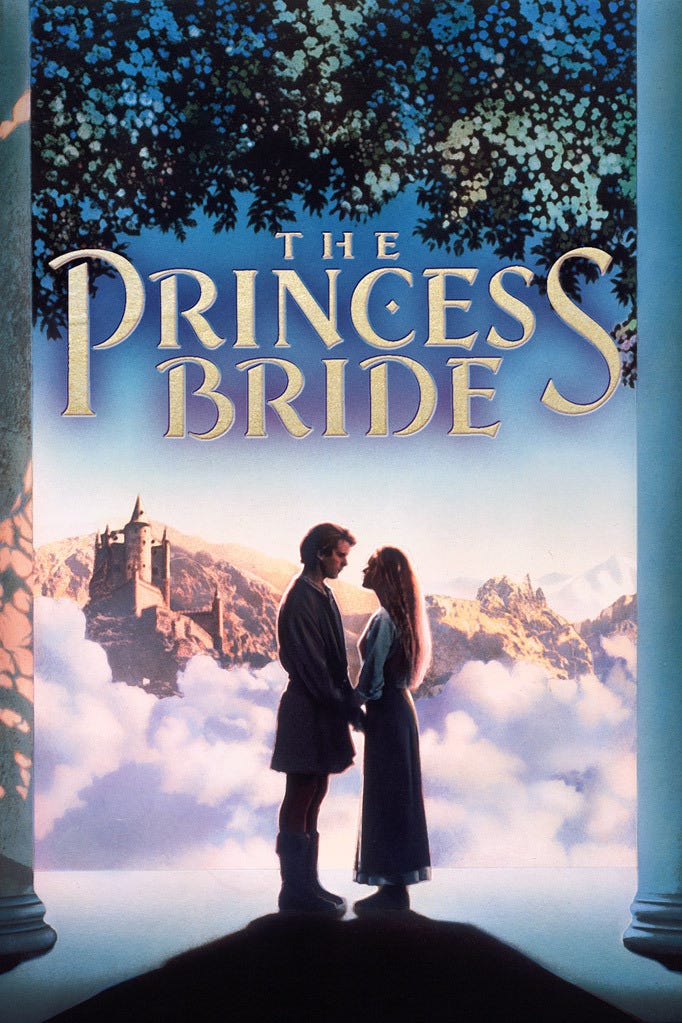
Rather than shy away from visual references, Reiner’s film is full of them. So much of the movie resonates with the golden age of illustration. If Little Red Riding Hood should come skipping by or Frog and Toad amble into a scene, you almost wouldn’t be surprised. Rather than disconnect from the literary worlds viewers might have understood, Reiner drew on those themes. The film poster, created by John Alvin, is said to quote the work of Maxfield Parrish. The American artist Maxfield Parrish is widely shared online today for the visual pleasure of his work. Rather than offer challenging, even ugly, visuals, the poster, like the film, really focused on the pleasure of attractive spaces. In a sense, The Princess Bride is the film equivalent of illustration. Many of the same conceits, like the pleasure of rounded doorways or the ways in which wood grain is accentuated in both the film and many illustrators’ work, are about using visual images to evoke emotions.
Another way The Princess Bride is akin to illustration is in the complexity of its visual images. Go back to any scene, and you will find many more visual details than were absolutely necessary to make the scene work. The palace, Buttercup’s house, and the laboratory all have visual texture that adds pleasure even if you don’t notice it. More can feel better visually when an astute artist finds a way to bring you into their vision.
Which brings me to the biggest point The Princess Bride can make for creatives today: giving the gift of humor, visual pleasure, and curiosity is an incredible kindness. These days, a feel-good movie is often equated with a movie that has no weight. The reason The Princess Bride holds up is certainly all of the efforts I described above, but underlying that is this great kindness. The clear pleasure of the filmmaking comes out on the screen. At its core, the story is a great love story, but it’s also a story about friendship and community. In saying “As you wish” to Buttercup, Westley was announcing a desire to remain connected. Our society has become “as I wish” rather than “as you wish.” So much of our creative content comes at others' expense rather than for their joy. As Buttercup said about her betrothed, “You are the slimiest weakling ever to crawl the earth.” So much of our media landscape is about cowardice and hate. We rarely battle each other and wish each other well afterward. No one online is saying, “I hate to kill you,” though many of us hope not to die, even an internet death. Instead, every fight online is “to the pain”. So many people online hope that others are left “in anguish, wallowing in freakish misery forever,” solely for their personal financial gain.
As we look back on these 39 years, it’s worth remembering we had a lot less technology when this film was made. We can harness many of the same tools. The film's long-lived efficacy should remind us it’s worth harnessing joy instead of fostering hate. Now, can we change? Do I think it will work? I admit, “It would take a miracle.”
Let me know your favorite quote in the comments.