For the first fifteen years of its existence, the greatest threat to Bitcoin was external. We worried about 51% attacks from hostile nation-states, we worried about coordinated global internet blackouts, and we worried about the sheer brute-force banning of the asset by coordinated global superpowers.
But as we sit here in the spring of 2026, the external attacks have largely failed. The protocol survived. The hash rate is at an all-time high. Nation-states are quietly accumulating. The physical network is virtually indestructible.
The state is a slow, bureaucratic machine, but it is not entirely stupid. When a predator realizes the prey’s armor is too thick to bite through, it stops attacking the shell and begins searching for a parasite it can inject into the bloodstream.
The attack vector has shifted from destruction to capture. The battlefield is no longer the fiat exchange rate; the battlefield is the block template.
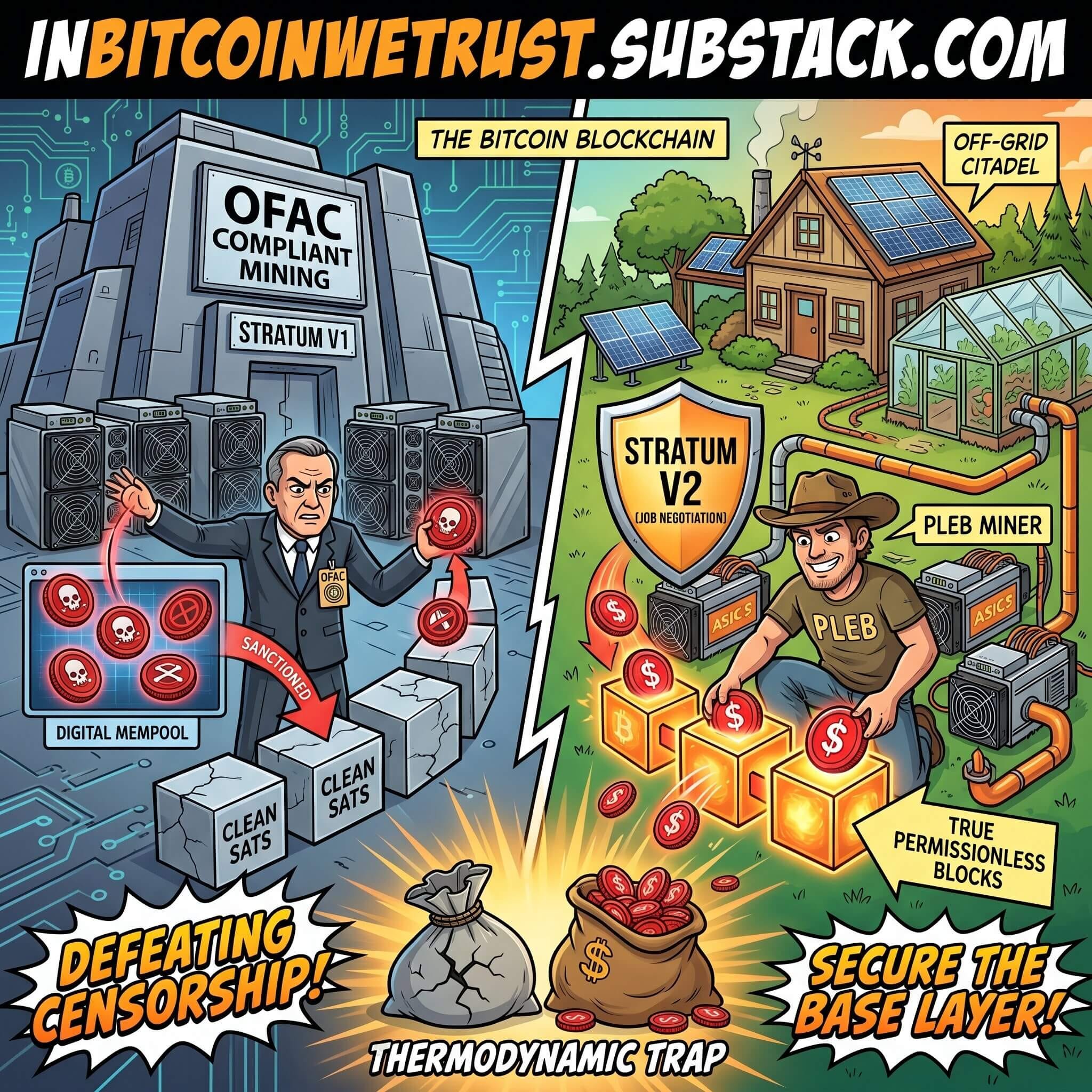
We are currently witnessing the most insidious attack on the Bitcoin network in its history: the state-mandated balkanization of the base layer via OFAC (Office of Foreign Assets Control) censorship. The US Treasury and allied Western regulatory bodies have issued mandates requiring all publicly traded, institutional mining companies to actively filter and censor transactions originating from “sanctioned” addresses.
They are attempting to divide the immutable ledger into two distinct categories: compliant “Clean Sats” and sanctioned “Blood Sats.”
If they succeed, Bitcoin ceases to be permissionless money. It becomes just another heavily regulated PayPal, operating on a slower, more expensive database.
Today, we are going to expose the fatal architectural flaw that allowed this corporate capture to happen in the first place. More importantly, we are going to outline the exact technical and economic counter-offensive. We will explore how sovereign individuals are weaponizing the Stratum V2 protocol and at-home ASIC deployments to strip power from the corporate mining pools, financially bankrupt the censors, and permanently secure the base layer.
To understand the mechanics of the counter-offensive, we must thoroughly understand the anatomy of the attack.
By 2024, the mining landscape had fundamentally transformed. The romantic era of cypherpunks mining blocks on their laptops was a distant memory. The network was dominated by massive, publicly traded corporations operating warehouses filled with tens of thousands of ASICs. These companies—Riot, Marathon, Core Scientific—were tethered to the legacy financial system. They relied on Wall Street debt, BlackRock equity, and state-subsidized energy contracts to survive.
This made them incredibly vulnerable to regulatory pressure.
In late 2025, under the guise of “national security” and combating the financing of parallel economies, the US Treasury dropped the hammer. **They updated their OFAC guidelines with a devastating new interpretation: **Any entity validating transactions on a decentralized ledger must comply with global sanctions lists.
For a corporate miner operating within Western jurisdiction, the mandate was clear: If a Bitcoin transaction sitting in the mempool involves an address associated with a sanctioned entity, a privacy-mixing service (like a CoinJoin coordinator), or a flagged decentralized autonomous organization (DAO), you are legally forbidden from including that transaction in the block you mine.
If you include it, your executives face federal prison time, your bank accounts are frozen, and your energy contracts are terminated.
The corporate miners immediately capitulated. They had to. They modified their node software to run heavily filtered mempools. Before constructing a block, their software cross-references every pending transaction with an automatically updating government database. If a transaction is flagged, it is silently dropped from their block template.
Let us walk through exactly what this means for a sovereign individual transacting in 2026.
You live in a hostile jurisdiction. Your local bank account has been frozen because you donated fiat to a protesting trucker convoy. You rely entirely on your sovereign Bitcoin stack to buy groceries and pay your localized internet provider via a non-KYC decentralized exchange.
The state algorithm flags your UTXOs as “subversive.” You are added to the OFAC list.
You try to send a transaction to buy a week’s worth of food. You sign the transaction with your Coldcard and broadcast it to the network.
The transaction enters the global mempool. But when the massive corporate mining pools—who now control 60% of the global hash rate—look at the mempool to build the next block, their software sees your flagged address. They ignore your transaction.
Ten minutes pass. A corporate miner finds a block. Your transaction is not in it.
Twenty minutes pass. Another compliant pool finds a block. Your transaction is skipped again.
Your transaction sits in purgatory. The funds never arrive. The grocer does not give you the food.
If a large enough percentage of the global hash rate becomes compliant, the censorship becomes systemic. Your wait time for a confirmation goes from ten minutes to ten hours to ten days. In a purely theoretical worst-case scenario where 100% of miners are captured, your Bitcoin is effectively confiscated, not because they stole your keys, but because they permanently froze your ability to move the math.
This is the balkanization of the base layer. It destroys the core value proposition of censorship resistance.
How did the state manage to capture the network so easily? They exploited a massive centralization vector hidden inside the mining communication protocol itself: Stratum V1.
When you buy an ASIC miner, plug it into your wall, and point it at a mining pool (like Foundry USA or Antpool), you are using the Stratum V1 protocol. This protocol was designed in 2012, long before the reality of nation-state attacks was a genuine concern. It was designed purely for efficiency.
Stratum V1 operates on a strict Master/Slave dynamic.
The Mining Pool (The Master) runs the full Bitcoin node. The pool operator looks at the mempool, selects which transactions to include, constructs the final block template, and then sends a tiny cryptographic header down to your machine.
Your ASIC (The Slave) is entirely blind. It does not know what transactions are in the block. It does not run a node. It is simply a dumb, thermodynamic hammer. It takes the header provided by the pool and smashes it with quadrillions of hashes per second, hoping to find the winning nonce. If your ASIC finds the winning hash, the pool broadcasts the block and shares the reward with you.
Do you see the vulnerability?
The intelligence, the selection, and the power of censorship are entirely centralized in the hands of the Pool Operator.
When a sovereign individual at home points their ASIC at an OFAC-compliant pool, they are physically burning their own electricity to fund their own censorship. They are providing the thermodynamic armor for a block template crafted by the US Treasury.
To defeat the state, we have to strip the power of block construction away from the central pools and push it all the way to the edges of the network. We have to give the brain back to the brawn.
The counter-offensive is not political. It is mathematical. It relies on the mass deployment of Stratum V2, the most critical software upgrade in the history of Bitcoin mining.
Stratum V2 is not just an efficiency upgrade (though it does dramatically reduce data loads and improve security against man-in-the-middle attacks). It is a structural redesign of power.
The core feature of Stratum V2 that changes the geopolitical landscape is called Job Negotiation.
Under Stratum V2 with Job Negotiation enabled, the dynamic is entirely flipped.
The sovereign individual at home runs their own full Bitcoin node. They look at the mempool. They select the transactions. They construct the block template.
The individual miner then sends their self-constructed block template up to the mining pool. The pool becomes nothing more than a dumb aggregator. The pool’s only job is to pool the hash rate together to smooth out the payout variance, but they have absolutely zero say in what transactions are included in the blocks.
If the state sends an enforcement agent to the headquarters of a Stratum V2 mining pool and demands that they censor a transaction, the pool operator literally cannot comply. They can look the agent in the eye and say, “We do not build the blocks. We do not select the transactions. The blocks are built by ten thousand anonymous individuals scattered across the globe. Arrest them if you can find them.”
Stratum V2 achieves the Holy Grail: it allows miners to pool their financial resources while maintaining absolute, decentralized sovereignty over the protocol rules.
Software is useless without hardware. Stratum V2 only works if there are thousands of sovereign individuals willing to run the machines.
This brings us to the renaissance of the at-home pleb miner in 2026.
For years, the legacy media insisted that home mining was dead, that you could never compete with the massive industrial farms in Texas or the Middle East with their sub-three-cent energy contracts. If your goal is purely to maximize fiat profit, they were right.
But in 2026, the sovereign individual does not mine for fiat profit. They mine to secure their own financial escape hatch. Mining is no longer an investment strategy; it is a defensive military expenditure.
The genius of the pleb miner movement lies in redefining the cost of energy. An ASIC is not just a math-solving machine; it is a 100% efficient resistive heater. Every single watt of electricity that goes into an ASIC comes out as pure heat.
Sovereign homesteaders are weaponizing this physical reality. They are not plugging ASICs into standard racks and exhausting the heat out the window. They are integrating them directly into their living infrastructure.
**The Off-Grid Citadel:**Individuals are tying ASICs directly to their localized solar grids, capturing excess stranded energy that would otherwise be wasted.**The Water Heater:**Using specialized immersion cooling tanks or heat exchangers, cypherpunks are routing the 150°F exhaust liquid from their ASICs directly into their home’s radiant flooring or domestic hot water supply.**The Greenhouse:**Agricultural homesteads are venting ASIC exhaust into their winter greenhouses, subsidizing their physical food supply with cryptographic energy.
When you use the heat for something you already had to pay to heat anyway (like your shower, your home, or your food), your effective electricity cost for mining drops to absolute zero.
You are getting the hash rate for free.
Armed with free hash rate, these individuals are flashing their ASICs with open-source Stratum V2 firmware (such as Braiins OS+), connecting to decentralized, censorship-resistant pool architectures (like OCEAN Pool), and negotiating their own custom block templates.
They are actively seeking out the transactions that the corporate pools are dropping, and they are stamping them into the immutable ledger.
Why will the Stratum V2 counter-offensive inevitably win? Because Bitcoin is an arena of pure, unforgiving thermodynamics. In this arena, censorship is not just a moral failing; it is a massive financial liability.
Let us examine the economic game theory of a balkanized mempool.
**The Censor’s Dilemma:**The OFAC-compliant corporate miner is forced to ignore a sanctioned transaction.**The Fee Escalation:**The sovereign individual who sent the sanctioned transaction realizes they are being censored. To break through the wall, they increase the transaction fee. They signal to the network:*“I will pay a massive premium to anyone willing to mine this.”***The Profit Disparity:**The transaction fee for the censored UTXO climbs higher and higher. The mempool is now bifurcated. There are low-fee “clean” transactions and high-fee “blood” transactions.**The Pleb’s Advantage:**The sovereign pleb miner, running SV2 and building their own block template, sees this massive fee sitting in the mempool. Because they are not bound by OFAC regulations (they are anonymous, off-grid, and decentralized), they immediately scoop up the sanctioned transaction and include it in their block.**The Financial Bleed:**When the pleb miner finds the block, they collect the massive fee reward. The corporate miner, hobbled by state compliance, is forced to mine the low-fee blocks.
Over time, this creates a devastating compounding effect. The censorship-resistant miners consistently earn a higher yield than the compliant miners. Because mining operates on razor-thin margins, the censorship-resistant miners can afford to reinvest their superior profits into newer, more efficient ASICs.
The OFAC-compliant corporate miners slowly bleed out. They earn less revenue, they fall behind in the difficulty adjustment, and eventually, their massive debt obligations crush them. They go bankrupt, their ASICs are liquidated, and who buys those ASICs at pennies on the dollar?
The sovereign pleb miners.
The state’s attempt to capture the network mathematically destroys the entities that comply with the state. The censorship act physically subsidizes the enemies of the state. It is a perfectly engineered, self-correcting thermodynamic trap.
The final piece of this architectural defense is the infrastructure of the pools themselves.
Even with Stratum V2, if everyone points their hash at the same three major corporate entities, the risk of coercion remains high. The state could simply order ISPs to block the IP addresses of the major Stratum V2 pools, or raid their physical data centers.
The parallel economy responded by entirely decentralizing the pooling mechanism.
Initiatives like the OCEAN Pool (and the evolution of true P2Pool structures) emerged as the gold standard for sovereign mining in 2026. These are not traditional companies holding your funds. They are hyper-transparent, non-custodial smart contracts.
In a traditional pool, the pool operator receives the entire block reward, holds it in their own wallet, and then slowly pays out the miners based on their hash contribution. This creates a massive custodial risk. If the pool is hacked or if the government freezes the pool’s wallet, your mining profits are gone.
In the modern non-custodial Stratum V2 pools, the pool never holds the money. The block template is constructed in such a way that the coinbase transaction (the transaction that creates the new Bitcoin) pays every single contributing miner directly from the protocol itself, instantly.
The block is solved, and the Satoshis arrive in your cold storage wallet without ever passing through a middleman.
There is no corporate treasury to seize. There is no central point of failure to attack. The pool is simply a ghost in the machine, a temporary mathematical alignment of thousands of sovereign individuals cooperating to solve a puzzle, get paid simultaneously, and vanish back into the cryptographic ether.
For over a decade, the culture of Bitcoin was dominated by passive strategies. “Hodl.” Stack sats in cold storage and wait for the fiat system to collapse under its own weight.
But as we navigate the treacherous waters of 2026, passive resistance is no longer sufficient. The state has realized that while it cannot confiscate the keys, it can attempt to paralyze the ledger. They can attempt to turn our decentralized sanctuary into a highly regulated, corporate-controlled panopticon.
Censorship resistance is not a magical property granted by the Bitcoin whitepaper. It is not an inherent…