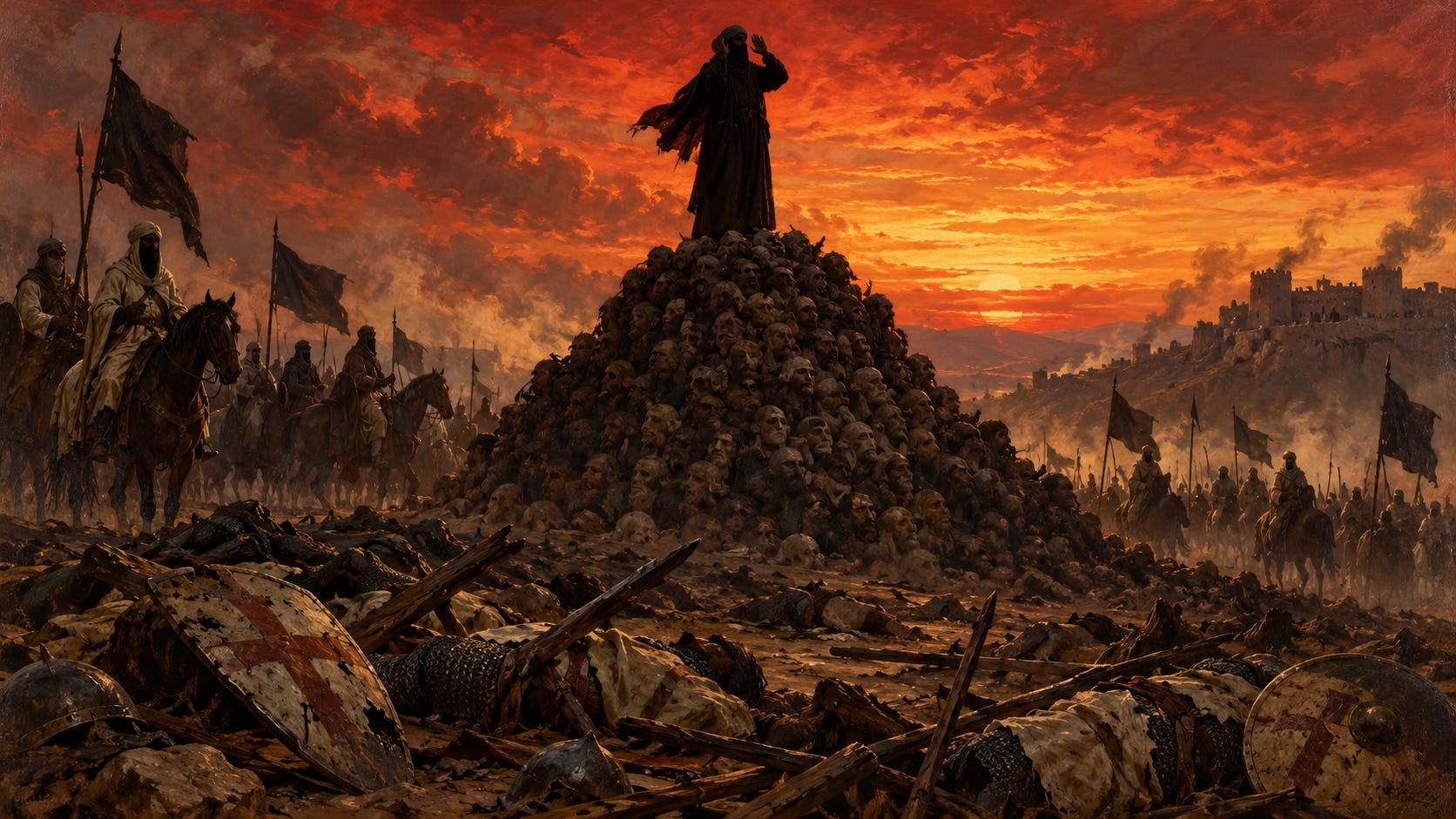
Today in history, a battle that all would-be jihadists venerate took place against Christians in Spain (then known among Muslims as al-Andalus).
In 1085, Alfonso VI of Leon-Castile captured the Muslim city of Toledo, launching the Reconquista. Great was the lamentation among Muslims and the rejoicing among Christians. The Muslim emirs of al-Andalus — notorious for their disunity and dissipated lifestyles — had to act fast, for “the arrogance of the Christian dogs” had “waxed so great,” wrote a Muslim chronicler.
So the emirs called on their fanatical coreligionists in North Africa, the Almorivades, a sect devoted to waging jihad and enforcing sharia. Its elderly leader was Yusuf bin Tashfin, “a wise and shrewd man,” who had “passed the greater part of his life in his native deserts; exposed to hunger and privation, he had no taste for the life of pleasure.”
Dressed in black with a veil cloaking all but the zeal in his eyes, the 76-year-old sheikh accepted the invitation and entered al-Andalus. The Moorish emirs quickly “acknowledged his sway, hoping that he would stop the victorious course of the infidel, and thus open, for the prosecution of jihad, those gates which they had hitherto kept criminally locked,” thereby “propping up the tottering edifice of Islam, and humbling the pride of the insolent Christian.”
By October 1086, a vast coalition of thousands of Almorivades and Andalusians under Yusuf’s command found themselves facing King Alfonso and his knights at Sagrajas, near Badajoz. While exact numbers are unclear, the Muslims outnumbered the Christians by roughly three to one. According to a Muslim chronicler,
When the two armies were in the presence of each other, Yusuf wrote to Alfonso offering him one of the three [conditions] prescribed by the law; namely, Islam, tribute, or death.
On October 23, 1086, the Christians finally charged the front lines of the Muslim army, where Yusuf had placed the Andalusian emirs, while he and his African warriors held the rear. The battle soon “became fiercer than ever, and the furnaces of war burned with additional violence; death exercised its fury.” As expected, before long the Moorish line began to crumble and retreat before the Christians, who “repeated their attacks with increasing fury.”
Yusuf’s unperturbed reaction belied the contempt he held for his “moderate” Muslim allies: “Let the slaughter continue a little while longer,” he told a concerned general. “They no less than the Christians are our enemies.” Moreover, once the Christians had tired themselves out, added the shrewd sheikh, “we shall vanquish them without great difficulty.”
Continue reading below.
If you value unflinching, historically grounded analysis that mainstream outlets soften or ignore, consider upgrading. Paid subscribers get:
**Several new, full-length articles every week.**Carefully researched pieces you won’t find elsewhere.
Full access to the complete premium archiveArchive of in-depth writing, research, and commentary — all in one place.
Entry into the subscriber chatA private space for serious readers and thoughtful discussion.