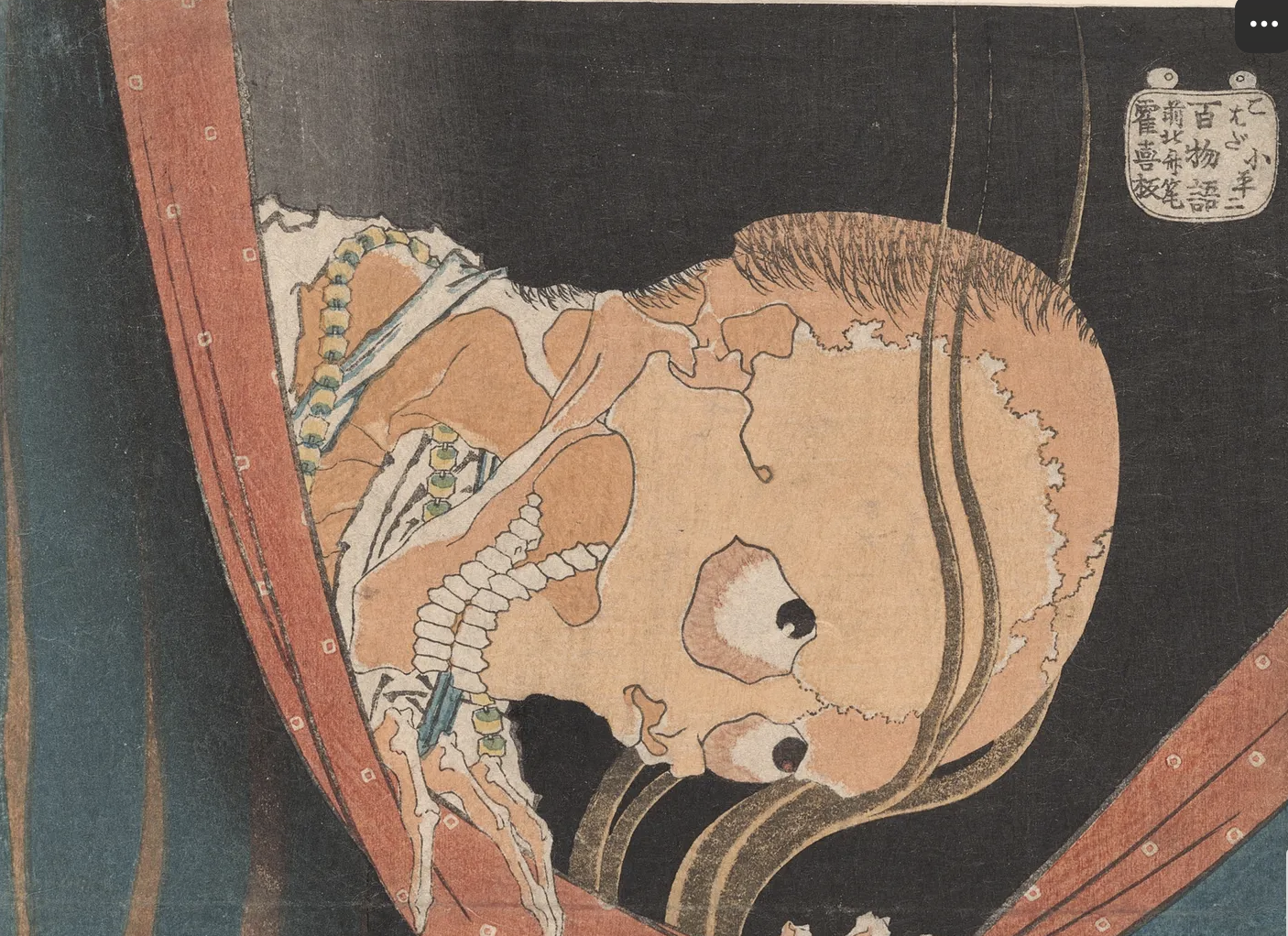
Are Japanese ghost stories the same as Western ones? Spooky is spooky, right? Prints of 19th-century Japanese Ghost stories help us compare and contrast how the spooky realm functions in Japan versus the West.
The Spooky Season
I’m writing this article in late October, when many Americans are bringing out their Halloween decorations. Americans celebrate a commercial holiday rooted in historic European traditions. All Hallows Eve stems from the Christian celebration of All Saints' Day and All Souls' Day. But these events likely trace back to earlier European harvest festivals. As the Earth prepared for winter rest and days grew shorter and darker, people turned their minds to the departed.
In Japan, summer is the spooky season. The O-Bon Festival is Japan's annual celebration of the deceased. The festival has its roots in Buddhism, celebrating the moment that Mokuren (Maudgalyayana in Sanskrit), one of the Buddha’s disciples, saves his mother. He used his spiritual abilities to see into hell, only to find his mother trapped in the hell of the hungry ghosts. She’s stuck eating for eternity; every bite turns to flames. The ceremony he performed to save her soul is said to be the basis of O-Bon. As with Halloween, O-Bon was likely connected to older traditions. Rather than seeing the cold as the moment the dead might return, people saw summer's extreme heat as a time when the veil between the living and dead seemed thin. Having lived in Japan, I sometimes found the steamy evenings spooky, or maybe it was just my heat-addled mind.
While the West told ghost stories, particularly to young children, in Japan adults historically told them as part of summer festivities. Why? Unlike in the West, where people often avoided ghosts, ghosts were an expected part of life in Japan. In Japanese lore, ghosts existed, and only the bad ones were worth avoiding.