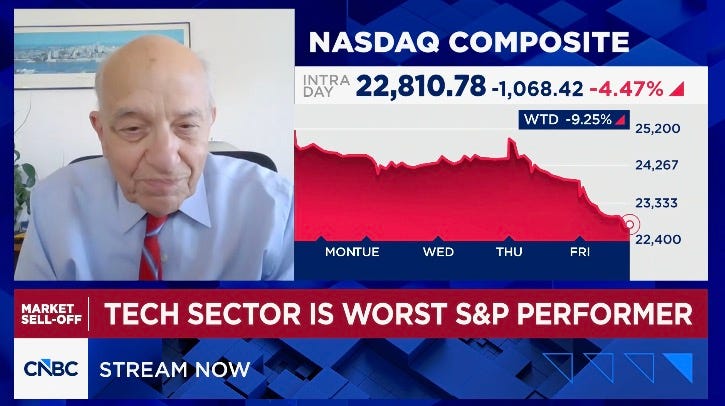
Today’s column is going to be two parts. First, I’m going to review a lot of what I’ve written about on this blog the last two weeks. Then, I’m going to offer my take on where Nvidia, the market, other sectors, and everything else is going forward.
Punk band Lit had a great song called “The Best Is Yet To Come (Undone).”
After Friday’s market crash and headlines suggesting that the SEC could be investigating Nvidia’s accounting, I can’t think of a more appropriate title for my column this weekend.
Because if there’s one thing I’ve been trying to communicate to readers over the last four months, it’s that the unraveling of the AI bubble was never going to be a single event, a single bad earnings report, or a single afternoon of panic selling. It was going to be a chain reaction, one in which deteriorating sentiment, increasingly questionable financing arrangements, political uncertainty, and scrutiny of the companies at the center of the boom could begin feeding on one another.
And as much as Wall Street has wanted to declare the worst over at virtually every opportunity over the last two weeks, my argument has consistently been that the next shoe probably hasn’t even dropped yet.
Meanwhile, over on CNBC in just the last two weeks, it appears to have been a love-fest for Nvidia while it’s been plunging -43% in the last month and -20% in the last week alone:
And it appears to have been a love fest for the overall market as well…
Now before getting into where I think Nvidia and the broader market go from here, I want to spend a few minutes reviewing just how on top of things we’ve been over the last four months.
Not because I feel compelled to take a victory lap every time the market takes a shit, but because in my initial call for an AI crash this year in August, I also made a prediction about timing, which I almost never do. I’m sure I’ll be wrong and/or humbled again at some point soon, but as for then, the bond market spiking had my conviction through the roof, and here we are 4 months later looking like we were ahead of the game.
I’ve been laying out, in real time, why I thought this trade was vulnerable (noting eight specific bear cases from eight of my favorite investors heading into Fall), what could cause it to break, and why the initial selling would likely be followed by developments that investors hadn’t even begun to consider.
And while plenty of people have been happy to tell me I’m too bearish, a fearmonger, or simply beating a dead horse, I think the last several weeks have offered a pretty compelling answer to those criticisms. As I said back in July, your delusion doesn’t make me a doomer. And said more recently, let the morons eat cake…I’m done trying to convince the world they’re staring into the abyss.
On August 17, I published * The Real AI Crash Will Start This Year*. It was the first time all year that I had made a serious attempt to call the timing of the AI bubble bursting.
I argued that the end of 2026 and beginning of 2027 could finally mark the point at which years of speculative excess, extraordinary valuations, and increasingly circular investment arrangements began to unwind. More specifically, I was concerned about the enormous amount of capital being committed to AI infrastructure, the questionable economics underpinning some of that spending, and the extent to which global financial markets had become dependent on a handful of technology companies continuing to deliver perfection.
One of my central arguments was that investors had confused the extraordinary potential of artificial intelligence with the idea that every dollar being spent to develop it would necessarily generate an attractive return.
As I wrote at the time, the technology could be transformative while the capital cycle supporting it had already moved far beyond what the economics could reasonably justify. I pointed to the railroads, fiber optics, and the dot-com bubble as examples of how genuinely revolutionary technologies could produce extraordinary financial destruction for investors who paid the wrong price or financed too much infrastructure too early. The internet ultimately changed the world, but that didn’t stop the Nasdaq from losing roughly 80% of its value after the technology bubble burst.
I also focused specifically on Nvidia and the increasingly circular financing arrangements supporting the AI ecosystem. My concern was that the company had become so central to the market, and its chips so central to the investment plans of other companies, that any serious shock to Nvidia could produce consequences far beyond its own shareholders. Here’s what some of that web looks like, courtesy of Zero Hedge:
When the same ecosystem of companies is investing in, financing, buying from, and depending on one another, the distinction between organic demand and capital being recycled through the system becomes critically important. And when enormous portions of the global equity market are priced around the assumption that this arrangement can continue indefinitely, a loss of confidence in the company at its center can become a much bigger problem than a single stock declining.
I warned that such a shock could cause sentiment to change almost instantly across millions of trading desks. Four months later, Nvidia has reportedly fallen roughly 40% in a month, and the market is being forced to reconsider many of the assumptions that seemed untouchable when I published that piece.
I wasn’t arguing that AI was fake, that Nvidia didn’t make extraordinary products, or that the technology wasn’t going to change the world. I was arguing that the financial structure built around the boom had become dangerously vulnerable to disappointment. Something to remember when looking at how the stock has performed over the last month…
In late September, stress was showing up in the credit markets and Oracle was cancelling data center projects and trying to convince the public it was all totally normal and everything was fine, which I noted it obviously wasn’t.
By October, the Nasdaq was beginning to show signs of weakness, and I started writing repeatedly about how the approaching midterm elections could introduce another major catalyst for a market already looking increasingly fragile. On October 20th, as the market was starting to show some weakness, I urged my subscribers to remember that “knives keep falling” as CoreWeave, which I had started warning about in July 2025, specifically came under pressure:
On October 31, I published * Could Democrats Crash This Market?*, arguing that investors were underestimating how dramatically the regulatory and political environment could change if Democrats took control of Congress. The market had enjoyed years of relatively accommodating regulatory conditions, particularly in technology, banking, cryptocurrency, and private credit. I thought a Democratic victory could change that calculus quickly, even without a single piece of new legislation being passed.
My argument was that congressional control meant subpoena power, committee investigations, hearings, and the ability to put corporate executives and previously unquestioned business practices under a microscope. I specifically pointed to the possibility of increased scrutiny of AI financing arrangements, data-center subsidies, corporate conflicts of interest, and opaque private-market valuations.
These were precisely the types of arrangements I had already been questioning for months, and I believed the political environment could become another source of pressure on an already overstretched trade. The election didn’t need to cause the bubble to burst on its own. It simply needed to introduce another reason for investors to reassess the extraordinary assumptions embedded in stock prices.
Then Democrats swept the midterms, and the market initially reacted with a remarkable reversal. Nasdaq futures plunged more than 2% overnight before reversing sharply higher, with investors apparently deciding that political gridlock was something to celebrate.
On November 4, while Wall Street was busy trying to interpret the rally as bullish, I published * Bearish Beyond This ‘Blue Wave’ Market Bounce*. I argued that the enthusiasm was missing the much bigger picture: the election had potentially made the political and regulatory backdrop considerably less favorable for the very companies investors were rushing to buy. I called the rally a fake-out to its face here:
I was particularly concerned about the implications for AI infrastructure, including the possibility of permitting delays and higher capital costs for data-center projects in Texas. I also warned that Democratic control of Congress could bring greater scrutiny to the technology, cryptocurrency, banking, and private-credit sectors, all of which had benefited from a relatively favorable political environment. My point was that investors were celebrating the initial bounce without adequately considering what the election could mean for the businesses and valuations underlying the market.
The very next trading day, the Nasdaq collapsed more than 5%. As it was happening, in a mid-day update to subscribers, I wrote:
For all intents and purposes, this is exactly what I have been expecting since I started calling for a crash in August.
As my paid subscribers know, this was my most likely scenario heading into the midterms: Democrats would win, and the resulting political pressure on data centers, combined with forthcoming scrutiny of industries like crypto and banking, would become a decisive headwind for markets.
There’s going to be a lot more to talk about in the coming days and weeks, but for right now, I’m fairly certain we’re seeing a combination of everybody heading for the exits at once,
[together with forced liquidations], margin selling, and an abrupt reassessment of just how much growth investors were willing to pay for.I will have plenty more to say in the coming hours and days. For now, I think the most important thing is recognizing that the psychology may finally be changing. And once that happens, the market can travel a very long way before the fundamentals have even had time to catch up.
What followed since then has beeen a brutal stretch for technology stocks, as the market began repricing risks that had been accumulating for months.
I don’t pretend that every point of that decline was attributable to the election, nor that any single article explains every subsequent market move. But the larger warning was clear: the market was far more vulnerable than the post-election rally suggested, and investors were making a mistake by interpreting a temporary bounce as evidence that the underlying problems had disappeared.
The following morning, November 6, I published * After The Crash, Another Wave Of Bad News Will Be Coming*. This was an especially important piece because I wasn’t merely arguing that stocks could continue falling.
I was arguing that the initial crash could set off a series of financial, corporate, and political consequences that had not yet had time to become public. This was 15 days ago.
I said I expected enormous volatility in both directions, potential policy responses, and greater scrutiny of the AI industry’s increasingly questionable valuations and financing arrangements. As I wrote:
The market’s reaction to yesterday’s crash is not nearly as important as what yesterday’s crash may have set in motion.
I continued by warning that the most important question wasn’t whether stocks could bounce, but how many companies, investors, and lenders had built their plans around the assumption that the market would never stop going up.
That, to me, was the real danger. A violent selloff doesn’t simply change the prices on a screen. It changes the assumptions lenders use to extend credit, the collateral values supporting financing arrangements, the willingness of counterparties to take risk, and the confidence investors place in companies that had previously been treated as virtually invincible.
I also made a point of warning readers not to confuse violent rallies with durable bottoms. In that November 6 article, I wrote:
Volatility tends to beget volatility.
The VIX is up about 40% since that, and is up 115% to 35.89 in the last month:
It was an important distinction because I expected the market to produce exactly the kind of violent countertrend rallies that would convince investors the worst was over, even as the underlying problems continued to develop. I wrote this piece to remind readers that the pops can look seductive, but to be careful:
My thesis was that the initial selloff would be followed by more information, more questions, and potentially more unpleasant surprises. And almost immediately, that is what began happening.
Then came the granddaddy of all AI stocks…the one with its fingerprints on virtually every company on Earth, its DNA woven into every ETF, retirement account, and investment portfolio on the planet. The undisputed golden child of Wall Street took center stage at the school play… and promptly pissed itself in front of the entire class.
Readers may recall that I first began questioning what a black swan event at Nvidia could do to broader financial markets as far back as 2023, when it was becoming increasingly apparent just how much of the market’s fortunes were being tied to one semiconductor company at the same time critical questions were being asked of Nvidia’s relationship with CoreWeave. I followed up again in 2024, ridiculing the almost religious, cult-like status Nvidia had.
As many online have joked, “there were signs…”
On November 8, as controversy surrounding Jensen Huang and allegations involving Chinese intelligence began emerging, I published * Could Nvidia’s Spy Scandal Force Jensen Huang To Resign?*. At the time, the idea that Huang could be forced out of the company he built was treated by many investors as almost unthinkable. I received plenty of shit talk on social media for even raising the possibility.
Nobody wanted to hear that the man who had become the face of the AI revolution might suddenly become a source of enormous uncertainty for the company at the center of the trade. Days before the news broke in late October, I reiterated that Nvidia had become so central to financial markets that an extraordinary amount of the world’s financial fortunes now hangs in the balance of what happens to it.
When the Alice Huang story…