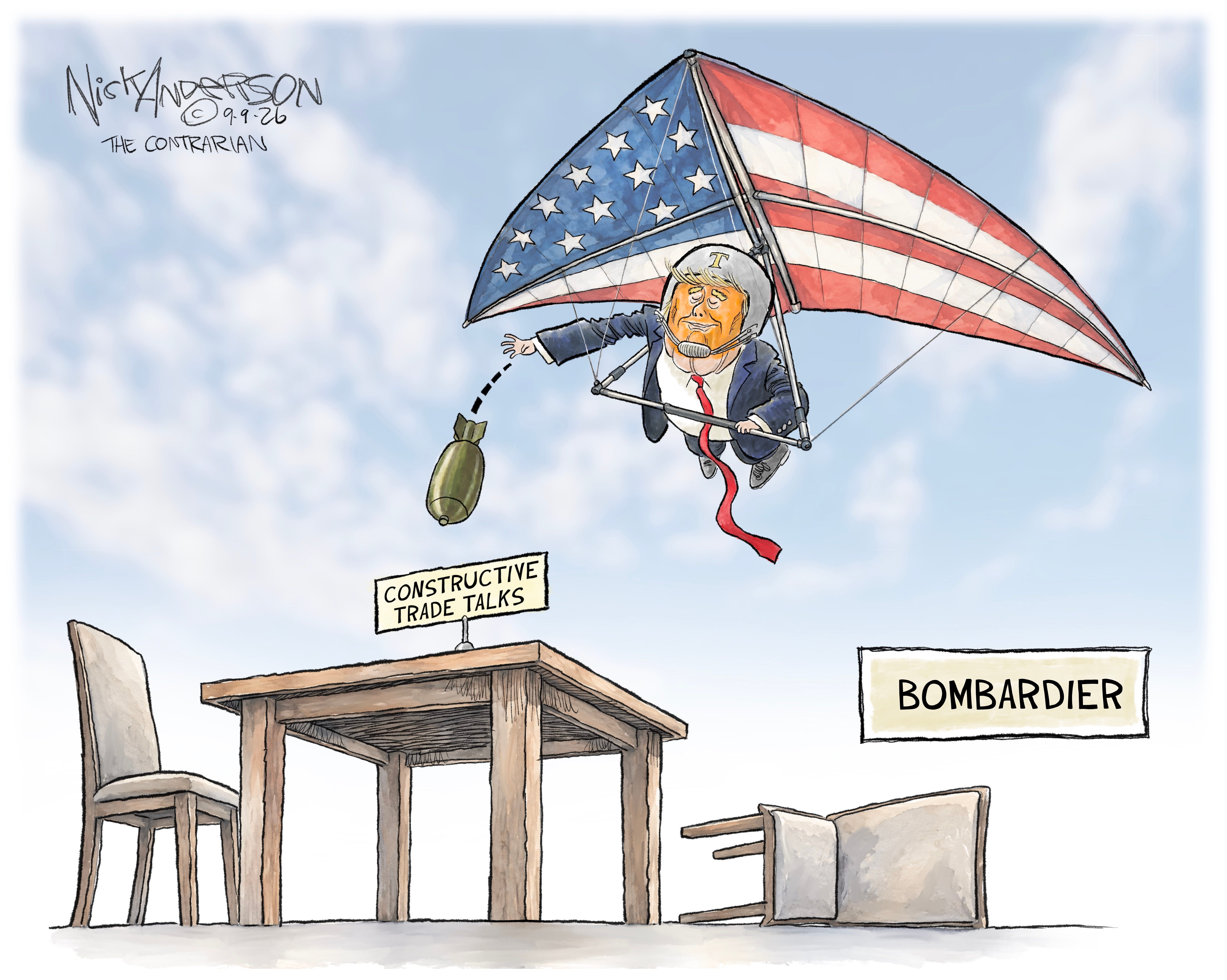
President Trump has found a new front in the U.S.-Canada trade war: private jets. Trump threatened to bar Bombardier aircraft from the U.S. market unless the Montreal-based company starts building its planes here, declaring that if Bombardier wants access to American customers, it must stop treating the country like a “piggybank.” The complication is that Bombardier already employs thousands of Americans, operates facilities in California and Texas, and says its supply chain includes 2,800 U.S. companies.
Bombardier is particularly vulnerable because America is by far its most important market. Roughly half of the company’s worldwide fleet of more than 5,200 aircraft operate in the United States, and about 55% of its $9.6 billion in 2025 revenue came from the U.S. Its aircraft are also used by the U.S. military for surveillance and intelligence missions. So banning Bombardier would be an unusually comprehensive way of punishing Canada: American companies could lose business, American customers could lose access to aircraft, and the American military could find itself operating planes made by a company America doesn’t want selling planes in America.
There’s also a history here. During Trump’s first administration, Boeing accused Bombardier of benefiting from unfair Canadian subsidies, and the Commerce Department proposed tariffs approaching 300%. That effort produced an unexpected result: Bombardier transferred control of its CSeries jet program to European rival Airbus, which began assembling the planes in Alabama, renamed them the A220 and effectively sidestepped the tariffs. The U.S. International Trade Commission subsequently rejected the duties unanimously. It was an impressive piece of trade policy: America tried to protect Boeing and helped Airbus instead.
Trump revived the feud earlier this year by threatening 50% tariffs and decertification of Bombardier jets unless Canada approved several Gulfstream aircraft. Canada approved those planes the following month and Trump’s threatened measures never took effect. Now he’s back with an even bigger threat: manufacture in America or potentially lose access to the market altogether.
Some cartoons write themselves.