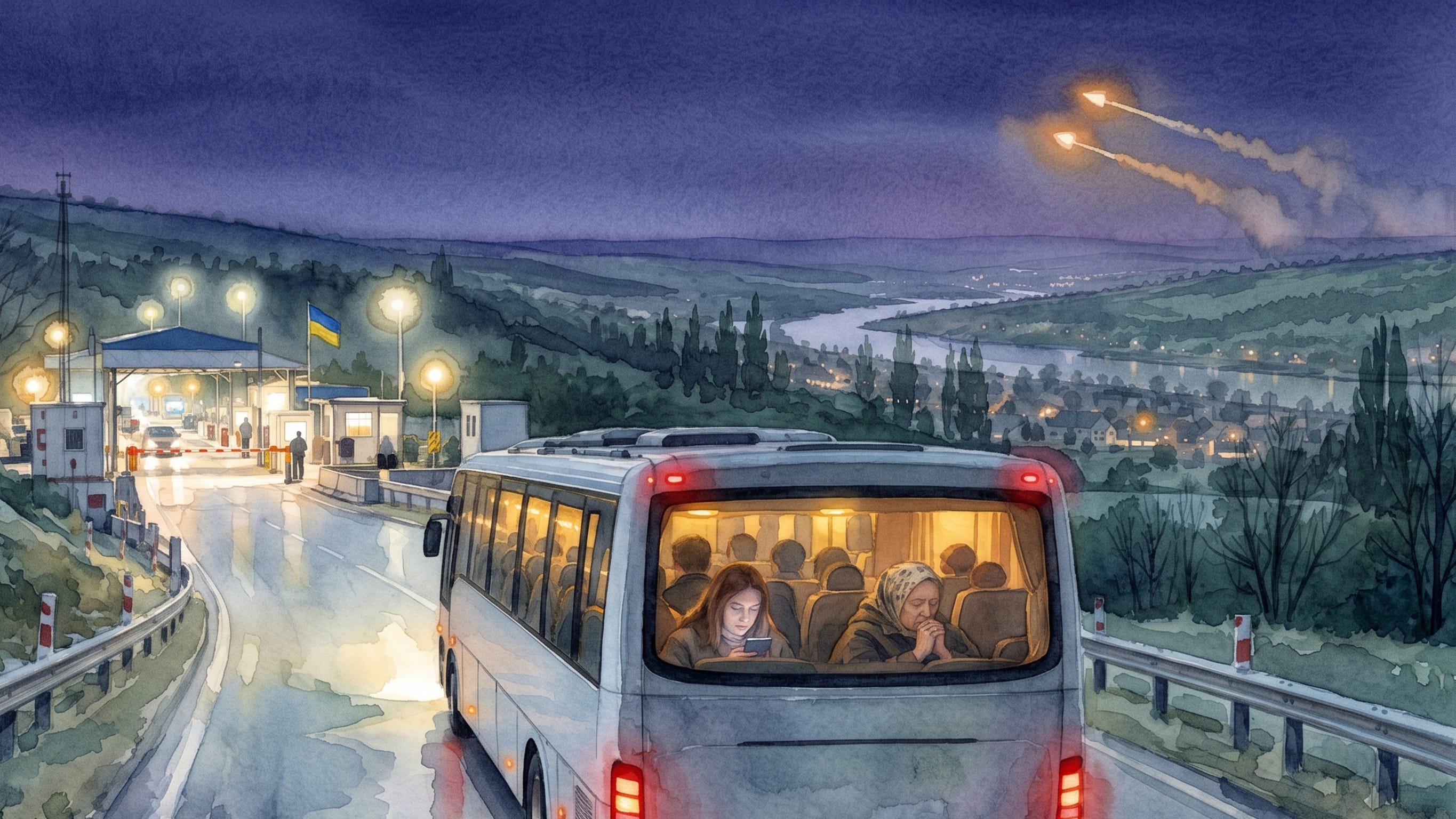
**ODESA—“Maiaky—that’s us!” the girl next to me blurted out, **looking at her phone. Russian “Banderol” cruise missiles had just been fired at the Moldovan-Ukrainian border post at Maiaky, right as we were pulling out of it after having completed passport control. She ran to the driver and wanted to know whether we should get off. The grandmother next to me began to pray loudly. I just looked towards the front of the bus, hoping the driver knew something we did not, but he just shouted that we needed to keep going. And that is what we did, keep going into uncertainty.
We publish this newsletter every day at 9:05am NYC time / 4:05pm Kyiv.Your subscription fuels our work.
On September 9, strike drones damaged Starokozache–Tudora, a Ukrainian border crossing into Moldova. Two people near it were killed, three were injured, and sixteen had to be evacuated.
I remember switching my attention between the girl, the grandmother, and my phone, where I was tracking the alarm notifications as we kept moving. The girl was still waiting for a satisfying answer, while the grandmother seemingly had decided there was none to be had from the people on the bus and continued to appeal to a higher power instead. We had crossed the border, and the bus was moving. I should have felt relieved that the wait was over. Instead, I kept trying to guess whether we were driving directly into the path of one of those Russian missiles. The reaction of the people of the bus was different, but had one common denominator: None of us knew which side of luck we were on.
Traveling to Ukraine since the full-scale invasion has always been difficult and time-consuming. You fly to a neighboring country because you cannot fly directly, then take a train or a bus and give up any confident prediction of when you will arrive. You learn which stations have somewhere to sit after midnight, how much time a border crossing might add, and whether the final stretch is better done asleep on a train or awake in a minibus. To this day, Ukraine’s airspace remains closed to civil aviation.
For a long time, I thought of this as exhausting rather than frightening. On the way in, a delayed connection meant getting to your destination later than planned. On the way out, it meant watching the hours before a flight from Warsaw, Krakow, Chișinău, or any of the other potential departure airports around Ukraine disappear. There was always the possibility of an air raid somewhere along the route, of course. But the border itself still felt like the end of one part of the journey and the beginning of another. You could be miserable there without believing you were in immediate danger.
Russia’s continued aggression has once again removed another safe haven.
I have taken enough Ukrainian trains to know how much trust a passenger places in the crew. People sleep through stops. They hand over tickets, settle into their compartments, and assume the railway will get them through the night. An evacuation reverses all of that in a moment.