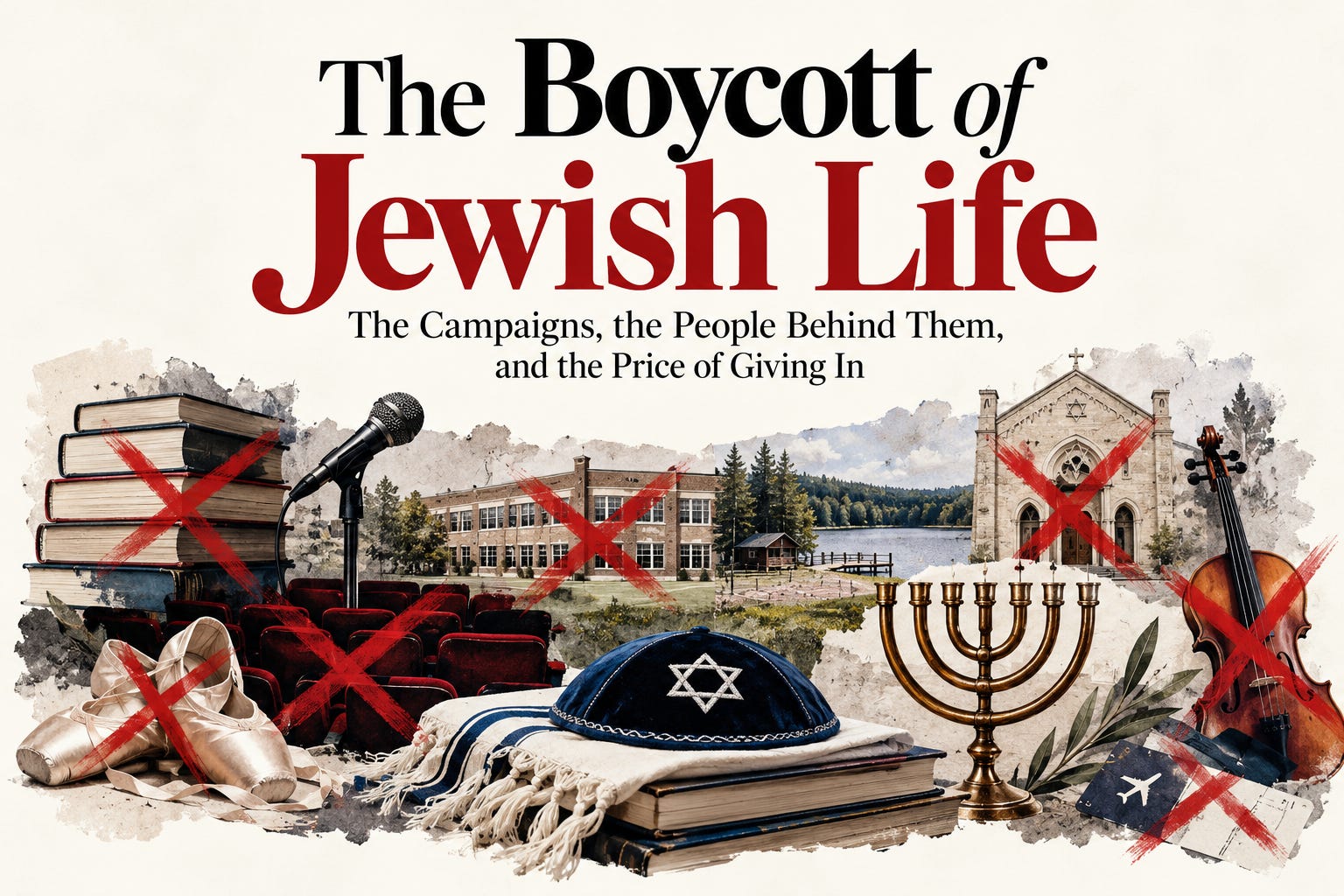
Antizionists love calling Jews Nazis. It’s become such a regular part of their vocabulary that apparently nobody stops to think about what the Nazis actually did to Jews before the deportations and the killing began.
On April 1, 1933, Germans woke up to find brownshirts standing outside Jewish businesses, warning customers to stay away. Some shop windows had been painted with antisemitic slogans. Others had the Star of David smeared across the glass. The Nazis had organized a nationwide boycott, and the men stationed outside those shops were there to make sure everybody knew which businesses belonged to Jews.
Six days later, the government passed a law removing Jews from the civil service. Jewish professors lost their university positions, and government employees who had spent their careers serving Germany were told they were no longer welcome. President Paul von Hindenburg insisted on exemptions for certain Jewish World War I veterans and longtime civil servants, but even those protections were temporary.
The restrictions kept coming. Jewish doctors and lawyers were pushed out of their professions. Musicians were dismissed from orchestras, actors lost their places on German stages, and publishers stopped carrying Jewish authors. In September 1933, the Nazis established the Reich Chamber of Culture, putting the country’s artistic professions under government supervision. Jews who had helped shape German cultural life were being systematically removed from it.
Germany was a dictatorship, and those measures were enforced by the state. What followed was the Holocaust. Nobody needs to pretend today’s boycott organizers have the same powers as the Nazi government to recognize what they’re asking institutions to do.
In Canada, activists have asked camping associations to reconsider the accreditation of Jewish summer camps and have filed complaints with federal regulators against Jewish schools. In Europe, performances have been canceled over artists’ Israeli connections. In publishing, Jewish writers have described editors and agents treating their names, characters, and national identities as professional liabilities. The campaigns have organizers, published demands, financial supporters, and institutional targets, and some of the same organizations appear in Canadian charity complaints, international cultural-boycott coalitions, and meetings where activists discuss coordinating their efforts.
On February 4, 2026, Just Peace Advocates published allegations against Jewish summer camps in Canada, accusing them of supporting Israel and its military. The organization urged camping associations to review the camps’ accreditation and encouraged supporters to contact the bodies responsible for overseeing them. The Ontario Camps Association, whose members operate summer programs involving swimming, hiking, outdoor education, and other activities, suddenly found itself asked to weigh political accusations against camps already subject to professional standards for staffing, facilities, safety, and programming.
Jewish camps often include Hebrew, Jewish history, and connections to Israel alongside ordinary summer activities. Just Peace Advocates argued that certain activities and affiliations raised concerns about support for Israeli military operations and anti-Palestinian racism. The association disputed those accusations, and on February 13 its board issued a statement rejecting the campaign. According to the board, activists had contacted camping associations in Ontario, Quebec, and Nova Scotia seeking action against Jewish camps and staff members. Accreditation, the board maintained, would continue to be determined by established professional standards.
The campaign didn’t result in a verified public decision stripping a Jewish camp of accreditation. But the allegations and demands were public, and the camps had been identified as targets. Families considering Jewish summer programs could now see a political organization asking professional associations to reconsider whether those camps should retain recognition because of their connections to Israel.
In April, Just Peace Advocates joined Palestinian and Jewish Unity, the Ontario Palestinian Rights Association, and the Canadian Foreign Policy Institute in submitting a 112-page complaint to the Canada Revenue Agency. Filed on April 22, it identified 11 Jewish schools and associated charities, including Associated Hebrew Schools, Bnei Akiva Schools, Toronto Heschel School, Netivot HaTorah, TanenbaumCHAT, Bialik Hebrew Day School, and Leo Baeck Day School. These institutions teach mathematics, science, literature, Hebrew, Jewish history, and other subjects, while relying on tuition and charitable contributions to support their programs.
The complainants examined appearances by Israeli soldiers, fundraising activities, educational programs, and graduates who later served in the Israel Defense Forces. They also raised allegations involving foreign military recruitment and asked federal regulators to investigate whether the schools’ activities violated Canadian charitable rules. A school inviting a former soldier to speak, teaching students about Israel, and actively recruiting people into a foreign military are legally different activities, however, and the complaint’s allegations didn’t establish that any of the schools had broken the law.
On May 1, Michael Teper, president of the Canadian Antisemitism Education Foundation, wrote to Sharmila Khare, director general of the CRA’s Charities Directorate, challenging the accusations. The available public record doesn’t show that the CRA accepted the complainants’ allegations or revoked any of the schools’ charitable registrations. The request nevertheless put the institutions’ charitable status under scrutiny, with potential consequences for fundraising, tax receipts, and the programs supported by donations.
Just Peace Advocates had been pursuing complaints involving charities and Israel for years. Its 2025 annual report described more than 70 campaigns, over 500,000 letter-writing actions, and a mailing list approaching 70,000 contacts. It also identified the people directing its activities and the organizations working alongside it, including Jonathan Kuttab, a Palestinian-American attorney whose professional relationships extended well beyond Canada.