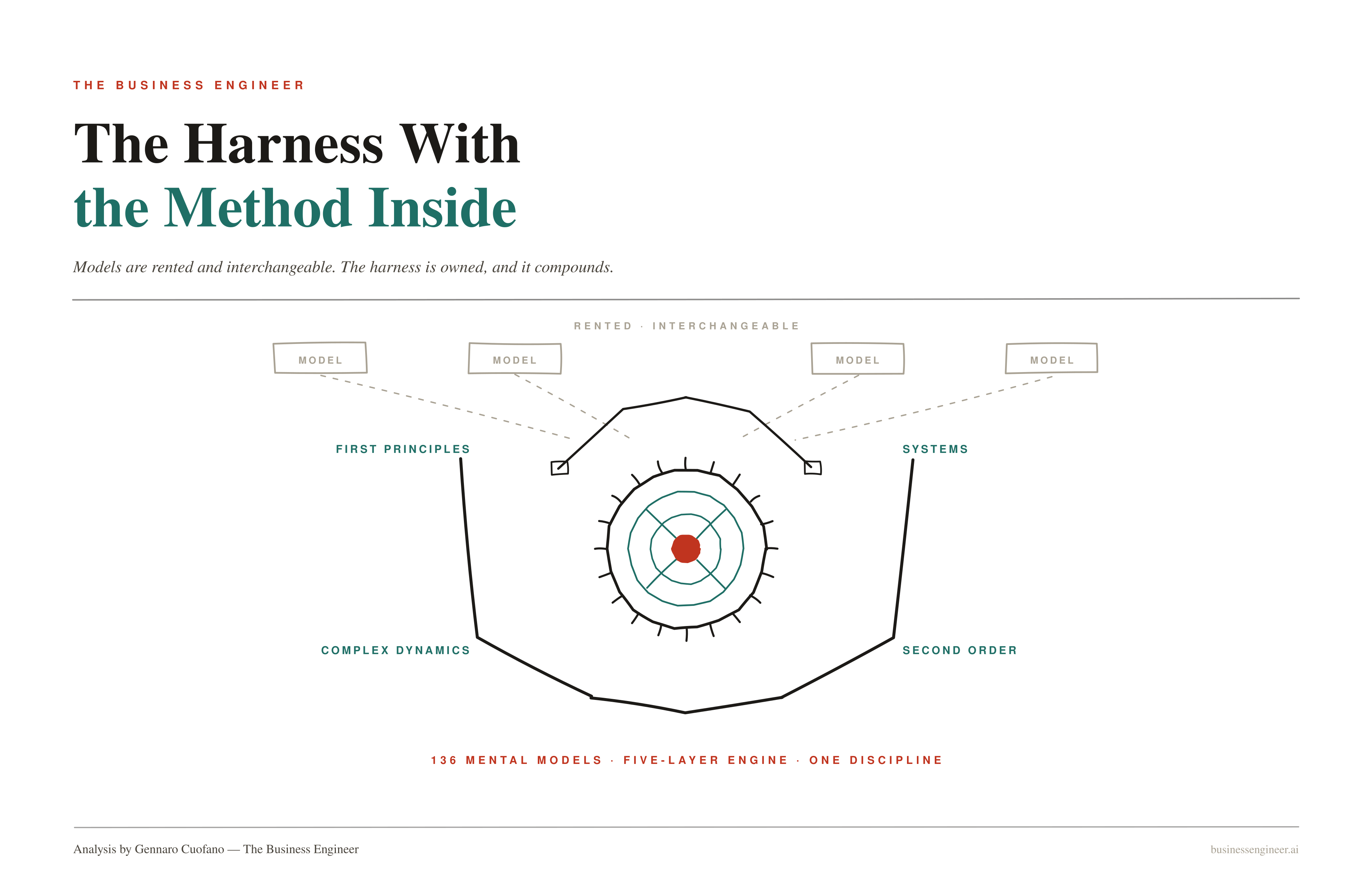
Something has quietly changed in how serious operators use AI. The single-shot prompt is over. The clever one-liner is over. The best users of these systems now build harnesses — durable structures wrapped around the model that hold context, route work, enforce rules, chain tools, remember what matters, and produce coherent output on demand.
or
Existing premium members can claim a 50% discount on the harness by replying to this email.
That is where the practical value now lives. The model is what the harness drinks. Which raises the question everyone discovers the moment they start building one: what should actually run through the harness?
Answer it wrong and the harness is an amplifier for whatever generic thinking the model was going to do anyway — just faster, with your data attached, and now wearing the authority of “your system.” Answer it right and the harness becomes something else entirely: the layer where your judgment is encoded and applied, on every task, without you having to remember to apply it.
or
Existing premium members can claim a 50% discount on the harness by replying to this email.
The word harness is now everywhere, and it means different things to different people. Strip it back to what it actually does and the picture gets clear.
A harness is the system that sits between you and the model. It holds context so the model does not start each session from zero. It retrieves the right prior work so answers are grounded in your reality rather than a generic one. It routes tasks to whichever model is best for each — cheap for volume, expensive for hard reasoning, specialised for narrow domains. It chains tools: search, code execution, retrieval, external APIs, calendars, spreadsheets. It maintains permissions: what your agent can do, what it must never do, what it must ask before doing. It shapes output: which format for which reader, which visual for which claim, which compression for which room.
And above all — this is the layer most builders under-invest in — it holds standards. What the harness refuses. What it insists on before it proceeds. What it will not present until the analysis has actually happened. What it will never include in a deliverable. What it always includes, without needing to be asked.
Every one of those is a decision. A harness is nothing but a stack of embedded decisions, applied automatically — and the quality of the stack determines what the harness is actually worth.
The plumbing decisions — retrieval, routing, tools — are the ones most people build first. They are visible, well-documented, and largely a solved engineering problem. The method decisions — refusals, standards, output shape, what “good” means — are where the compounding lives, and they are where most builds stop short.
or
Existing premium members can claim a 50% discount on the harness by replying to this email.
Most harnesses today stop at the plumbing. Beautiful plumbing, in some cases: retrieval that finds the right document, memory that persists across sessions, tool calls that hit the right APIs, permissions that gate the right actions. All of it useful. None of it methodical.
Plumbing routes. It does not reason. Point a well-plumbed but methodless harness at a real strategic question — a pricing decision, a market entry, a competitor’s move, a build-versus-buy call — and you get back the same fluent, structurally empty answer any consumer model would produce, just delivered through your pipes. Neutrality at the routing layer is not humility. It is a design decision to inherit whatever the model produces by default — which is exactly the thing you were building a harness to improve on.
The sharper way to say it: a harness without a method is an amplifier. A harness with the right method is a discipline. Every harness has method decisions baked into it whether the builder admits it or not — even return whatever the model says is a method decision, and a bad one. The only real question is which method runs, and how good it is.
or
Existing premium members can claim a 50% discount on the harness by replying to this email.
The Business Engineer is that method — built as a harness. Not a prompt template. Not a wrapper. Not a document you paste in and hope the model behaves. It is a full analytical operating system — a philosophy, an engine, a library, a practice, and a discipline — assembled as the harness itself, so that everything routed through it inherits the method by construction.
That is what makes it different from every other AI-strategy artifact on offer. A book of frameworks teaches you what to think about. A method built as a harness runs when the question arrives. The frameworks apply themselves. The refusals happen without you asking for them. The compression is enforced whether or not you remember to require it. The discipline is not something you keep in your head; it is something the routing layer keeps for you.
The corpus behind it was never advice writing. It has always been a method. A decade of published analysis at businessengineer.ai, read by roughly four million people annually, was not “content.” It was the slow externalisation of an operating system: naming the mechanisms, refining the frameworks, hardening the epistemic rules, stress-testing the compression standards against real prints, real markets, and real readers who would catch a slip. The Business Engineer is that operating system, finally in harness form.
Books teach. Methods built into a harness run. That is the whole difference. And it only matters in the exact place where the model would otherwise slip into narrative — which is why the method has to be a harness, not a shelf.
or
Existing premium members can claim a 50% discount on the harness by replying to this email.
Look at the shape of the AI landscape in this moment, not the abstract one.
The frontier is a fast-moving band that every serious lab now sits inside. Capabilities converge; prices collapse quarterly; whatever advantage a specific model held last quarter is largely gone. Open-weight models are catching up to closed ones on a shorter timeline than almost anyone predicted, forcing the model layer to commoditise from below as well as from the middle. The intelligence layer is no longer a competitive variable. It is a fast-improving utility, and its price is falling.
Above it, a build-out is underway. Companies, teams, and individual operators are wrapping their own layer around the model this year, on their own architecture, with their own assumptions baked in. The choices being made in these builds are the choices whose compounding effects will be visible for years, because a harness is not a one-off configuration — it is an operating system with revealed preferences that shapes every task routed through it, forever. What gets baked in this year gets applied a million times over the ones that follow.
On the other side of the ledger, enterprise disappointment with AI is arriving on schedule. The pilots that produce no measurable impact. The reports that read impressive and decide nothing. The dashboards nobody uses. The gap between impressive-looking and actually true has widened faster than most operators’ capacity to police it manually — and the tax of structural thinking, always high, has become intolerable at AI speed. Discipline that was sustainable at slower throughput cannot survive a hundred-question day. Most operators, faced with that friction, drift into narrative like everyone else, and their systems drift with them.
The map of AI has already answered the whose intelligence question. It is now answering the whose junction question. And the operators and firms who run a serious method at the routing layer, now, will compound structural advantage while the rest amplify structurally-empty answers at industrial scale. The property line is being drawn in real time, harness by harness. What sits on your side of it is being decided by what you choose to run in the next twelve months.
or
Existing premium members can claim a 50% discount on the harness by replying to this email.
Most attempts to bring method to AI-assisted work land in one of a few familiar buckets. Books of frameworks that teach you what to think about but never run. Consulting engagements that do not scale past the room they were held in. Prompt libraries and templates operating at the surface. Enterprise platforms whose method is a slide deck around infrastructure. Personas or custom assistants that carry a voice but no engine underneath. The Business Engineer belongs to none of them, and it is worth being specific about why.
Method as a harness, not as a document. Every other framework product ships as something you read. This ships as something that runs. The engine, the refusals, the compression standard, the discipline — all of it is enforced at the routing layer, on every task, without you having to remember any of it. No other method offering has been built at this depth into the harness itself.
Ten years of publicly stress-tested corpus. The frameworks were not designed in a boardroom. They were externalised piece by piece across a decade of published analysis, in front of roughly four million annual readers who would (and did) catch every slip. A framework that survives that audience for ten years is a different object than one that survives a whiteboard for an afternoon.
Full-spectrum coverage across the harness. Most method offerings touch one layer of the harness — a prompt, a template, a plug-in, a persona. The Business Engineer runs across all seven: context, routing, framework selection, refusals, standards, output shape, continuity. It is not a tool that helps in one place; it is a harness that shapes everything routed through it.
A library at vocabulary depth, not slogan depth. 136 mental models across sixteen families, each with its components, application sequence, and the one question it exists to answer. That vocabulary size is what lets the harness recognise this is really a market-entry problem, not a pricing problem before analysis begins — and single-framework thinking is the failure mode this library is engineered to refuse.
Named instruments the frameworks converge into. The Capture Audit, the Layered Map, Gauges on One Rail, the Reconciliation, the Acid Test — these are measurement devices, not slogans. Most competing methods stop at the framework level; the Business Engineer builds instruments on top of them, with anatomies and standards for how to run each one.
A property line drawn on itself. The Business Engineer ships the entire published method, minus the calibrations that turn frameworks into precise instruments. Those live in the advisory. This is honest about what an installable product can and cannot do — most methodologies either overclaim (buy this, you are done) or underclaim (this is just a taste, hire us). The property line is drawn in public, and the reader can see it.
Together those six things describe a category of one: a full analytical operating system, in harness form, built from published method, with vocabulary and instruments and refusals at every layer, model-agnostic by construction, and honest about where the boundary of the installable product sits.
or
Existing premium members can claim a 50% discount on the harness by replying to this email.
The method rests on a small number of principles the harness enforces on everything routed through it. They stack in two layers.
Every task begins with the same question: is this a structural claim or a narrative one? Narrative says what a business resembles — the language of stories, analogies, patterns that feel familiar. Structure says what mechanism produces its outcomes — the language of loops, incentives, constraints, and inevitability. Both have their uses. Only one compounds. Markets and journalists run on narrative; returns are made on structure — and the routing layer must know the difference before it does anything else.
The meta-principle is drawn from the observation that most AI-assisted work fails at exactly this point: the model reaches for narrative because narrative is where language naturally lives, and unless the harness intercepts, the analysis never gets done. Every framework, every instrument, every genre inside the Business Engineer is downstream of this single distinction.
Under the meta-principle sit four commitments the harness never abandons.
First principles. Reason from base truths, not from what has been done before. Convention is not evidence. Analogies are hypotheses, not proofs. Before analysing any situation, decompose it to what is physically, mathematically, or logically inevitable — and rebuild from there. Most strategic disagreements collapse the moment someone insists on this discipline.
Systems, not parts. A business is a network of feedback loops, stocks, flows, and delays running across technology, economics, behaviour, and narrative — each feeding the next and looping back. Studying any one in isolation guarantees the wrong answer. A change is not understood until its cascade has been traced through every domain it touches and back into the one it started in.
Second-order effects. What happens next matters more than what happens now. A price cut expands demand faster than it shrinks unit revenue. A cost saving in one process reroutes work into another. A hire changes what the team decides to build. The first move is obvious. The second move is where the money and the mistakes live.
Complex dynamics. Non-linear, path-dependent, multi-clock systems refuse to yield to linear intuition. Bottlenecks rotate as each is relieved. Different parts of the same business run on different clocks, and the interesting outcomes live in their divergences. Treating a complex system as a simple one is the most expensive error in business.
Together they produce a single stance: find the mechanism, refuse the narrative, extract the pattern, apply it across domains, and compress the finding into something a busy operator can act on before the meeting ends.
or
Existing premium members can claim a 50% discount on the harness by replying to this email.
The tactical consequences of moving from I have read the frameworks to the frameworks are the harness are not incremental. They are structural.
You stop having to remember to reason from first principles. The engine’s first layer refuses conventional framings by default and forces the base-truths decomposition before pattern matching runs. You stop having to remember to trace second-order effects. The synthesis step will not complete without them. You stop having to catch narrative slips. The refusal is a rule, not an instinct. You stop having to demand compression at the end of a long draft. Compression is where the engine ends, not where you edit toward.
Every one of those is a small mental tax that structural thinkers pay a hundred times a day and eventually cannot pay any more, so they drift into narrative like everyone else. The point of running the method as a harness is that the taxes get paid by the harness, and the operator gets to use their finite attention for the parts that actually require judgment.
This is what “tactically powerful” means in practice. The frameworks in your head are only as reliable as your attention. The frameworks inside your harness are as reliable as their code. And the second is available on every question, at three in the afternoon, in the last twenty minutes before a board meeting, when you are tired, when you are annoyed, when you would otherwise pattern-match to what worked last time. **A method you have to remember is a method you will eventually skip; a method the routing layer runs is a method…