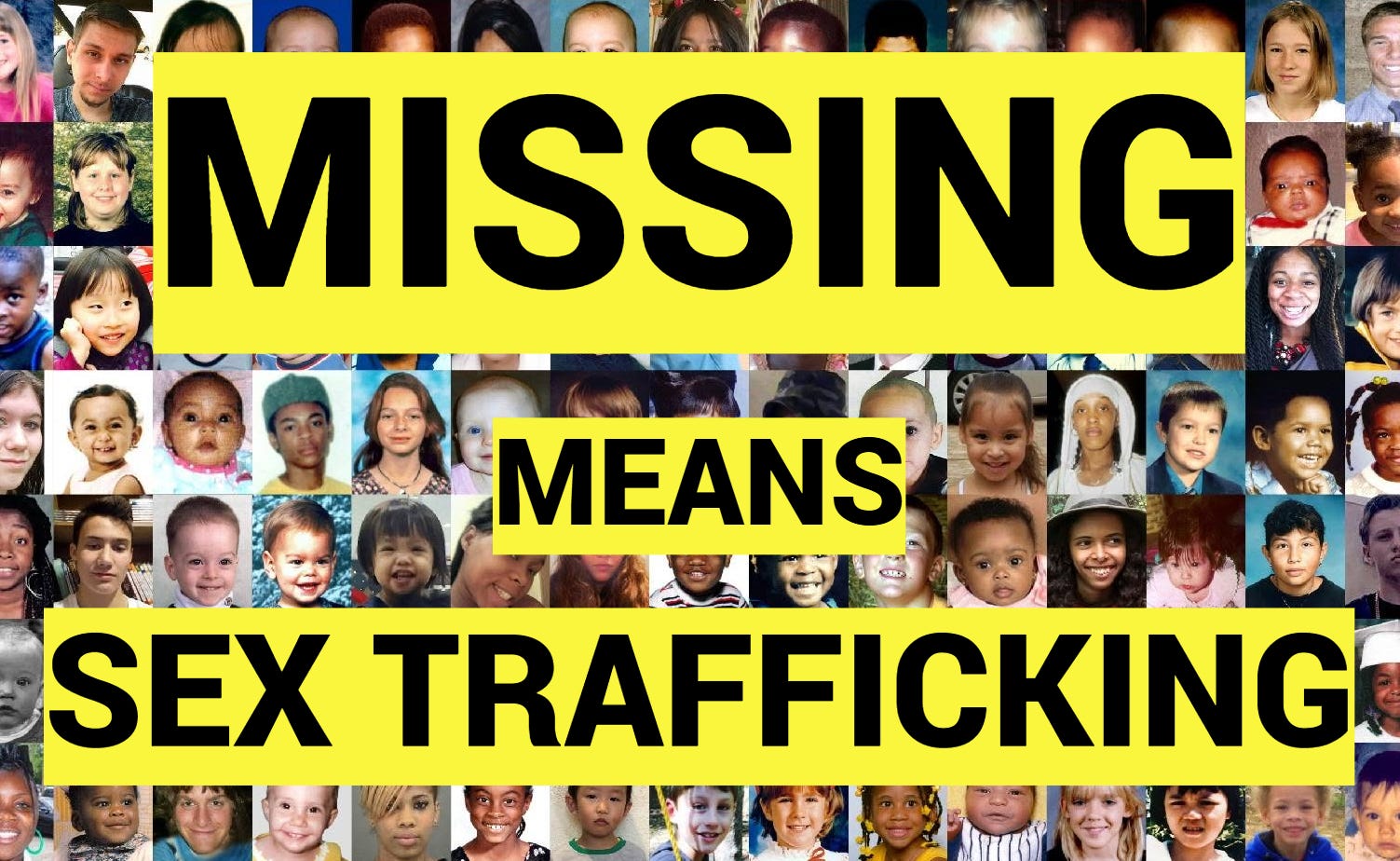
LUTHMANN NOTE: I call this designer child trafficking because the system manufactures the population predators want: children who are young, isolated, traumatized, mobile, and separated from protective relatives. No secret meeting is required. The judge signs the order. The agency selects the placement. The contractor collects payment. The caseworker misses the warning. The child runs. Police receive a late report or none at all. The trafficker takes possession. Each official performs one bureaucratic act while the child suffers the combined result. Government built this pipeline with coercive power, sealed files, and public money. Government must now open every file and account for every child. This piece is “The Child Sex-Slavery Pipeline,” first available on The Family Court Circus.
I did not appear on * The Judge’s Oath* to conduct another polite seminar about family-court reform. I went there to identify evil. America’s family courts have become the headwaters of an unpoliced government pipeline that takes children from their families, converts them into federally financed foster-care placements, loses thousands of them, and leaves the most vulnerable within reach of pimps, pedophiles, and organized child-sex traffickers.
Family court supplies the removal order. Foster care supplies the isolation. Government funding sustains the placement machinery. When the child disappears, the same institutions that claimed emergency power to seize that child retreat behind sealed files, fragmented responsibility, and administrative excuses.
That is the child sex-slavery pipeline. It does not require every judge, caseworker, and contractor to participate in a secret meeting. It operates through division of labor, public money, and institutional cowardice. Everyone performs one bureaucratic act. The child absorbs the total evil.
I called family court “a town with no police.” The phrase comes from David Weigel and the Family Court Fraud Warrior Project, whose work understands the system’s central fraud. Family court possesses overwhelming police power when it wants to act against a parent, then develops paralysis when judges, lawyers, guardians, evaluators, social workers,s and placement contractors require investigation.
The courthouse has armed deputies when a mother refuses to surrender her child. It has contempt warrants when a father falls behind on support. It has marshals, wage executions, gag orders,s and enough state force to empty a home, seize a bank account,t or destroy a parent slowly. What it lacks is law enforcement aimed inward. Nobody raids the judge who approves a catastrophic placement. Nobody handcuffs the administrator who loses a child. Nobody threatens a foster-care contractor with prison when a missing-child report disappears inside an agency database.
Government mobilizes against parents with guns and court orders. When government loses children, it produces paperwork.
The family-court judge performs the first essential act. A removal or custody order separates the child from the relatives most likely to search, scream, spend everything, and raise hell when that child disappears. The order arrives beneath the sacred incantation of “best interests.” The child then passes to an agency, a contractor, a foster parent, a group home, a residential facility,y or a therapeutic placement. Responsibility fractures at every transfer until nobody accepts ownership of the outcome.
The judge blames the agency. The agency blames the provider. The provider blames the child for running. Police receive a late report, a defective report, or no report. The court file stays sealed because the government that seized the child suddenly claims confidentiality protects the child from public scrutiny.
Confidentiality increasingly protects the system from discovery.
I have followed this machinery across the country. In Oregon, I reported on claims that a social worker funneled children into foster care while federal funding flowed through the system and on brain-scan evidence that advocates said exposed abuse while court professionals continued fighting for control of the children’s placement. Another Oregon investigation showed how the courthouse can turn protective parents into criminal defendants.
In New Jersey, Dr. Bandy X. Lee accused family-court actors of hiding behind sealed proceedings while suppressing criticism of what she called the country’s largest child-trafficking business.
In Connecticut, our reporting has examined claims that DCF ignored evidence while protecting the courthouse narrative, that institutions were enabling predatory systems, and that courts used their coercive machinery against the people sounding the alarm.
Different states. Different professionals. Different children. The same sealed machinery.
The fiscal architecture supplies the fuel. Title IV-E of the Social Security Act reimburses eligible foster-care maintenance payments, administrative expenses, and training. Related programs finance adoption assistance and guardianship. Congress later added prevention services, but the established system still commits enormous public resources to removal, placement, administration, and permanent separation. AFCARS data records the children moving through that national apparatus.
Title IV-E does not instruct judges to steal children, and a federal reimbursement is not evidence that any particular removal was corrupt. The incentive problem lies in what government chose to finance at scale. Once a child enters custody, money becomes available for maintenance, administration, legal work, case management, contracted care, and professional services. The courthouse begins with a family crisis and creates paid work for lawyers, guardians ad litem, attorneys for children, evaluators, therapists, visitation supervisors, social workers, foster agencies, and residential providers.
One appointment recommends another. One report generates another hearing. One failed placement creates another service plan and another contractor. Parents with money finance their destruction directly. Parents without money enter the taxpayer-funded version. Either way, prolonged conflict creates work, and every transfer generates another billable event.
I called it a “never-ending parade” on The Judge’s Oath. That was too polite. It is a feeding line, and the child occupies the plate.
The agencies call them cases. Contractors call them placements. Federal administrators call them beneficiaries. The fiscal system treats them as units moving through a reimbursable process.
Then the inventory goes missing.
The National Center for Missing and Exploited Children received 23,348 reports involving children missing from foster care during 2025. Of the children missing from care who were reported to NCMEC, 17 percent were identified as likely victims of child sex trafficking. These children entered government custody carrying the vulnerabilities traffickers cultivate: histories of abuse, unstable attachments, loneliness, fear, homelessness, and a desperate need to believe the next adult who promises food, shelter, affection, or protection.
The trafficker offers a room. The pimp offers money. The predator offers attention and a counterfeit family. The foster-care system has already performed the difficult work of separating the child from relatives, moving the child between strangers and teaching the child that placements collapse, adults disappear, and government promises mean nothing.
That is why children missing from care are such valuable targets. Government concentrates wounded children inside a fragmented system, then repeatedly fails to guard the exits.
The federal government’s own numbers establish the scale of the betrayal. The Department of Health and Human Services inspector general examined 74,353 episodes in which foster children were missing for at least two calendar days between July 2018 and December 2020. Auditors estimated that 13,983 episodes were not reported to law enforcement in accordance with federal requirements. That included an estimated 8,324 episodes that were never reported for entry into the National Crime Information Center database.
State agencies took custody of children, lost track of them, and failed thousands of times to make the police reports required to trigger a national search. A parent who conceals a child can face kidnapping charges, armed officers, and interstate pursuit. An agency that loses one receives findings, recommendations, technical assistance,e and another training module.
The failures continued after children returned. HHS auditors examined 413 foster children in five states where trafficking screenings were required following recovery. Sixty-five percent of the files contained no evidence that the child received the required sex-trafficking screening. When screenings occurred, some lacked comprehensive questions, failed to follow up when children did not answer, or depended entirely upon traumatized children volunteering what pimps, buyers, and rapists had done. One-third of the completed screenings contained no documented conclusion.
The child disappeared from government care and returned carrying fear, trauma, and possible evidence of sexual exploitation. Government often failed to ask the necessary questions. That is not a paperwork error. It is moral abandonment financed with public money.
Missouri provides the full institutional anatomy. Federal investigators found that 978 children went missing from foster care at some point during 2019. In nearly half of the 59 cases reviewed closely, investigators found no evidence that Missouri reported the missing child to both local law enforcement and NCMEC as required. For one-third of those children, there was no documentation of required health and safety checks following their return.
The failures are not ancient history. A 2026 HHS-OIG review found that Alaska frequently failed to assess missing American Indian and Alaska Native foster children for signs of sex trafficking, failed in 25 percent of reviewed incidents to take required location efforts beyond notifications, and omitted additional missing incidents from its case-management system for 38 percent of the children reviewed. In nearly 60 percent of incidents, required caseworker visits had not all occurred before the child disappeared.
State-level disclosures fill out the map. Illinois records obtained through a Freedom of Information Act request identified 166 foster children reported missing during 2024. Maryland disclosed 990 children in state foster care reported as runaways or of unknown whereabouts between January 2020 and August 2025. Of those Maryland children, 562 were female, and the median duration of missing status was 26 days.
Those numbers describe a national hunting ground.
I use the phrase “designer child trafficking” because the system produces children with the characteristics predators want: young, isolated, mobile, traumatized, detached from protective relatives and guarded by agencies whose records remain sealed. The phrase describes an institutional outcome. Judges and caseworkers do not need to select victims for traffickers deliberately. They create the population, concentrate the vulnerabilities, fracture accountability, and repeatedly fail to sound the alarm when children disappear.
The public does not need a Hollywood conspiracy to understand the result. The judge signs an order without personally inspecting the placement. The agency chooses the placement without accepting personal responsibility for what follows. The provider collects payment while pleading staffing shortages. The caseworker misses warnings. The child runs. Police receive incomplete information or no timely report. The predator takes possession.
Family-court judges cannot wash their hands at the courthouse door. They approve removals, reject relatives, accept agency recommendations, and continue placements after warning signs emerge. When a child taken under judicial authority disappears into prostitution, pornography, or sexual slavery, the trafficking did not begin in some unrelated universe. The pipeline began with a government decision and, often, a judicial signature.
That principle extends beyond foster care. Our investigations into killer family-court outcomes and the wider courthouse machinery exposed on * The Judge’s Oath* show the same institutional reflex. Courts exercise enormous coercive power over families, outsource responsibility to professionals and close the files when scrutiny approaches.
The judge receives immunity. The child receives none.
Every state should publish a live accounting of children missing from foster care, including the placement from which each child disappeared and the time each case was reported to police, NCIC and NCMEC. Every recovered child should receive an independent forensic trafficking assessment outside the agency that lost that child. Placement providers should disclose abuse complaints, missing-child incidents, licensing violations,s and financial relationships. Judges should explain on the record why safe relatives were rejected. Federal auditors should trace Title IV-E money through agencies, contractors, facilities,s and every failed placement.
Most of all, open the files. Confidentiality has become the velvet curtain concealing broken placements, missing reports, failed screenings, and institutional cowardice. A government powerful enough to take a child must answer publicly for where that child went.
There is evil in this system. The old kind. Adults collect money, institutions protect themselves, predators feed, and children suffer beyond the sealed courthouse door. Family court loads the pipeline. Foster care supplies the vulnerability. Traffickers collect the children.
[FOIA Bombshell Reveals Child Sex-Trafficking Fears: 166 Illinois Foster Children Missing](https://thefamilycourtcircus.com/20…