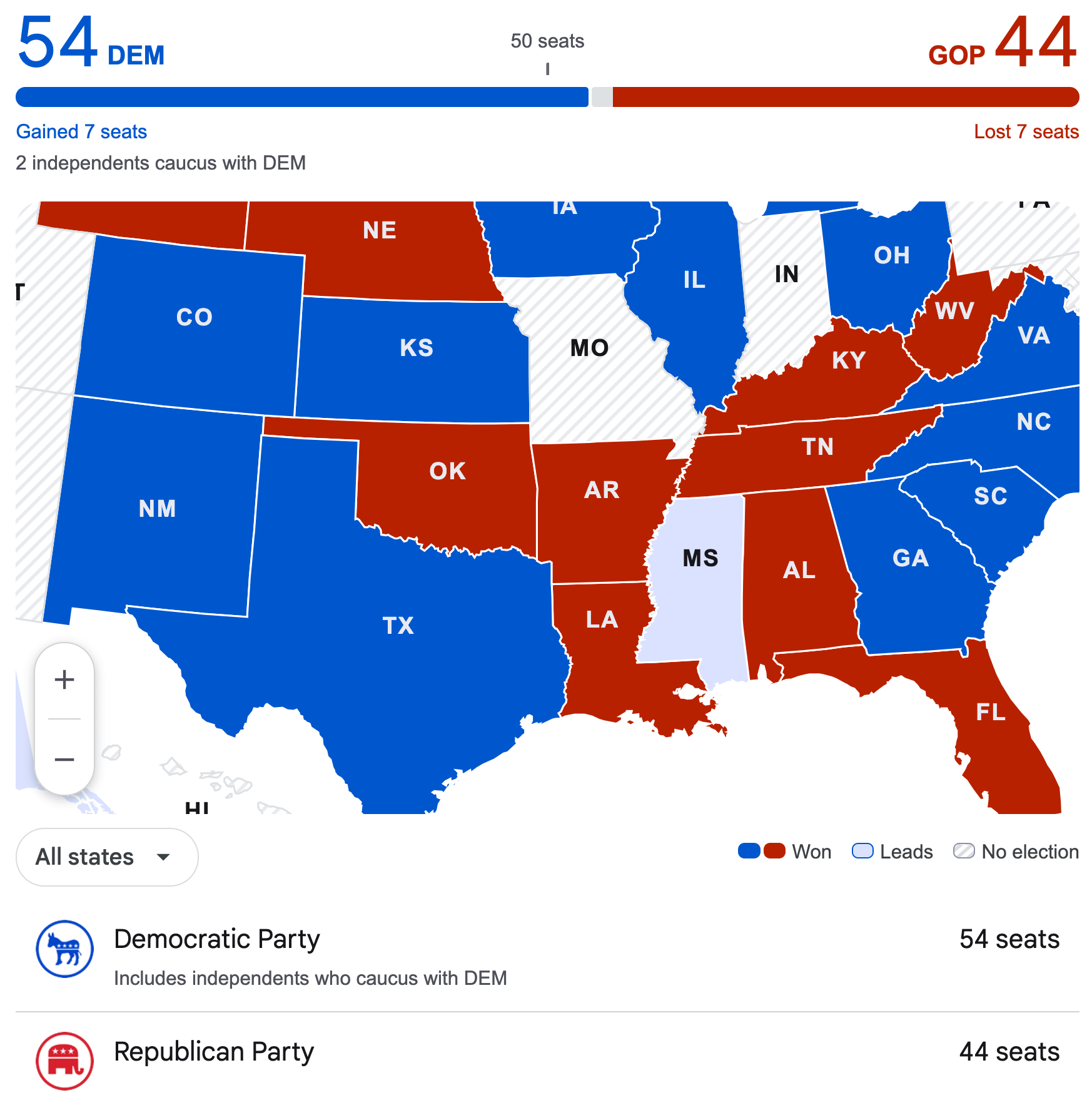
This morning, historian Steve Kantrowitz, author of * Ben Tillman & the Reconstruction of White Supremacy, *observed that if Scott Colom holds his lead in Mississippi, a majority of the former Confederate states will send a Democrat to the Senate in January.
I did not have Mississippi in mind as a possible flip this election cycle, especially given that Scott Colom is African American. The last time Mississippi elected a Black U.S. Senator was during the post-Civil War Reconstruction era when Blanche Bruce and Hiram Revels were elected by the state legislature.
By the early twentieth century, African Americans in Mississippi were largely disfranchised following the ratification of new state constitutions. Solomon Saladin Calhoon, president of the 1890 Mississippi constitutional convention and a white county judge, stated regarding the push to disenfranchise Black voters: “Let's tell the truth if it bursts the bottom of the universe. We came here to exclude the Negro. Nothing short of this will answer.”
And James Vardaman, who served in the Mississippi Legislature during the 1890 convention and later became Governor of Mississippi, famously declared: “There is no use to equivocate or lie about the matter. In Mississippi we have in our constitution legislated against the racial peculiarities of the Negro. . . . When that device fails, we will resort to something else.”
Jim Crow laws were designed specifically to target African Americans, but it was also intended to prevent the formation of interracial coalitions that had proved successful in a number of former Confederate states during the second half of the nineteenth century.
I agree with Kantrowitz that “we are now seeing what a southern multiracial electoral coalition looks like, how it is organized, and how it wins.”
Thanks to historian John Legg for posting these two maps earlier today on his Facebook page. The map on the right, pulled from the 1860 census report and digitized at the Library of Congress, clearly outlines the counties along the Mississippi River with the highest concentration of enslaved people. The map on the left highlights the political mobilization of their descendants in this week’s election.
It was in the 1890s, at the very moment of legalized disfranchisement, that Mississippi changed its state flag to include the Confederate battle flag in the new design. That flag was only changed in 2020.
The governor still signs an annual proclamation marking April as Confederate Heritage Month. Compared with other former Confederate states, very few monuments and statues have been removed or been relocated.
Of all the former Confederate states, the Lost Cause narrative has enjoyed the longest half life in Mississippi. It’s role throughout much of the twentieth century served to rally its white citizens around a shared history and a future that always assumed they would remain in charge while African Americans remained a subordinate class.
This past week’s results points to a very different future.
Regardless of the result of the state-wide election, Scott Colom will win in Jefferson Davis County…
…as well as Forrest County, named after slave trader, Confederate general, and Klan Leader, Nathan Bedford Forrest.
Those two maps, set side by side, compress a century and a half of Mississippi history into a single glance. The counties where enslaved people were forced to labor in the greatest numbers in 1860 are now the places where their descendants, joined by allies across racial lines, are reshaping the state’s political future.
The architects of disfranchisement in 1890 built their system to ensure that such a coalition could never form again, and for more than a hundred years it largely held. The at a Black Democrat could now carry Jefferson Davis County and Forrest county, places named for the Confederacy’s president and for one of its most notorious generals, suggests that the work of those men and the narrative that sustained them is finally losing its grip.
Whatever the final tally shows, Mississippians have demonstrated that the exclusion Calhoon and Vardaman promised would last was never as permanent as they imagined.