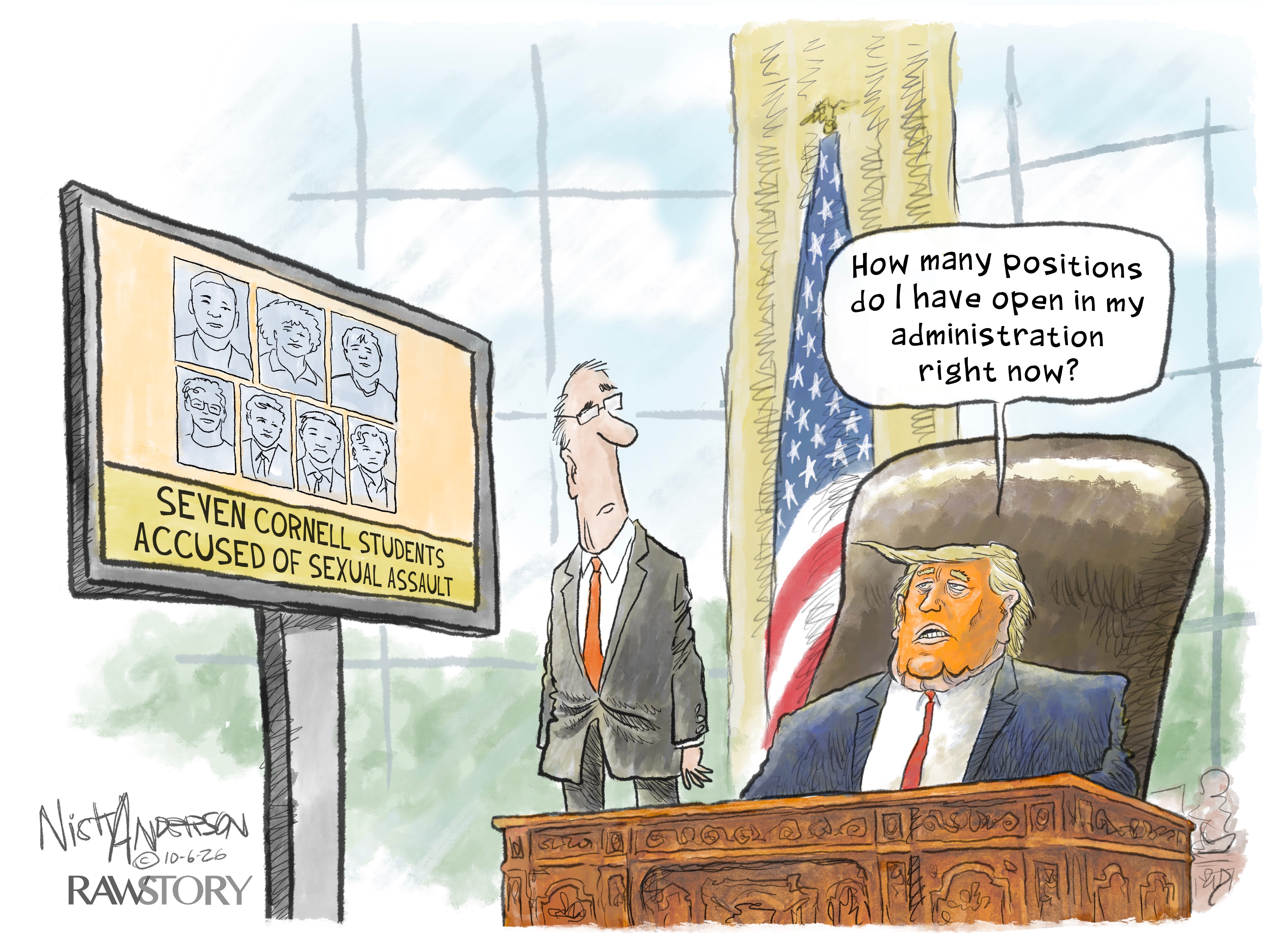
Donald Trump returned to the White House carrying something unusual for an American president: a civil jury verdict finding him liable for sexual abuse.
But Trump isn’t the only prominent figure in his political orbit to have faced allegations of sexual assault or misconduct. Several men Trump has nominated, appointed or selected for powerful positions—including Defense Secretary Pete Hegseth, Health and Human Services Secretary Robert F. Kennedy Jr., Supreme Court Justice Brett Kavanaugh and former attorney general nominee Matt Gaetz—have faced allegations or findings involving sexual misconduct.
In Trump’s case, there’s an actual civil verdict. A federal jury found in 2023 that Trump sexually abused writer E. Jean Carroll and defamed her. The Supreme Court declined in June 2026 to hear Trump’s appeal, leaving the $5 million verdict intact. Trump has denied Carroll’s allegation, but 27 other women have also accused him of sexual misconduct. The pattern seems pretty clear.
Then there’s Hegseth. Before Trump selected him to run the Pentagon, Hegseth had been accused of sexually assaulting a woman following a Republican women’s conference in Monterey, California, in 2017. Police investigated but no charges were filed. Hegseth told police the encounter was consensual and has denied sexually assaulting the woman. Trump nominated him anyway. The Senate confirmed him, and he now oversees roughly 1.3 million active-duty military personnel.
Robert F. Kennedy Jr., Trump’s choice to run the Department of Health and Human Services, was accused by a former family babysitter, Eliza Cooney, of groping her in the late 1990s. Kennedy said he had no memory of the alleged incident and subsequently sent Cooney a text apologizing for anything he may have done that made her uncomfortable. He, too, was confirmed.
The pattern extends back to Trump’s first term.
Brett Kavanaugh was accused by Christine Blasey Ford of sexually assaulting her when the two were teenagers. Kavanaugh categorically denied the allegation. Deborah Ramirez separately accused Kavanaugh of exposing himself to her while they were students at Yale, which he also denied.
After one of the most contentious Supreme Court confirmation battles in modern history, Kavanaugh was confirmed 50-48.
And then there’s Matt Gaetz. Trump selected the former Florida congressman to become attorney general after the 2024 election. Gaetz withdrew before confirmation, but the bipartisan House Ethics Committee subsequently released its investigation.
Its findings went considerably beyond an unsubstantiated allegation. The committee said there was “substantial evidence” that Gaetz regularly paid women for sex and had sex with a 17-year-old girl in 2017, which the committee concluded violated Florida’s statutory-rape law. Gaetz denied having sex with a minor and has denied wrongdoing. A separate Justice Department investigation ended without criminal charges.
So the common denominator isn’t that all these men were proved guilty of sexual assault. It’s that allegations or findings of serious sexual misconduct repeatedly failed to disqualify men Trump wanted in positions of extraordinary power. That represents a significant change from the political assumptions of an earlier era, when merely facing a serious allegation could derail a nomination.
With Trump, the allegations themselves have increasingly become part of the confirmation fight rather than an automatic end to it.
Hegseth is perhaps the clearest example. Senators knew about the 2017 sexual-assault allegation during his confirmation process. The police investigation and Hegseth’s denial were publicly available. The Senate considered them, and confirmed him anyway.
Kennedy’s allegation was also public before he entered Trump’s Cabinet.
Kavanaugh’s confirmation hearings became nationally televised examinations of Ford’s allegation.
And Gaetz was selected to become the nation’s chief law-enforcement officer despite a long-running House Ethics investigation into allegations that included sexual misconduct. The committee’s findings became public only after he withdrew.
In Trump’s political movement, sexual-misconduct allegations that once might have ended a nominee’s prospects have repeatedly become obstacles to overcome rather than barriers to office, and perhaps nothing illustrates that transformation better than the man making the appointments.
The president selecting nominees accused of sexual misconduct is himself a man whom a federal jury found liable for sexual abuse. Given his track record, he seems to see it more as a qualification rather than an impediment.