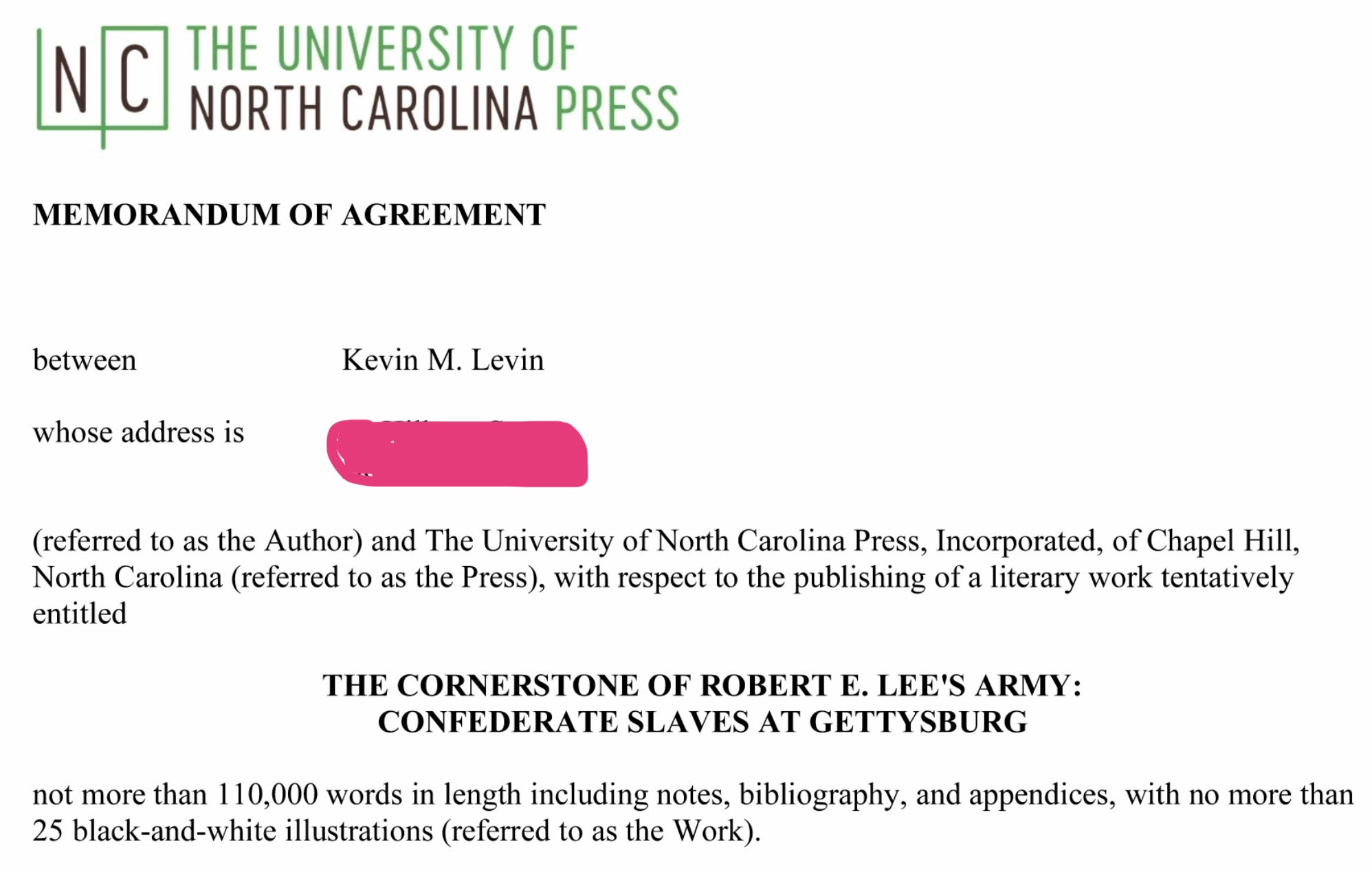
I am thrilled to announce that my next book, tentatively titled * The Cornerstone of Robert E. Lee’s Army: Confederate Slaves at Gettysburg* is now under contract with The University of North Carolina Press. Though my last two books appeared in UNC Press’s “Civil War America” series, this one will appear in their new
The plan is to submit the manuscript by May 2028. I am already hard at work on collecting sources, identifying themes and individual stories and working on the overall narrative arc of this book. I’ve never been more excited about a book project.
I wrote * Searching For Black Confederates* as a public service. There wasn’t much that surprised me about what I came away with in terms of the place of enslaved laborers in the Confederate army or how they were remembered after the war. Confederate records are crystal clear about the way in which slaves were employed over the course of the war.
Postwar sources are also pretty straightforward in terms of how these very same men evolved from laborers, operating under slavery’s coercive hold, to “loyal Black Confederates.”
This is the book I always wanted to write about the place of enslaved laborers in the Confederate war effort. It will be the first book-length study of the role of enslaved laborers in the army through an entire campaign.
Gettysburg is the obvious case study. It is the most high profile battle in Civil War memory, but it also offers a number of windows into the larger story of slavery during the war.
In late June 1863 as many as 10,000 slaves marched into the free state of Pennsylvania.
The timing of the battle makes the project all the more urgent. Gettysburg was fought six months after Lincoln signed the Emancipation Proclamation, placing the destruction of slavery at the center of the Union war effort. When the Army of Northern Virginia crossed into Pennsylvania, it carried the institution of slavery into free territory.
The stakes for the thousands of enslaved men in that army, men who knew they were marching into a free state, were existential in a way they were not for any white soldier on either side.
A study of these men is therefore not a footnote to the story of Gettysburg; it is essential to understanding what the battle was about. The men of the Army of the Potomac did not die opposing an abstraction. They died opposing an army whose camps, kitchens, and supply lines ran on slave labor, an army that brought the institution north on its own legs.
To stand at Gettysburg and understand what was at stake in the summer of 1863, what Lincoln would call “a new birth of freedom,” requires seeing these men.
I look forward to sharing my progress over the course of the next year and a half.
Finally, thanks to all of you for your continued support. My new biography of Robert Gould Shaw appears to be doing very well. I’ve enjoyed traveling in support of it, signing copies, and getting to know some of you in person.
Soon, my attention will shift entirely to completing this new project. I could really use your help in continuing to collect materials at various locations across the country. This is the life of and challenges that independent historians face.
If this project excites you, please consider becoming a paid supporter of Civil War Memory. Your support will go far in helping me to complete what I believe will be a groundbreaking study of Gettysburg.
You can also drop a couple dollars into my Venmo account. You can find me @Kevin-Levin-37. Thank you.