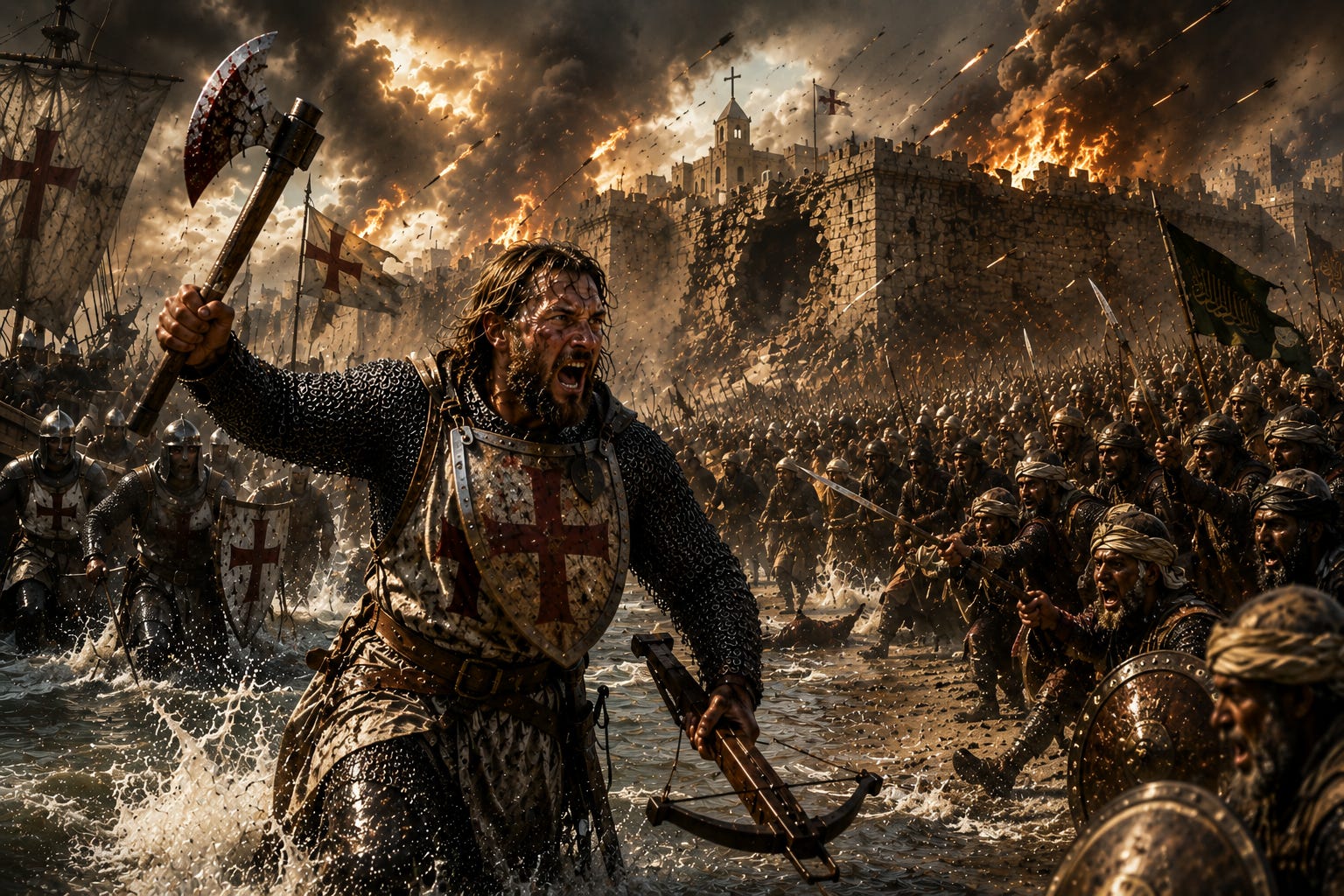
In a feat of heroism that even Hollywood fiction cannot match, today in history witnessed Richard Lionheart and a few thousand Christian knights put to flight a massive Muslim army that, moments earlier, had been torturing and murdering Christian civilians.
On July 27, 1192, Saladin, the great sultan-hero of Islam, besieged the tiny Christian-held town of Jaffa. According to contemporary chronicles, the Muslims numbered as many as 20,000 and “covered the face of the earth like locusts.”
Messengers were instantly dispatched to King Richard I, then in Acre preparing to sail for England. Before the battered envoys had even finished recounting Jaffa’s plight, Richard declared, “With God as my guide, I will set out to do what I can,” and immediately boarded his fleet with just over 2,000 fighting men.
Jaffa, meanwhile, was fighting for its life. According to Saladin’s court historian, Baha’ al-Din, who witnessed the siege, after one of its walls collapsed, all the Muslims rushed into the city, “and there was not an enemy heart that did not tremble and shake.” Even so, the Christians “were more fierce and determined in the fight and more eager for and devoted to death.”
Moments before the Muslims flooded into Jaffa, when its main gate finally gave way and brought part of the wall crashing down with it, a “cloud of dust and smoke went up and darkened the sky.” Once it cleared, the Muslims saw that “spear-points had replaced the walls and lances had blocked the breach.” Only death would release the Crusaders from their charge.
Eventually, however, sheer numbers drove the defenders back into the citadel, while the attackers turned their attention to Jaffa’s civilian population. “Alas for the pitiful slaughter of the sick!” recalls a chronicler. “They lay weakly on couches everywhere in the houses of the city; the Turks tortured them to death in horrible ways.”
Richard’s fleet finally arrived off Jaffa on the evening of July 31 but did not attempt an immediate landing. As Baha’ al-Din explains, the newly arrived Crusaders “saw the town crammed with the Muslims’ banners and men and they feared that the citadel might have already been taken. The sea prevented their hearing the shouts that came from everywhere and the great commotion and cries of ‘There is no god but Allah’ and ‘Allahu Akbar.’”
To make matters worse, “When the Turks saw the king’s galleys and ships approaching, masses of them ran on to the shore,” writes a chronicler, “raining down spears, javelins, darts and arrows densely so that they would have nowhere free to land. The shore was seething, so covered with crowds of the enemy that there was no empty space left.”
Continue reading below.
If you value unflinching, historically grounded analysis that mainstream outlets soften or ignore, consider upgrading. Paid subscribers get:
**Several new, full-length articles every week.**Carefully researched pieces you won’t find elsewhere.
Full access to the complete premium archiveArchive of in-depth writing, research, and commentary — all in one place.
Entry into the subscriber chatA private space for serious readers and thoughtful discussion.