We spend our lives building impenetrable walls. We use air-gapped laptops built from scavenged e-waste to generate our keys. We bounce our transaction broadcasts off the Tor network and the invisible I2P labyrinth. We deploy elaborate digital steganography to sneak our seed phrases past border patrol agents. We study supply chain attacks, mitigate voltage fault injection, and treat every corporate entity as a compromised adversary.
We are sovereign individuals. We have removed every single trusted third party from our financial architecture.
And yet, there is one gaping, fatal vulnerability in the security model of almost every bitcoiner on earth. It is the one adversary you cannot outsmart, outcompute, or outrun.
Your own mortality.
What happens to your stack when your heart stops beating? What happens when your car veers off the road, or a plane goes down, or a sudden aneurysm ends your biological existence?
For the vast majority of the parallel economy, the answer is a disaster. Either the keys die with them, plunging millions of dollars of purchasing power into the cryptographic abyss forever, or worse, they rely on the very legacy fiat system they spent their lives escaping to handle the transition of their wealth.
In 2026, dying is a taxable event. It is a highly regulated, aggressively monitored administrative procedure. If you leave your digital wealth to be managed by the fiat probate courts, you are abandoning your life’s work to the vultures.
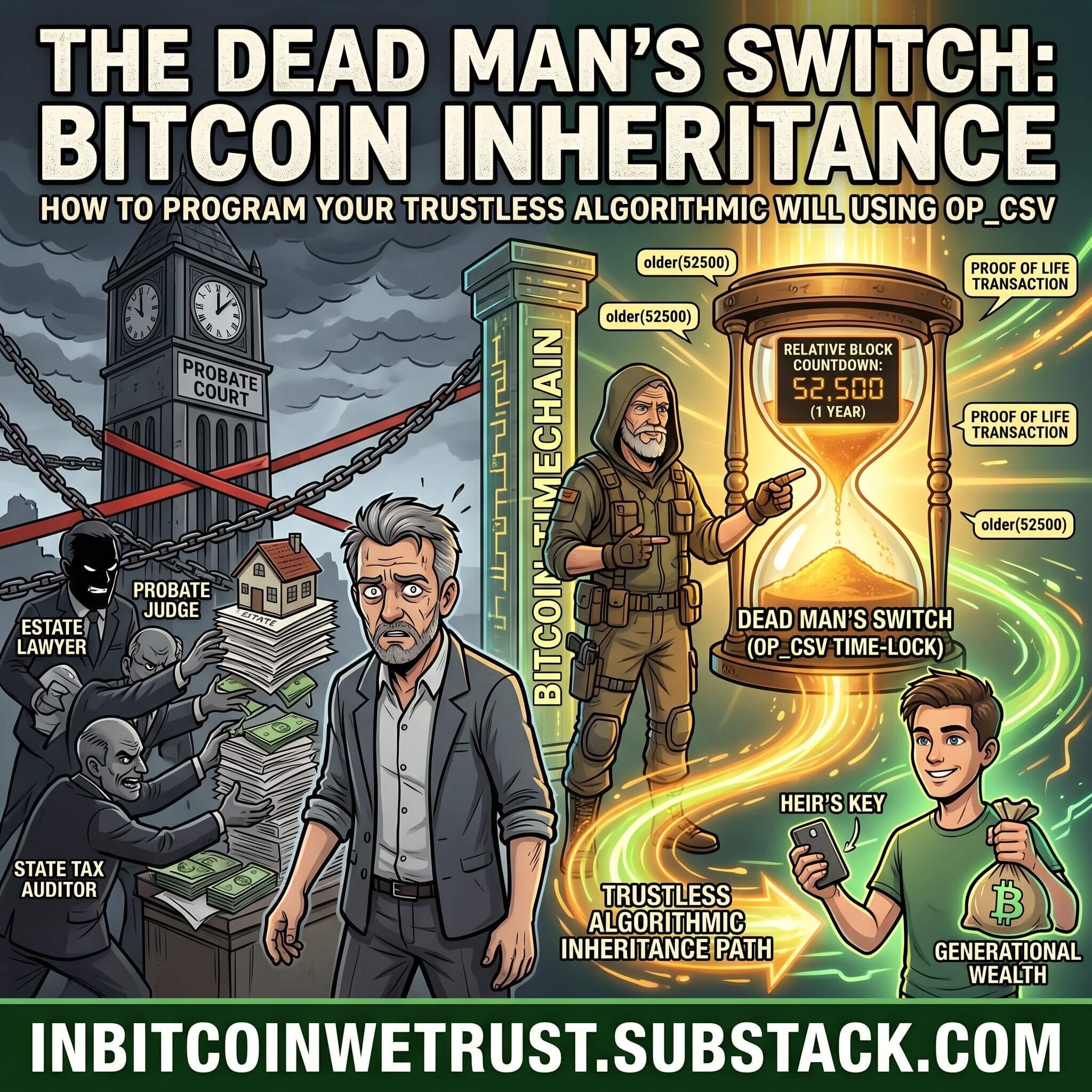
Today, we are going to solve the final vulnerability. We are going to explore how to completely remove the estate lawyer, the probate judge, and the state auditor from your family’s inheritance. We are going to dive into the beautiful, uncompromising mathematics of Bitcoin time-locks, specifically OP_CHECKSEQUENCEVERIFY (OP_CSV), and build a sovereign, mathematically guaranteed Dead Man’s Switch.
To understand why we must program our inheritance directly into the base layer, we have to look at the terrifying reality of the legacy estate system.
When you die in the fiat world, your assets do not smoothly transition to your spouse or your children. Your assets transition to the state’s probate court. A judge appoints an executor. The courts demand a full, transparent accounting of every single asset you owned so they can calculate the estate tax, which, in the current macroeconomic environment, is often a crippling percentage designed to prevent the passing of generational wealth.
If you hold your Bitcoin in a standard, single-signature hardware wallet, how do you pass it on using this system?
You write a traditional will. You put your 24-word seed phrase on a piece of paper, put it in a sealed envelope, and lock it in your estate lawyer’s safety deposit box with instructions to hand it to your daughter when you pass away.
*You have just violated the prime directive of Bitcoin: *** Not your keys, not your coins. You are trusting that the lawyer will not simply open the envelope, memorize the words, sweep the funds, and claim the envelope was empty. You are trusting that the lawyer’s office will not be raided. You are trusting that the lawyer will not legally comply with a state order to liquidate your Bitcoin to pay a newly invented “retroactive wealth tax” before handing the remainder to your family.
Realizing the lawyer is a threat, you decide to handle it yourself. You split your metal seed plate into three pieces. You bury one piece in the backyard. You hide one in the floorboards of the attic. You put the third in a hidden compartment in your desk. You write a cryptic set of instructions for your spouse, assuming they will figure it out when you are gone.
This is the “Scavenger Hunt” OpSec model, and it fails spectacularly. It assumes your spouse will have the emotional bandwidth, the technical knowledge, and the physical capability to execute a complex cryptographic recovery while grieving your sudden death.
What if the house burns down? What if they accidentally throw out the desk? What if you suffer from cognitive decline in your later years and forget where you buried the first plate?
To avoid the scavenger hunt, you simply give your 18-year-old son a copy of your 24 words right now, while you are alive.
You have just doubled your attack surface. Your generational wealth is now only as secure as the digital hygiene of a teenager. If he gets phished, if his apartment is burglarized, or if he simply makes a reckless mistake, your entire stack is wiped out while you are still alive, and there is nothing you can do to stop it.
We need a system where your heirs absolutely cannot access the funds while you are alive, but are mathematically guaranteed to receive them when you die, without requiring permission from a lawyer, a judge, or a bank.
Bitcoin is not just a ledger of dumb money. It is a highly robust, Turing-incomplete programming language. Every time you send Bitcoin, you are not really sending a file; you are locking a specific amount of Bitcoin (a UTXO) inside a mathematical puzzle, and defining exactly what conditions must be met to unlock it.
**Normally, the only condition is: **“Provide a valid cryptographic signature from this specific private key.”
But we can add other conditions. We can add time.
There are two primary ways to lock Bitcoin across time, and understanding the difference is the key to building the Dead Man’s Switch.
An absolute time-lock states that a UTXO cannot be spent until a specific, exact date in the future (or a specific block height). For example, you could lock your Bitcoin so it cannot be moved until Block #1,000,000.
This is useless for inheritance. You do not know which block you are going to die on. If you lock your coins until 2040, and you die in 2028, your family has to wait 12 years to buy groceries. If you live until 2050, the lock expires while you are alive, completely defeating the purpose.
This is the holy grail. A relative time-lock does not care about the absolute date. It cares about how much time has passed since the UTXO was created.
OP_CSV dictates that a UTXO cannot be spent on a specific path until a defined number of blocks have been mined after that UTXO was confirmed on the blockchain.
If you set an OP_CSV lock for 52,500 blocks (which is roughly one year, at 10 minutes per block), a countdown timer starts the exact moment your Bitcoin hits the blockchain. If you move the Bitcoin to a new address, the countdown timer resets to zero.
This relative countdown is the mechanical engine of the Dead Man’s Switch.
Writing raw Bitcoin Script is dangerous and highly technical. One wrong line of code, and you burn your coins forever. Thankfully, in the mid-2020s, developers finalized Miniscript—a structured way to write complex Bitcoin smart contracts that are automatically verified by the software to ensure they are safe, readable, and executable.
Furthermore, we now have specialized open-source desktop wallets (like Liana, originally pioneered by the Revault team) that wrap this complex Miniscript into a beautiful, user-friendly interface.
Here is the exact logic of the algorithmic will you will build.
You are going to create a Taproot smart contract with two distinct spending paths. Think of it as a fork in the road.
**Condition:**Requires a signature from your primary hardware wallet (e.g., your Coldcard).**Time-Lock:**None.**Result:**You have absolute, unrestricted control. As long as you are alive and hold your master key, you can spend the Bitcoin instantly, to anyone, at any time.
**Condition:**Requires a signature from your child’s hardware wallet (a key that they control, which you never possess).**Time-Lock:**OP_CSV set to 52,500 blocks (1 Year).**Result:**Your child’s key is mathematically invalid until the UTXO has sat completely motionless on the blockchain for one full year.
The Miniscript policy looks something like this in plain text:
or(pk(MasterKey), and(older(52500), pk(HeirKey)))
When you fund this smart contract, you take your master stack of Bitcoin and send it into this dual-path address.
The countdown begins.
As the petrodollar falters and stablecoins expose their hidden backdoors, a single shipping toll in the Middle East just cemented Bitcoin as the new settlement layer for global geopolitics.
You have funded the contract. Your Bitcoin is now sitting in a UTXO that has a ticking clock attached to it. If that clock reaches one year (52,500 blocks), your child’s hardware wallet suddenly gains the cryptographic authority to sweep the funds.
How do you stop them from taking your money while you are still alive?
You execute the Proof of Life ritual.
Every six months, you sit down at your desk. You boot up your node. You open your Liana wallet. You connect your master Coldcard.
You create a transaction that sends your entire stack from the current smart contract address, right back into a brand new address controlled by the same smart contract. You are effectively paying yourself.
You sign the transaction. You broadcast it to the network. You pay a small miner fee.
When that transaction is mined into a new block, the old UTXO is destroyed, and a new UTXO is created. Because OP_CSV measures time relative to the creation of the UTXO, the one-year countdown timer instantly resets to zero.
You have proven to the Bitcoin network that you are alive.
That small miner fee you paid? That is your life insurance premium. By simply interacting with your stack twice a year, you ensure that the OP_CSV time-lock never expires. The secondary path remains mathematically sealed. Your child’s key remains completely useless.
But what happens when you die?
If you die, you miss the six-month Proof of Life ritual. You miss the nine-month mark.
The blockchain does not care that you died. The blockchain just keeps ticking, verifying blocks every ten minutes. It is a cold, relentless metronome.
Block 52,498.
Block 52,499.
Block 52,500.
The exact moment the 52,500th block is mined since your last Proof of Life transaction, the protocol’s consensus rules shift. The secondary path in your Miniscript contract silently unlocks. The barrier drops.
Your child’s key is now valid.
Let us look at this from the perspective of your 18-year-old child.
In a traditional inheritance, they would be drowning in probate paperwork, fighting with a lawyer, and trying to decipher a metal plate you hid in the wall.
In the OP_CSV architecture, their experience is clean, sovereign, and entirely unburdened.
When you set up the contract, you buy them a simple hardware wallet (like a Trezor or a BitBox). You sit down with them. You teach them how to generate their own 24 words. You teach them how to secure their own seed phrase. You do not look at their words. They own this key completely.
You extract their public key (xpub) and use it to build Path B of your smart contract.
You then hand them a digital file called a Wallet Descriptor. This is not a private key. A descriptor is just the map of the smart contract. It tells their wallet software where the coins are on the blockchain and what the rules of the time-lock are. You can print this descriptor on a piece of paper, email it to them, or leave it in a standard safety deposit box. If a hacker steals the descriptor, it is useless because the hacker does not have your child’s hardware wallet.
Your child goes to college. They live their life. Their hardware wallet sits in their drawer. It has zero Bitcoin on it. It is an empty vessel.
Then, the tragedy strikes. You pass away.
Your child does not need to hire a lawyer. They do not need to notify the state. They simply wait. They mourn.
One year after your last transaction, the time-lock expires. Your child opens their laptop, imports the Wallet Descriptor into their software, and plugs in their hardware wallet. The software scans the blockchain, sees that the 52,500 blocks have passed, and recognizes that their key is now valid.
With a single click and a physical button press on their device, they broadcast a transaction that sweeps your entire generational stack into a new, standard wallet that they entirely control.
The wealth transfers across generations, across the unbreachable void of death, without a single human intermediary involved.
Restoring the standard of living requires more than just “bringing inflation down to 2%.” It requires a recognition that money cannot be printed into prosperity.
The beauty of the OP_CSV Dead Man’s Switch is its ultimate flexibility.
What happens if your child makes a mistake while you are still alive? What if they accidentally type their 24 words into a phishing website? What if their apartment is burglarized and their hardware wallet is stolen along with their PIN?
In a standard multisig setup, a compromised key is a massive emergency.
But with a relative time-lock, a compromised heir key is entirely harmless as long as you are alive. The attacker realizes they have stolen the key to a massive Bitcoin vault. They import the key. They see the funds. They eagerly try to broadcast a transaction to steal the wealth.
Their transaction is instantly rejected by the Bitcoin nodes. The network mathematically denies the theft because the OP_CSV countdown has not expired. The attacker cannot touch the money.
The attacker’s only hope is to wait in the shadows for a year, praying that you die and the time-lock expires.
But you are alive. Your child calls you and says, “Dad, I messed up. I think my seed phrase was compromised.”
You do not panic. You simply open your master wallet, use your Master Key (Path A), and sweep your funds into a brand new smart contract. You create a new Miniscript policy using a fresh, uncompromised public key from your child.
The moment you broadcast that transaction, the old contract is emptied. The attacker is left holding the key to a vault that has nothing inside it. You neutralized a catastrophic OpSec failure with a single, unhurried transaction.
Death is the ultimate loss of sovereignty. It is the one event where we completely surrender control of our physical bodies, our actions, and our presence in the world.
For the entirety of human history, passing the fruits of your labor to the next generation meant trusting the surviving society to honor your wishes. It meant relying on kings, courts, judges, and lawyers. It meant paying tolls to the gatekeepers of the grave.
Bitcoin changes the physics of mortality.
By utilizing time-locks and Miniscript, we are able to project our will beyond our biological lifespan. We can write our intentions directly into the thermodynamic bedrock of the timechain. We can create an algorithmic executor that cannot be bribed, cannot be threatened, cannot be taxed, and cannot be reasoned with.
The legacy fiat system relies on trust, and trust is the enemy of generational wealth. The parallel economy relies on verification.
You will not live forever. But your cryptographic intent can. By building a Dead Man’s Switch, you ensure that the state ends at your front door, the lawyers remain unemployed, and your children inherit the pure, mathematically unburdened freedom you spent your entire life fighting for.
From Theory to Trillions: Positioning Your Portfolio for the Greatest Technological Shift Since the Internet.